

May 27, 2022
An avoidable crisis that was predictable, actually predicted, willfully precipitated, but easily resolved by the application of common sense,
writes Jack Matlock, the last U.S. ambassador to the U.S.S.R.
We are being told each day that war may be imminent in Ukraine. Russian troops, we are told, are massing at Ukraine’s borders and could attack at any time. American citizens are being advised to leave Ukraine and dependents of the American Embassy staff are being evacuated.
Meanwhile, the Ukrainian president has advised against panic and made clear that he does not consider a Russian invasion imminent. Vladimir Putin, the Russian president, has denied that he has any intention of invading Ukraine.
His demand is that the process of adding new members to NATO cease and that in particular, Russia has assurance that Ukraine and Georgia will never be members. President Joe Biden has refused to give such assurance but made clear his willingness to continue discussing questions of strategic stability in Europe.
Meanwhile, the Ukrainian government has made clear it has no intention of implementing the agreement reached in 2015 for reuniting the Donbas provinces into Ukraine with a large degree of local autonomy—an agreement with Russia, France and Germany which the United States endorsed.
Originally published at ACURA Viewpoint & Consortiumnews on February 16, 2022
Maybe I am wrong—tragically wrong—but I cannot dismiss the suspicion that we are witnessing an elaborate charade, grossly magnified by prominent elements of the American media, to serve a domestic political end.
Facing rising inflation, the ravages of Omicron, blame (for the most part unfair) for the withdrawal from Afghanistan, plus the failure to get the full support of his own party for the Build Back Better legislation, the Biden administration is staggering under sagging approval ratings just as it gears up for this year’s congressional elections.
Since clear “victories” on the domestic woes seem increasingly unlikely, why not fabricate one by posing as if he prevented the invasion of Ukraine by “standing up to Vladimir Putin”? Actually, it seems most likely that President Putin’s goals are what he says they are—and as he has been saying since his speech in Munich in 2007.
To simplify and paraphrase, I would sum them up as: “Treat us with at least a modicum of respect. We do not threaten you or your allies, why do you refuse us the security you insist for yourself?”
The End of the Cold War

In 1991, when the Soviet Union collapsed, many observers, ignoring the rapidly unfolding events that marked the end of the 1980s and the beginning of the 1990s, considered that the end of the Cold War. They were wrong.
The Cold War had ended at least two years earlier. It ended by negotiation and was in the interest of all the parties. President George H.W. Bush hoped that Mikhail Gorbachev would manage to keep most of the twelve non-Baltic republics in a voluntary federation.
On August 1, 1991, Bush made a speech to the Ukrainian parliament (the Verkhovna Rada) in which he endorsed Gorbachev’s plans for a voluntary federation and warned against “suicidal nationalism.” The latter phrase was inspired by Georgian leader Zviad Gamsakurdia’s attacks on minorities in Soviet Georgia. For reasons I will explain elsewhere, they apply to Ukraine today.
Bottom line: Despite the prevalent belief, both among the “blob” in the United States, and most of the Russian public, the United States did not support, much less cause the break-up of the Soviet Union.
We supported throughout the independence of Estonia, Latvia and Lithuania, and one of the last acts of the Soviet parliament was to legalize their claim to independence. And—by the way—despite frequently voiced fears—Putin has never threatened to re-absorb the Baltic countries or to claim any of their territories, though he has criticized some that denied ethnic Russians the full rights of citizenship, a principle that the European Union is pledged to enforce.
But, let’s move on to the first of the assertions in the subtitle:
Was the Crisis Avoidable?
Well, since President Putin’s major demand is an assurance that NATO will take no further members, and specifically not Ukraine or Georgia, obviously there would have been no basis for the present crisis if there had been no expansion of the alliance following the end of the Cold War, or if the expansion had occurred in harmony with building a security structure in Europe that included Russia.
Maybe we should look at this question more broadly. How do other countries respond to alien military alliances near their borders?
Since we are talking about American policy, maybe we should pay some attention to the way the United States has reacted to attempts of outsiders to establish alliances with countries nearby.
Anybody remember the Monroe Doctrine, a declaration of a sphere of influence that comprised an entire hemisphere? And we meant it! When we learned that Kaiser’s Germany was attempting to enlist Mexico as an ally during the first world war, that was a powerful incentive for the subsequent declaration of war against Germany.
Then, of course, in my lifetime, we had the Cuban Missile Crisis—something I remember vividly since I was at the American Embassy in Moscow and translated some of Khrushchev’s messages to Kennedy.
Should we look at events like the Cuban Missile Crisis from the standpoint of some of the principles of international law, or from the standpoint of the likely behavior of a country’s leaders if they feel threatened? What did international law at that time say about the deployment of nuclear missiles in Cuba?
Cuba was a sovereign state and had the right to seek support for its independence from anywhere it chose. It had been threatened by the United States, even an attempt to invade, using anti-Castro Cubans. It asked the Soviet Union for support.
Knowing that the United States had deployed nuclear weapons in Turkey, a U.S. ally actually bordering on the Soviet Union, Nikita Khrushchev, the Soviet leader, decided to station nuclear missiles in Cuba. How could the U.S. legitimately object if the Soviet Union was deploying weapons similar to those deployed against it?
Obviously, it was a mistake. A big mistake!(One is reminded of Talleyrand’s remark … “Worse than a crime …”) International relations, like it or not, are not determined by debating, interpreting and applying the finer points of “international law”—which in any case is not the same as municipal law, the law within countries.
Kennedy had to react to remove the threat. The Joint Chiefs recommended taking out the missiles by bombing. Fortunately, Kennedy stopped short of that, declared a blockade and demanded the removal of the missiles.
At the end of the week of messages back and forth—I translated Khrushchev’s longest—it was agreed that Khrushchev would remove the nuclear missiles from Cuba. What was not announced was that Kennedy also agreed that he would remove the U.S. missiles from Turkey but that this commitment must not be made public.
We American diplomats in Embassy Moscow were delighted at the outcome, of course. We were not even informed of the agreement regarding missiles in Turkey.
We had no idea that we had come close to a nuclear exchange. We knew the U.S. had military superiority in the Caribbean and we would have cheered if the U.S. Air Force had bombed the sites. We were wrong.
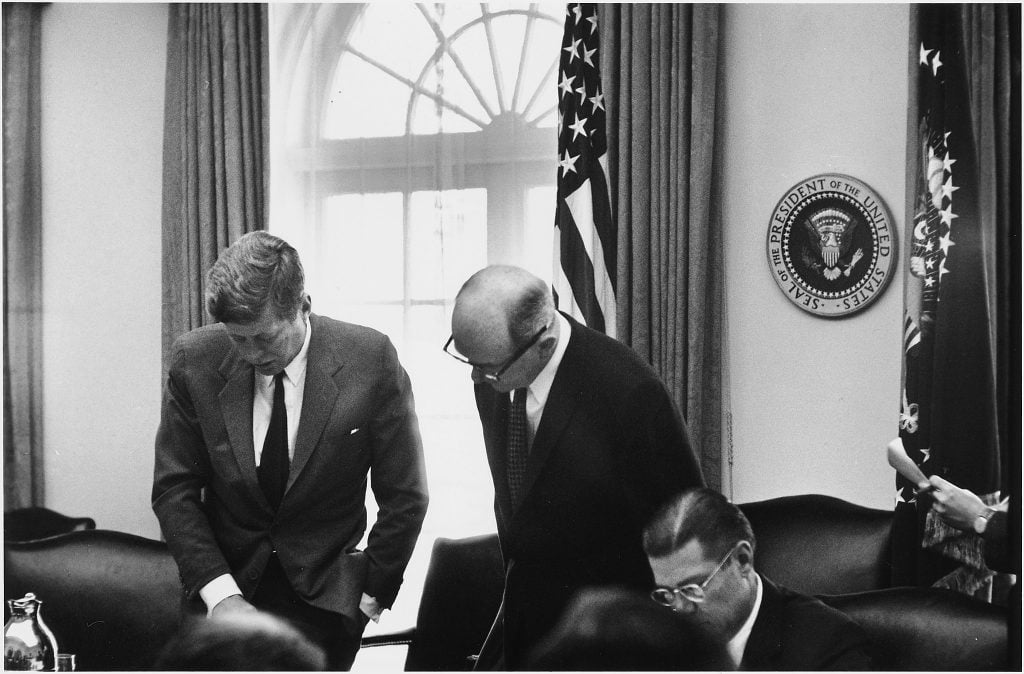
In later meetings with Soviet diplomats and military officers, we learned that, if the sites had been bombed, the officers on the spot could have launched the missiles without orders from Moscow. We could have lost Miami, and then what?
We also did not know that a Soviet submarine came close to launching a nuclear-armed torpedo against the destroyer that was preventing its coming up for air.
It was a close call. It is quite dangerous to get involved in military confrontations with countries with nuclear weapons. You don’t need an advanced degree in international law to understand that. You need only common sense.
OK—It was predictable. Was it predicted?
“The most profound strategic blunder made since the end of the Cold War”
My words, and my voice was not the only one. In 1997, when the question of adding more members to the North Atlantic Treaty Organization (NATO), I was asked to testify before the Senate Foreign Relations Committee. In my introductory remarks, I made the following statement:
“I consider the Administration’s recommendation to take new members into NATO at this time misguided. If it should be approved by the United States Senate, it may well go down in history as the most profound strategic blunder made since the end of the Cold War. Far from improving the security of the United States, its Allies, and the nations that wish to enter the Alliance, it could well encourage a chain of events that could produce the most serious security threat to this nation since the Soviet Union collapsed.”
The reason I cited was the presence in the Russian Federation of a nuclear arsenal that, in overall effectiveness, matched if not exceeded that of the United States. Either of our arsenals, if actually used in a hot war, was capable of ending the possibility of civilization on earth, possibly even causing the extinction of the human race and much other life on the planet.
Though the United States and the Soviet Union had, as a result of arms control agreements concluded by the Reagan and first Bush administrations, negotiations for further reductions stalled during the Clinton Administration. There was not even an effort to negotiate the removal of short-range nuclear weapons from Europe.
That was not the only reason I cited for including, rather than excluding Russia from European security. I explained as follows:
“The plan to increase the membership of NATO fails to take account of the real international situation following the end of the Cold War, and proceeds in accord with a logic that made sense only during the Cold War. The division of Europe ended before there was any thought of taking new members into NATO. No one is threatening to re-divide Europe. It is therefore absurd to claim, as some have, that it is necessary to take new members into NATO to avoid a future division of Europe; if NATO is to be the principal instrument for unifying the continent, then logically the only way it can do so is by expanding to include all European countries. But that does not appear to be the aim of the Administration, and even if it is, the way to reach it is not by admitting new members piecemeal.”
Then I added, “All of the purported goals of NATO enlargement are laudable. Of course the countries of Central and Eastern Europe are culturally part of Europe and should be guaranteed a place in European institutions. Of course we have a stake in the development of democracy and stable economies there. But membership in NATO is not the only way to achieve these ends. It is not even the best way in the absence of a clear and identifiable security threat.”
In fact, the decision to expand NATO piecemeal was a reversal of American policies that produced the end of the Cold War and the liberation of Eastern Europe. President George H.W. Bush had proclaimed a goal of a “Europe whole and free.”
Soviet President Gorbachev had spoken of “our common European home,” had welcomed representatives of East European governments who threw off their Communist rulers and had ordered radical reductions in Soviet military forces by explaining that for one country to be secure, there must be security for all.
The first President Bush also assured Gorbachev during their meeting on Malta in December, 1989, that if the countries of Eastern Europe were allowed to choose their future orientation by democratic processes, the United States would not “take advantage” of that process. (Obviously, bringing countries into NATO that were then in the Warsaw Pact would be “taking advantage.”)
The following year, Gorbachev was assured, though not in a formal treaty, that if a unified Germany was allowed to remain in NATO, there would be no movement of NATO jurisdiction to the east, “not one inch.”
These comments were made to President Gorbachev before the Soviet Union broke up. Once it did, the Russian Federation had less than half the population of the Soviet Union and a military establishment demoralized and in total disarray.
While there was no reason to enlarge NATO after the Soviet Union recognized and respected the independence of the East European countries, there was even less reason to fear the Russian Federation as a threat.
Willfully Precipitated?
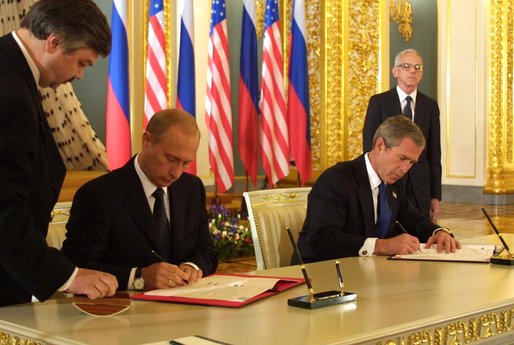
Adding countries in Eastern Europe to NATO continued during the George W. Bush administration (2001-2009) but that was not the only thing that stimulated Russian objection. At the same time, the United States began withdrawing from the arms control treaties that had tempered, for a time, an irrational and dangerous arms race and were the foundation agreements for ending the Cold War.
The most significant was the decision to withdraw from the Anti-Ballistic Missile Treaty (ABM Treaty) which had been the cornerstone treaty for the series of agreements that halted for a time the nuclear arms race.
After the terrorist attacks on the World Trade Center in New York and the Pentagon in Northern Virginia, President Putin was the first foreign leader to call President Bush and offer support. He was as good as his word by facilitating the attack on the Taliban regime in Afghanistan, which had harbored Osama bin Laden, the Al Qaeda leader who had inspired the attacks.
It was clear at that time that Putin aspired to a security partnership with the United States. The jihadist terrorists who were targeting the United States were also targeting Russia. Nevertheless, the U.S. continued its course of ignoring Russian–and also allied–interests by invading Iraq, an act of aggression which was opposed not only by Russia, but also by France and Germany.
As President Putin pulled Russia out of the bankruptcy that took place in the late 1990s, stabilized the economy, paid off Russia’s foreign debts, reduced the activity of organized crime, and even began building a financial nest egg to weather future financial storms, he was subjected to what he perceived as one insult after another to his perception of Russia’s dignity and security.
He enumerated them in a speech in Munich in 2007. U.S. Secretary of Defense Robert Gates responded that we didn’t need a new Cold War. Quite true, of course, but neither he, nor his superiors, nor his successors seemed to take Putin’s warning seriously. Then Senator Joseph Biden, during his candidacy for the presidential election in 2008, pledged to “stand up to Vladimir Putin!” Huh? What in the world had Putin done to him or to the United States?1
(Senator Biden, as ranking member of the Senate Foreign Relations Committee in 1997, had approved NATO expansion. Throughout his tenure in the Senate he opposed lifting the trade restrictions imposed by the Jackson-Vanik amendment even though they never should have applied to the Russian Federation.)
Although President Barack Obama initially promised policy changes, in fact his government continued to ignore the most serious Russian concerns and redoubled earlier American efforts to detach former Soviet republics from Russian influence and, indeed, to encourage “regime change” in Russia itself. American actions in Syria and Ukraine were seen by the Russian president, and most Russians, as indirect attacks on them.
President Bashar al-Assad of Syria was a brutal dictator but the only effective bulwark against the Islamic state, a movement that had blossomed in Iraq following the U.S. invasion and was spreading into Syria. Military aid to a supposed “democratic opposition” quickly fell into the hands of jihadists allied with the very Al Qaeda that had organized the 9/11 attacks on the United States!
But the threat to nearby Russia was much greater since many of the jihadists hailed from areas of the former Soviet Union including Russia itself. Syria is also Russia’s close neighbor; the U.S. was seen strengthening enemies of both the United States and Russia with its misguided attempt to decapitate the Syrian government.
So far as Ukraine is concerned, U.S. intrusion into its domestic politics was deep—to the point of seeming to select a prime minister. It also, in effect, supported an illegal coup d’etat that changed the Ukrainian government in 2014, a procedure not normally considered consistent with the rule of law or democratic governance.
The violence that still simmers in Ukraine started in the “pro-Western” west, not in the Donbass where it was a reaction to what was viewed as the threat of violence against Ukrainians who are ethnic Russian.
During President Obama’s second term, his rhetoric became more personal, joining a rising chorus in the American and British media vilifying the Russian president. Obama spoke of economic sanctions against Russians as “costing” Putin for his “misbehavior” in Ukraine, conveniently forgetting that Putin’s action had been popular in Russia and that Obama’s own predecessor could be credibly accused of being a war criminal.
Obama then began to hurl insults at the Russian nation as a whole, with allegations like “Russia makes nothing anybody wants,” conveniently ignoring the fact that the only way we could get American astronauts to the international space station at that time was with Russian rockets and that his government was trying its best to prevent Iran and Turkey from buying Russian anti-aircraft missiles.
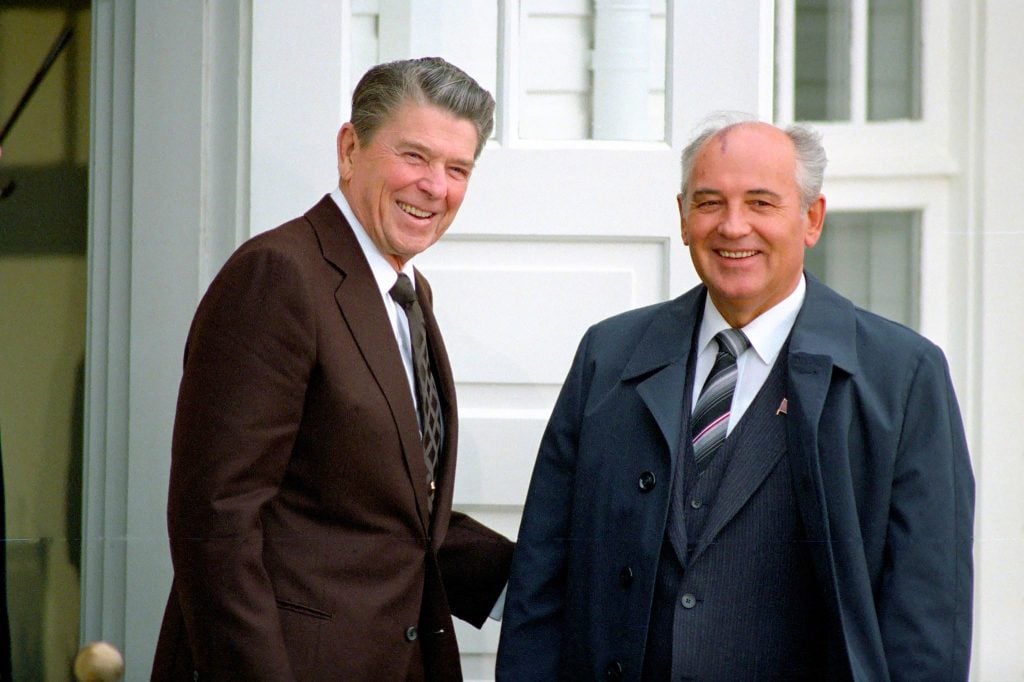
I am sure some will say, “What’s the big deal? Reagan called the Soviet Union an evil empire, but then negotiated an end of the Cold War.” Right! Reagan condemned the Soviet empire of old—and subsequently gave Gorbachev credit for changing it—but he never publicly castigated the Soviet leaders personally.
He treated them with personal respect, and as equals, even treating Foreign Minister Andrei Gromyko to formal dinners usually reserved for chiefs of state or government. His first words in private meetings was usually something like, “We hold the peace of the world in our hands. We must act responsibly so the world can live in peace.”
Things got worse during the four years of Donald Trump’s tenure. Accused, without evidence, of being a Russian dupe, Trump made sure he embraced every anti-Russian measure that came along, while at the same time flattered Putin as a great leader.
Reciprocal expulsions of diplomats, started by the United States in the final days of Obama’s tenure continued in a grim vicious circle that has resulted in a diplomatic presence so emaciated that for months the United States did not have enough staff in Moscow to issue visas for Russians to visit the United States.
As so many of the other recent developments, the mutual strangulation of diplomatic missions reverses one of the proudest achievements of American diplomacy in latter Cold War years when we worked diligently and successfully to open up the closed society of the Soviet Union, to bring down the iron curtain that separated “East” and “West.” We succeeded, with the cooperation of a Soviet leader who understood that his country desperately needed to join the world.
All right, I rest my case that today’s crisis was “willfully precipitated.” But if that is so, how can I say that it can be easily resolved by the application of common sense?
The short answer is because it can be. What President Putin is demanding, an end to NATO expansion and creation of a security structure in Europe that insures Russia’s security along with that of others is eminently reasonable. He is not demanding the exit of any NATO member and he is threatening none.
By any pragmatic, common sense standard it is in the interest of the United States to promote peace, not conflict. To try to detach Ukraine from Russian influence—the avowed aim of those who agitated for the “color revolutions”—was a fool’s errand, and a dangerous one. Have we so soon forgotten the lesson of the Cuban Missile Crisis?
Now, to say that approving Putin’s demands is in the objective interest of the United States does not mean that it will be easy to do. The leaders of both the Democratic and Republican parties have developed such a Russophobic stance (a story requiring a separate study) that it will take great political skill to navigate the treacherous political waters and achieve a rational outcome.
President Biden has made it clear that the United States will not intervene with its own troops if Russia invades Ukraine. So why move them into Eastern Europe? Just to show hawks in Congress that he is standing firm? For what? Nobody is threatening Poland or Bulgaria except waves of refugees fleeing Syria, Afghanistan and the desiccated areas of the African savannah. So what is the 82nd Airborne supposed to do?
Well, as I have suggested earlier, maybe this is just an expensive charade. Maybe the subsequent negotiations between the Biden and Putin governments will find a way to meet the Russian concerns.
If so, maybe the charade will have served its purpose. And maybe then members of congress will start dealing with the growing problems Americans have at home instead of making them worse.
One can dream, can’t one?
Originally published at ACURA Viewpoint & Consortiumnews on February 16, 2022
About the author
Jack F. Matlock served as U.S. ambassador to the U.S.S.R. (1987-1991). A member of the board of directors of the American Committee for U.S.-Russia Accord (ACURA), he writes from Singer Island, Florida. Here is the Wikipedia page for him.





