
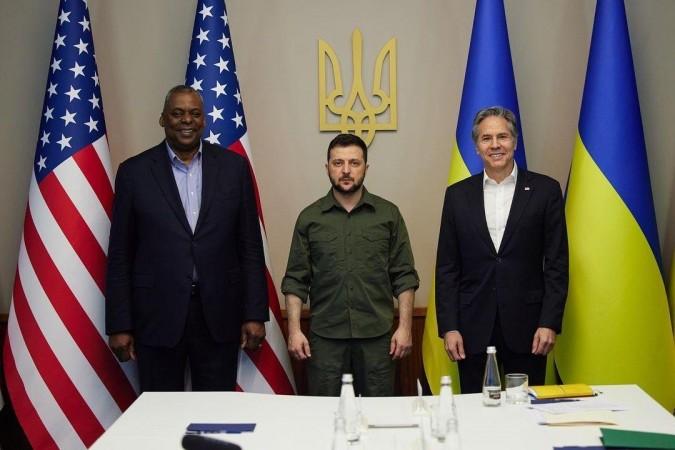
The Guardian of April 25, 2022, and several other media brought the news top front page about the Russia-Ukraine war: US ‘wants to see Russia weakened’ – the sensational headline statement by US Secretary of Defence, Lloyd Austin, after his and Secretary of State, Antony Blinken’s surprise visit to Kyiv.
It was stated also in connection with yet another US arms package for Ukraine (US$ 738 million – making total US military assistance to Ukraine pass US$ 3,4 billion) and before the meeting on April 26 in Ramstein, Germany where more than 40 countries gathered to intensify their cooperation about further militarizing the conflict with Russia played out of Ukraine.
Please note – there has been no similar meeting about how to de-escalate, mediate or whatever else to stop the war.
Here is the Pentagon transcript of what Austin said and Blinken endorsed:
“SECRETARY AUSTIN: I’ll just start and I’ll let the Secretary of State to give his thoughts. But I think – and he’s already kind of indicated the first piece of this. We want to see Ukraine remain a sovereign country, a democratic country able to protect its sovereign territory. We want to see Russia weakened to the degree that it can’t do the kinds of things that it has done in invading Ukraine.
So it has already lost a lot of military capability, and a lot of its troops, quite frankly. And we want to see them not have the capability to very quickly reproduce that capability. We want to see the international community more united, especially NATO, and we’re seeing that, and that’s based upon the hard work of, number one, President Biden, but also our Allies and partners who have willingly leaned into this with us as we’ve imposed sanctions and as we’ve moved very rapidly to demonstrate that we’re going to defend every inch of NATO.
SECRETARY BLINKEN: Yeah, and really nothing to add. I think the Secretary said it very well. Thanks.”
The Guardian’s Julian Borger followed it up with this analysis, Pentagon chief’s Russia remarks show shift in US’s declared aims in Ukraine.
In this article, Borger states and quotes:
“The remarks suggested that even if Russian forces withdrew or were expelled from the Ukrainian territory they have occupied since 24 February, the US and its allies would seek to maintain sanctions with the aim of stopping Russia reconstituting its forces.
It also indicated Washington is taking a position in an internal debate within Nato on whether to use the opportunity of Vladimir Putin’s strategic blunder in Ukraine to try to hobble his ability to threaten other countries in the future.
“The balance in Nato itself has shifted,” Rajan Menon, the director of the grand strategy programme at the Defense Priorities thinktank, said. “The argument now seems to be this is not just about Ukraine; it’s about a larger problem, that is the threat that Russia poses to Europe as a whole. And if you look at it that way, then these comments begin to make sense.”
With this, it should now be clear to anyone who wants to see: NATO is not only out to support Ukraine. Its new added goal is to reduce – forever – the military capability of Russia to such an extent that it will not be able to get back to its pre-Ukraine war capability which cost about 8% of NATO’s.
That is, the policy goal is to once and for all eliminate Russia as the already smaller, much weaker, threat it constitutes vis-a-vis NATO.
Let’s look at the background of all this.
•
So far NATO’s combined military expenditures have been about 12 times higher than Russia’s – and increasing. During the days of the First Cold War, the Warsaw Pact military expenditures were about 70-75% of NATO. Back then – 30-40 years ago – conventional wisdom on both sides would agree that balance – a little difficult to measure in terms of weapons, expenditures, firepower, technological quality etc – was the best for stability and that stability was a precondition of confidence-building and some kind of peace-maintenance.
Implicitly, the philosophy at the time was that gross imbalances would make one side feel inferior and potentially do panicking things before losing more relative power, alternatively that the stronger side might begin to operate on hubris and would, therefore, throw itself over the weaker side, finish it.
The military balance of power was believed to have a positive effect on dissuading both sides from starting a war and, over time, also help promote confidence, dialogue and trust-building at the political level.
All such thinking was thrown out of the window by the surviving, now-single alliance, NATO.
With the Soviet Union and then Russia at its knees, there was – from about 1994 during the Clinton Administration – only one policy which could be formulated roughly like this:
Take advantage of Russia’s weakness, start wars you’d never dare start when the Warsaw Pact existed – such as the bombings of Yugoslavia – expand NATO membership in spite of all promises to not do so given to President Gorbachev, and do not feel any sympathy for the Russians, do not involve or help them – for God’s sake, do not help Gorbachev to move Russia in the direction of a new version of a social-democratic welfare state. Let him get no help when he waited outside the G7 meeting in London in July 1990 expecting some economic assistance and not just nice words about his Perestroika and Glasnost.
One may say that militarily it was a rather symmetric conflict back then – that is, before both the Soviet Union and the Warsaw Pact fell apart. Thereafter, it became a more and more a-symmetric conflict between NATO’s 30 members and Russia.
At the time both The Transnational Foundation and this author argued that NATO’s thinking had become irrelevant and outdated and that something new was needed. NATO had lost its raison d’etre since both the Soviet Union and the Warsaw Pact were gone. But the West merely kept demanding more and more of Russia and declared itself the more or less eternal victor.
Read about it in “Leaving the Cold War Behind” (1989) and “Nordic Security in the 1990s. A Sceptical Contribution” (1992).
•
NATO’s political autism
While it is well-documented that all-important Western leaders promised President Gorbachev not to expand NATO one inch – and thereby got him to accept the united Germany in NATO, the Clinton administration decided to just break these promises by beginning to focus on and woo Georgia, the Baltic Republics and Ukraine as prospective NATO members. It established its office in Kiev in 1994.
It’s a non-issue in NATO circles and NATO media today because it is indisputable proof that NATO is co-responsible for the present war and for Russia’s feelings of insecurity.
It is well-known that President Yeltsin blew up in the face of Clinton about this expansion when they met personally in 1994.
Very early in his presidency, Vladimir Putin, approached NATO’s then Secretary-General, Robertson, and suggest that Russia joined the alliance. Then, in 2007, Putin gave a very serious, if not alarming, speech at the hawkish Western Munich Conference and asked a very legitimate question: Who is NATO arming against and expanding towards if not Russia? The year after, his concern was met with utter ignorance by NATO formally deciding to get Georgia and Ukraine into NATO.
Then came the Kyiv Maidan regime-change masterminded and financed by the Obama administration. A Russia-leaning President was sent running to Russia and Madam Nuland famously said “Fuck the EU” in a discussion with the then US ambassador to Ukraine. They literally decided who should be the future prime minister of Ukraine.
It was to those events and seeing the writing on the wall that Putin reacted in the Donbas and by annexing Crimea; he did not want Russia’s huge naval base there to be sitting in a future Western-run country, perhaps also a member of NATO.
Everytime these things happen, Western media and apologists start their history with Putin doing this or that out of the blue, nothing having happened back in time. Thus, the – of course indefensible – Russian invasion of Ukraine on February 24 is systematically called “unprovoked” in their rhetoric. That is supposed to secure what we shall understand and never doubt: that NATO has only good intensions, never did anything that could be seen as provocative by Russia, that it is not even party to a conflict but, rather, an innocent who is attacked again and again by a criminal.
Over the last good 20 years series of highly competent security experts have warned that any attempt to make Ukraine a full NATO member would lead to war. See for instance Kishore Mahbubani’s excellent analysis here.
NATO of course always knew that it was highly superior to Russia. Unwisely, it seems to have gotten to NATO’s head resulting in hubris – and one too many blunders from a peace and security point of view. Thus, contrary to what we have heard for decades, Russia is a comparatively small military power with a rather small economy and no global cultural, economic, military, projectional or political reach comparable to that of the West, the United States in particular.
This was – perhaps inadvertently – revealed on March 9, 2022, by the former NATO Secretary-General Anders Fogh Rasmussen in an televised interview in Danish (my translation):
“Putin will be beaten to a pulp by NATO. Once NATO moves, it will be with enormous force. You have to remember that the investments we make in defence are ten times greater than Putin’s,” he says.
Why were we told for decades that NATO always needed higher military expenditures – even the intellectually bizarre idea of tying it to economic performance by reaching 2% of GDP – to match the Russian threat when such a competent NATO personality expresses the opposite in rather blunt terms?
•
Biden’s regime-change statement
Now, add two more frightening developments, deviations from what you have heard before February 24 and way into the ongoing war. First, there was US President Joe Biden’s explicit reference to the desirability, or necessity, of getting rid of Putin in the Kremlin:
OK, there were several attempts by the Biden administration people to convince the world that the President did not mean regime-change in Kremlin. But, then, what did he mean?
•
UK weapons to be used by Ukraine on Russia’s territory and huge coordinated weapons and ammunition deliveries to Ukraine
On this very day two other events signify an extremely dangerous turn: 1) The UK announces that it is legitimate for Ukraine to use weapons from the UK against Russia on Russia’s territory. And 2) a meeting was held at the German Ramstein base, hosted by the US, with NATO members plus some 10-15 other countries in attendance. The agenda was how to coordinate, intensify and increase deliveries of arms and ammunition to Ukraine so it can win the war. Here the report by Stars & Stripes.
And here an excerpt of what was said:
“Summoned by the US at its German airbase Ramstein, the meeting’s official purpose was “to help Ukraine win the fight against Russia’s unjust invasion and to build up Ukraine’s defenses for tomorrow’s challenges,” in Austin’s words. “Ukraine clearly believes that it can win and so does everyone here,” he continued, speaking for the many US-allied nations present.
While Washington, as the top-dollar donor to Kiev, will “keep moving heaven and earth so that we can meet” the needs of the Ukrainian government, Austin made it clear other countries would be expected to pony up.”
Please note: There is no longer any talk about negotiations. Ukraine’s President Zelenski has stopped talking about it and also about his country accepting neutrality. His standard message now is: Give me more weapons and money, do it fast and harm Russia as much as you can.
•
Looking forward – hubris and boomerangs
The Russian-Ukraine war is basically rooted in the polarising NATO-Russia conflict over 30 years, being played out in Ukraine.
The US wants it to last for as long as it takes to decimate Russia militarily and cripple it economically at home. It wants Russia “cancelled” – as an important country and an adversary to be able to then turn on China.
Why?
Because the West evidently cannot live without enemies and it just will not see the writing on the wall: The West is declining and going to fall in the wake of the fall of the US Empire. That empire will be the last, and we shall live – if we survive – in a more balanced multi-polar world. The post-Western world.
The EU has no intellectual or political capacity to mitigate that trend, let alone become an alternative West in the eyes of the rest of the world.
Will the US/NATO succeed with its Russia crippling and cancelling project? Would it thereafter be able to keep China down?
I do not think so. I think both projects are doomed. Self-destructive and will speed up the decline of the West. The future of humanity is not about ongoing confrontation and militarism. It must – by necessity – be about cooperation and global common-good thinking.
The West’s reaction to the Russian invasion has been woefully ill-considered, emotionalist knee-jerk collective punishment. It seems like no decision-makers have thought of the consequences on even a one-month horizon.
I fear it’s bound over time to create hitherto unseen problems for the West itself:
• the original ‘real’ global problems like climate change, poverty eradication, etc. that must be solved through fast cooperation will be put aside;
• the consequences of the Corona – huge economic setbacks and lessons to learn;
• the boomerang effects of the eternal sanctions now imposed in all sectors on Russia;
• huge business losses after the almost total Western withdrawal from Russia, Germany in particular – a country that is also bent on wasting now US$ 100 billion more on the military – making it alone about twice as big as Russia;;
• social turmoil throughout Europe and the US when the economic downturn from the above-mentioned Russia-punishment initiative set themselves through at ever-higher day-to-day prices;
• that will cause a mood swing toward the political right;
• the political right and neo-Nazis in Ukraine may, if successful, demand high posts and coordinate their strategy with like-minded groups in the US and other European countries;
• mercenaries and terrorists formations are flocking to Ukraine to fight Russia, not the least those who lost to Russia and Syria in, say, Eastern Aleppo;
• although China has its problems, it is likely to gain even more economic and technological strength worldwide;
• the West has spent its energies on warfare, China on the Belt and Road Initiative, BRI; there will be a win-win there but not for the West;
• Europe will be more split – from the US but also from each other – because eventually, the members will see that they do not share the burden equally of caring for the millions of Ukrainian refugees now riding on first-class – also for all other refugees to see;
• the costs to the civilian economy of the ever-increasing military expenditures, keeping Ukraine armed and then rebuilding the country will drain whatever is left;
• the dollar is likely to be under strong pressure globally, alternatives to SWIFT emerging; the world simply will not keep on being victimised by US sanctions and its political misuse of the status of the greenback as global exchange standard;
• the larger parts of the world – Africa, India, Iran, China and South America, Syria, Saudi Arabia etc. already stating that they are not behind the NATO/EU policies (many preferring China’s more constructive Belt and Road Initiative);
• the Russian ruble did plunge after February 24, 2022, but about two months later it is stable around the value it had during 2021 and up to the invasion;
• the risk of a coup d’etat at some point in Moscow if Russia is crippled and someone much more nationalistic-militaristic than Putin might take over;
• trends towards turmoil in the US, 20% already living under the poverty line and incredible sums diverted from infrastructural projects and welfare to the Military-Industrial-Media-Academic Complex, MIMAC;
• the West has lost a positive vision for itself and the larger world, its attractiveness. It’s operating, as it seems, on constant crisis management, muddling through. It’s reducing diversity, practising both Fake and Omission in its media and increasingly cancelling creative dissent that it used to be proud of; this is an extraordinarily counterproductive strategy when it manifestly needs to re-invent itself;
• Russia will turn its back completely on the West and cooperate much more with China, Iran, India and others; there is a dialectic here that the West seem woefully ignorant about.
If just a few of these scenario-like points combine, it could well – at some point in the future – make the US/NATO/EU world more desperate, panicking and dangerous.
And what could the reaction be when it is impossible to deny the decline and coming fall?
Going down with a Bang – nuclear war – or with a Whimper?
Finally in a macro-perspective: the two historical versions of the Occidental Christian civilisation – Russia and the US/Western Europe – could well end up destroying each other thanks to their own incredibly short-sighted policies and all-consuming militarism – while both believe they are winning over “the other.”
In summary, there is much truth in this little poster:
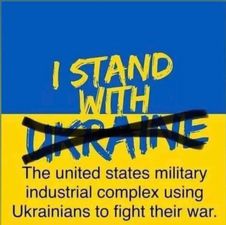
With this policy, the future of Europe is at stake and more threatened than at any time since 1945. This conflict is no longer, if it ever were, about Ukraine per se. It’s merely a tool in the hands of the declining NATO world. Intellectually, it should be impossible to call NATO a defensive alliance.
It is quite clear that from now on, Russia must see itself as being threatened on its very survival – rather than as an object of punishment for its invasion. It means no more peace talks and no longer a special – limited – military operation but a much larger war about all of Ukraine. While writing these lines, this happened to be confirmed in a feature published by Pravda.ru. “Russia’s only goal is Ukraine’s total capitulation.”
It could all have been avoided. Neither the US nor Western Europe have been threatened since 1945. But you are bound to create conflicts when you expand, dominate, subjugate and believe you have exceptional right to lead a Western mission civilisatrise.
And it could all have been avoided and we could have lived in peace today if the Western West had chosen another cooperative path at the dissolution of the Soviet Union and the Warsaw Pact instead of triumphalism and insistence on expanding an ever-since outdated, irrelevant alliance.






6 Responses
Although difficult to swallow for anti war peace activists, the Russian intervention in a pre-existing war and systematic program to purge Ethnic Russian Ukrainians is not indefensible. Ukraine was hosting NATO bases and weaponry with plans for more. The radicalisation and western military training of a large force was deeply entrenched. WMD facilities were enabled. It was only a matter of time. Just because there is no good law to justify that particular scenario of necessary self defence there is credible evidence to make the case that this intervention is one of self defence.
Excellent analysis – but I would like to add the responsibility of France and Germany in making armed conflict unavoidable. Russia tried to reach negotiated solutions: the 2014 agreement on transitional elections, the Minsk-agreement on federal reform had France and Germany as guarantors but in both cases they passively accepted that neo-nazi hooligans blocked the process. What could Russia do when US was enticing these hateful elements and “EU” was just passively standing by -or even abetting them?
The old truths prevail… 1. Empires come and go… 2. Neither Napoleon nor Hitler won their war on Russia… The one who fight for their very survival fight far better… Russia fights for it’s life… The West fight’s for a few to have more power and more money… to more effectively enslave others… Just like Viet Nam won against ”all ods”… so will Russia. .. Not least due to their will to fight being greater, their military weapons are more advanced, theie other weapons too as they sit on rawmaterials, vital for the world economy, not least the West’s economy… and if needed will be backed by China, who knows they are next… This is the end of 500 years of the West colonising and enslaving the world.
NATO tacticians are some fools with limited impressions of the world. With much effort and difficulty, one manages to pressure Russia into a closer and closer cooperation with its old hereditary enemy China and perhaps India. A constellation which will cause the West to go bankrupt within weeks and which will be able to beat the West militarily over the long term. Russia would rather have seen cooperation with the West, but this is ruled out and only has a relationship to the price of all of Russia’s nice resources in mind. Dear politicians, now the price may not pay more.
January 26, 2022 What is NATO? Military alliance in spotlight as Russia tries to forbid Ukraine membership NATO was established in 1949 as a defense against the Soviet Union. Its core principal is mutual defense, enshrined in Article 5 of its founding treaty. There are 30 NATO member. Russia is trying to keep Ukraine from joining them. The threat of a Russian invasion of Ukraine prompted NATO forces to mobilize across Europe, evoking for many the military alliance’s first reasons for being.
A wonderful exercise in turning things upside–down. For instance, NATO was established in 1949 as you rightly say. In February 1954, the Soviet Union asked to become a member of it, which was turned down, and then the Warsaw Pact was created in 1955.