
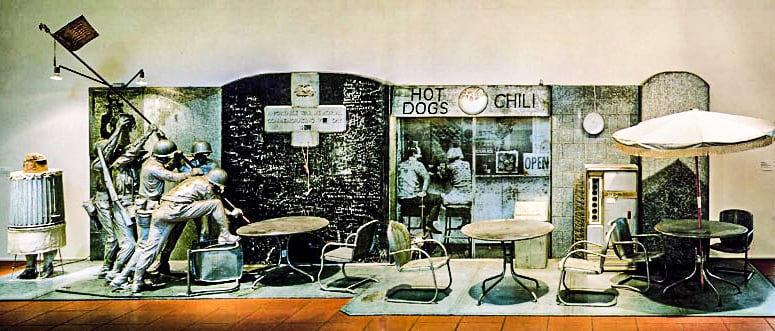
The US has been at war 225 out of 243 years since 1776

Edward Kienholz, “Portable War Memorial,” 1968

 Sabir Shah

April 14, 2022

The US Has Been at war for more than 92 percent of the time

The American history of overt and covert foreign interventions dates back to 1811, when it had invaded Chile, just a year after this South American country had gained independence from Spain.

Research conducted by the “Jang Group and Geo Television Network” reveals that the United States has been at war for about 225 of the 243 years since its inception in 1776. While the number of US foreign military interventions had stood at 188 till 2017, the world super power was found involved in 117 “partisan electoral interventions” between 1946 and 2000 or around one of every nine ballot exercises held since Second World War.

Originally posted on The News International in Pakistan on January 9th, 2020

This means that the United States has been at war for more than 92 per cent of the time since its birth, making critics view that the rulers of the land found by Christopher Columbus have been addicted to the use of military might and intoxicated with their successes against weaker nations that could not defend themselves for one reason or the other. Or in other words, the United States has only been at peace for less than 20 years.

In one of its November 23, 2017 reports, a known British media house “Channel 4 News” had carried a research undertaken by the Institute for Politics and Strategy at Carnegie Mellon University, a private research university based in Pittsburgh, Pennsylvania State. The researcher had calculated the vast scale of election interventions by both the US and Russia.

The media outlet had stated: “According to his research, there were 117 “partisan electoral interventions” between 1946 and 2000. That’s around one of every nine competitive elections held since Second World War.

The majority of these – almost 70 per cent – were cases of US interference. And these are not all from the Cold War era; 21 such interventions took place between 1990 and 2000, of which 18 were by the United States, and 60 different independent countries have been the targets of such interventions.”

The researcher interviewed by “Channel News 4” had maintained: “But almost two thirds of interventions were done in secret, with voters having no idea that foreign powers were actively trying to influence the results. According to Levin’s research, those countries where secret tactics have been deployed by the US include: Guatemala, Brazil, El Salvador, Haiti, Panama, Israel, Lebanon, Iran, Greece, Italy, Malta, Slovakia, Romania, Bulgaria, Albania, Sri Lanka, the Philippines, South Vietnam and Japan.”

He had asserted: “For Russia, the list of covert interventions includes: France, Denmark, Italy, Greece, West Germany, Japan, India, Pakistan, Bangladesh, the Congo, Venezuela, Chile, Costa Rica, and the US.”

By the way, the United States also has a long history of rigging polls, supporting military coups, channelling funds and spreading political propaganda in other countries.

The United States engaged in 46 military interventions from 1948–1991. From 1992–2017, this number had increased four-fold to 188

The United States has been involved in a number of foreign interventions throughout its history.

It was engaged in 46 military interventions from 1948–1991. “The National Interest”, an American bimonthly international affairs magazine, had carried a report in 2017, which had held: “The United States engaged in 46 military interventions from 1948–1991. From 1992–2017, this number had increased four-fold to 188. These statistics introduce two important puzzles. First, why would military interventions rise at the same time success in military interventions has been declining? Second, why would military interventions increase after the Cold War?”

The journal had added: “In other words, if the United States only intervenes with armed force when its vital interests are at stake, why intervene more often when there are arguably fewer vital interests at stake? The answer is that Washington too often intervenes militarily when it should not – and US security and prosperity have both suffered as a result.”

Between 1947 and 1989, the United States tried to change other nations’ governments 72 times

According to the prestigious “The Washington Post”, till December 2016, the United States had tried to change other countries’ governments 72 times during the Cold War.

The widely-read and quoted American media house had written: “Between 1947 and 1989, the United States tried to change other nations’ governments 72 times. That’s a remarkable number. It includes 66 covert operations and six overt ones. Of course, that doesn’t excuse Russia’s meddling in the 2016 US presidential election. These 72 US operations were during the Cold War – meaning that, in most cases, the Soviet Union was covertly supporting anti-US forces.”

“The Washington Post” had asserted: “We examined unclassified Central Intelligence Agency documents and historical academic research on US interventions to identify 27 US clandestine operations carried out between 1949 and 2000. Most US “secret wars” were against other democratic states.”

The report continued: “Unclassified documents published by the US national security archive at George Washington University show that the British government helped the United States overthrow Mohammad Mosaddegh, a democratically elected prime minister of Iran, and tried to block the release of information about its involvement in the coup.”

The 143-year old ace American newspaper had gone on to write: “But that’s just one example. In 1954, an anti-Communist “army” trained and armed by the CIA deposed democratically elected president Jacobo Arbenz Guzman in Guatemala – leading to years of violent civil war and rightist rule. Fifty-seven years later, Guatemalan President Alvaro Colom, on behalf of the state, asked Guzman’s family for forgiveness. And in 1981, President Ronald Reagan authorized the funding for the CIA-led “secret wars” against the democratically elected Sandinista government in Nicaragua. These are but a few examples of the US covert operations abroad.”

Please help TFF post more informative articles like this and to remain truly independent by contributing if you benefited from this article
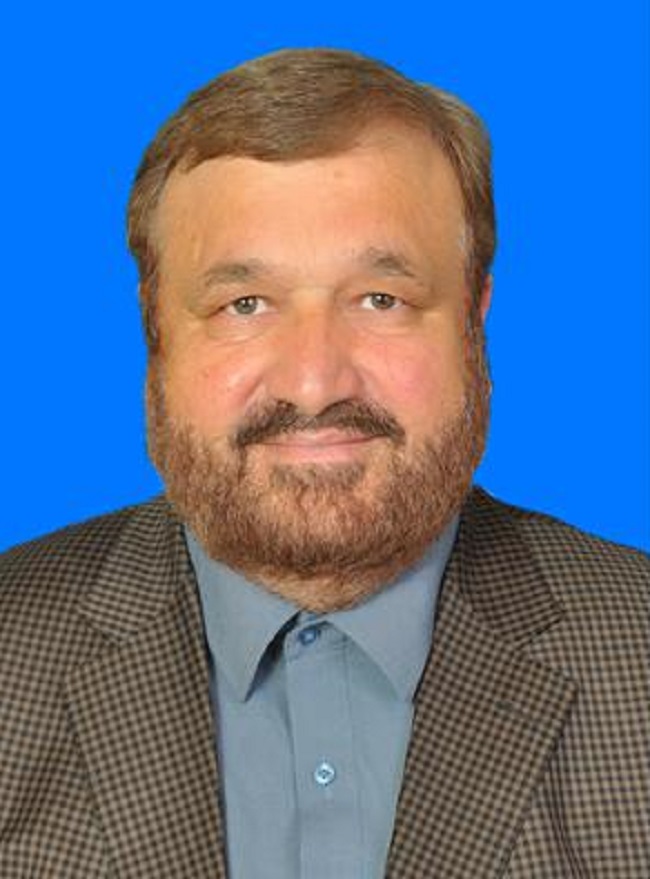
Syed Muhammad Sabir Shah or more commonly as Pir Sabir Shah is a Pakistani politician from the Khyber-Pakhtunkhwa province of Pakistan. He served as the 18th Chief Minister of the province from 20 October 1993 to 25 February 1994. He was advisor to Prime minister of Pakistan Nawaz Sharif from 1997 to 1999.


2 Responses

  1. Well written and documented. USA has always acted like Cowboy. Shoot first and ask questions later.

  2. Thanks for this information. USA has always maintained that its interference in other countries were to advance democracy but the reality is that it has supported the worst dictators and despots around the world to advance its economic and geo-political interests.

Related Posts

Jan Oberg, TFF director April 9, 2026 I was recently invited to have a good, long talk about the world – and, of course, about peace too – with Boris Malagurski on his Weight of Chains Channel on YouTube. It was a real joy and seems to have been greatly appreciated by the viewers too. Mr Malagurski and I shall of course be grateful if you share this conversation in your circles – of course, only if you like what you see and hear 😉☮️ And remember that this one – like hundreds of others with TFF Associates – can be enjoyed at our TFF Video Collection.
A friendly quarrel while we agree that the US sanctions are a weapon of mass destruction and kill more people than wars do. And that we must talk much more about sanctions than we have so far. Jan Oberg, TFF director March 16, 2026 John Mearsheimer recently stated that U.S. sanctions murdered around 38 million people between 1971 and 2021 – see the video below. It is a dramatic figure, and it has spread quickly because it captures, in one sentence, the enormous human cost of modern sanctions. I share his concern about the destructive effects of economic coercion. But the specific number he cites — and the way he attributes it — deserves a friendly academic clarification. The figure comes from a 2023 Lancet Global Health article estimating the mortality effects of unilateral U.S. and EU sanctions over the past half‑century. This is the first point where Mearsheimer’s shorthand diverges from the text: the study...
By Jan ObergTFF co-founder and director February 11, 2026 PART 3 — ECONOMICS, TRADE & FINANCIAL SOVEREIGNTY A. Trade Measures & Market Signaling Economic pressure can be applied instantly and scaled without violence. Immediate Measures (within a week) Government boycott US goods and services  A very powerful signal which over time will be felt. Targeted tariffs on selected U.S. goods Symbolic but high-visibility sectors send a clear message. Suspend trade facilitation talks A peaceful pause that signals deep concern. Freeze U.S. participation in public procurement – military procurement in particular A nonviolent way to reduce influence. Competition law review of U.S. corporations A legal tool to scrutinise market dominance. Longer-Term Measures EU–Asia–Africa trade corridors Reducing reliance on U.S. markets. European supply chains for critical minerals Strategic autonomy in resource access. European Strategic Trade Authority Monitoring coercive practices globally. Euro-denominated commodity markets Weakening the dollar’s pricing monopoly. The EU must resume contacts and negotiations with Russia, focusing on energy cooperation To...

Recent Articles

Tony Robinson October 4, 2026 Violence is easy to recognise when someone is being beaten, shot or killed. It becomes more difficult when nobody is holding a weapon. Poverty, discrimination, exploitation and repression can restrict a human life just as effectively, although they do so in very different ways and with very different consequences. Simply adding more categories to an ever-growing list of forms of violence does not really solve the problem. The more interesting question is what all these different situations have in common and why it makes sense to describe them using the same word. Human beings do not simply react to what happens around them. They remember the past, imagine things that do not yet exist, make plans and undertake projects. Workers organise because they imagine different working conditions; people migrate because they imagine another life somewhere else; social movements emerge because people refuse to accept the...
It’s a matter of principles, courage, vision and pulling together – while the militarist world is falling apart… Peter Langille October 3, 2026 “Here, then, is the problem which we present to you, stark and dreadful and inescapable: Shall we put an end to the human race; or shall mankind renounce war?”The Bertrand Russell—Albert Einstein Manifesto, July 9, 1955 ⁕ The forecast for what’s ahead is worrisome. The sharp rise in armed conflicts over the past three years is adding to what was already the highest level in over seventy years. Genocides, which should be prevented are supported. A shared climate emergency that jeopardises survival is ignored. Diverse polls now suggest that people are war-weary, worried and interested in a more effective United Nations. And, there are viable policy options for a more secure world! Yet governments are doubling-down, betting on more war and investing heavily. If current trends persist,...
Johan Galtung 1930-2024October 2015 Published here on October 3, 2026 Let us focus on Civilization for conflict analysis and remedies. Major forms of disorder use violence; war is state organized violence. The most belligerent states are the United States of America and Israel, both with civilization roots. National Evangelism, the US Protestant Christian civilization– more national than evangelical–justifies US warfare as exceptionalism of a people chosen by God, with a manifest destiny to run the world. Orthodox Judaism justifies Israeli warfare to conquer and expand from Nile to Euphrates as a religious right and duty to the Eternal One. The third most belligerent country, the UK, no longer believes it is God-chosen but chosen by the USA; not quite the same but something. But the root cause of global disorder lies in the Occident–with Islam–seeing itself as the single, universal civilization valid for all at all times, all others being...

TFF on Substack

Discover and subscribe to more peace materials on TFF Substack

Most Popular

Tony Robinson October 4, 2026 Violence is easy to recognise when someone is being beaten, shot or killed. It becomes more difficult when nobody is holding a weapon. Poverty, discrimination, exploitation and repression can restrict a human life just as effectively, although they do so in very different ways and with very different consequences. Simply adding more categories to an ever-growing list of forms of violence does not really solve the problem. The more interesting question is what all these different situations have in common and why it makes sense to describe them using the same word. Human beings do not simply react to what happens around them. They remember the past, imagine things that do not yet exist, make plans and undertake projects. Workers organise because they imagine different working conditions; people migrate because they imagine another life somewhere else; social movements emerge because people refuse to accept the...
It’s a matter of principles, courage, vision and pulling together – while the militarist world is falling apart… Peter Langille October 3, 2026 “Here, then, is the problem which we present to you, stark and dreadful and inescapable: Shall we put an end to the human race; or shall mankind renounce war?”The Bertrand Russell—Albert Einstein Manifesto, July 9, 1955 ⁕ The forecast for what’s ahead is worrisome. The sharp rise in armed conflicts over the past three years is adding to what was already the highest level in over seventy years. Genocides, which should be prevented are supported. A shared climate emergency that jeopardises survival is ignored. Diverse polls now suggest that people are war-weary, worried and interested in a more effective United Nations. And, there are viable policy options for a more secure world! Yet governments are doubling-down, betting on more war and investing heavily. If current trends persist,...
Johan Galtung 1930-2024October 2015 Published here on October 3, 2026 Let us focus on Civilization for conflict analysis and remedies. Major forms of disorder use violence; war is state organized violence. The most belligerent states are the United States of America and Israel, both with civilization roots. National Evangelism, the US Protestant Christian civilization– more national than evangelical–justifies US warfare as exceptionalism of a people chosen by God, with a manifest destiny to run the world. Orthodox Judaism justifies Israeli warfare to conquer and expand from Nile to Euphrates as a religious right and duty to the Eternal One. The third most belligerent country, the UK, no longer believes it is God-chosen but chosen by the USA; not quite the same but something. But the root cause of global disorder lies in the Occident–with Islam–seeing itself as the single, universal civilization valid for all at all times, all others being...
Read More
Living-Peace-Sign-Budapest-copy
Tony Robinson October 4, 2026 Violence is easy to recognise when someone is being beaten, shot or killed. It becomes more difficult when nobody is holding a weapon. Poverty, discrimination, exploitation and repression can restrict a human life just as effectively, although they do so in very different ways and with very different consequences. Simply adding more categories to an ever-growing list of forms of violence does not really solve the problem. The more interesting question is what all these different situations have in common and why it makes sense to describe them using the same word. Human beings do not simply react to what happens around them. They remember the past, imagine things that do not yet exist, make plans and undertake projects. Workers organise because they imagine different working conditions; people migrate because they imagine another life somewhere else; social movements emerge because people refuse to accept the...
b54a1f10-8c65-4f0b-9dd5-4abc0a7d04cc_2659x2659
It’s a matter of principles, courage, vision and pulling together – while the militarist world is falling apart… Peter Langille October 3, 2026 “Here, then, is the problem which we present to you, stark and dreadful and inescapable: Shall we put an end to the human race; or shall mankind renounce war?”The Bertrand Russell—Albert Einstein Manifesto, July 9, 1955 ⁕ The forecast for what’s ahead is worrisome. The sharp rise in armed conflicts over the past three years is adding to what was already the highest level in over seventy years. Genocides, which should be prevented are supported. A shared climate emergency that jeopardises survival is ignored. Diverse polls now suggest that people are war-weary, worried and interested in a more effective United Nations. And, there are viable policy options for a more secure world! Yet governments are doubling-down, betting on more war and investing heavily. If current trends persist,...
010
Johan Galtung 1930-2024October 2015 Published here on October 3, 2026 Let us focus on Civilization for conflict analysis and remedies. Major forms of disorder use violence; war is state organized violence. The most belligerent states are the United States of America and Israel, both with civilization roots. National Evangelism, the US Protestant Christian civilization– more national than evangelical–justifies US warfare as exceptionalism of a people chosen by God, with a manifest destiny to run the world. Orthodox Judaism justifies Israeli warfare to conquer and expand from Nile to Euphrates as a religious right and duty to the Eternal One. The third most belligerent country, the UK, no longer believes it is God-chosen but chosen by the USA; not quite the same but something. But the root cause of global disorder lies in the Occident–with Islam–seeing itself as the single, universal civilization valid for all at all times, all others being...
Screenshot 2026-10-02 011738
Jan ObergPhD, director, The Transnational Foundation for Peace and Future Research, TFFLund, Sweden October 2, 2026 This is my full original manuscript. The Chinese Academy of Social Science, CASS, makes two publications out if it. 1. China’s Five-year plan emphasized the capabilities of basic research and original innovation. It is regarded as the goal of the future social development, which, as required, should be significantly enhanced. Can you comment on the importance of original innovation in research and academic study? I believe it is easier to define “original innovation” in the natural sciences than in social sciences. The breaking points of what constitutes something new, or innovative, are not quite as sharp in the latter. But in both fields it is about opening up something that was closed, unseen, unexplored before – making manifest what was earlier latent. Innovations come in many forms and shapes – naming something that was not...
arctic-circle-map
The agreement is catastrophic both because of what it says and what it doesn’t mention. It reduces further the major asset of security policies: Freedom of action. Jan Oberg TFF director September 25, 2026 A couple of hours before the agreement was signed on September 22, 2026, I published the following 13 hypotheses about what it would most likely contain on TFF Substack (in English). I was wrong on only the first point. Contrary to what Trump had written on his Truth Social platform, it does not appear to come into force immediately. In fact, it turned out to be worse than even I had anticipated. After these hypotheses now come a number of reflections in light of what the agreement actually contains, and does not contain, as well as the way in which it has generally been presented by major media outlets and by the public-service broadcaster DR. My...
girl-5894831_1280
Below are TFF-related media mentions, comments, videos and social media posts published elsewhere but not on this homepage. We happen to catch and list only a fraction. Regarding video comments and debates, we recommend that you go to the TFF Video Channel on Substack where many of them are reproduced. Jan Oberg is a contributor to China Daily – 52 million daily clicks – and Global Times, CGTN and CCTV (the national television), China Investment, Xinhua News Agency and several others. Articles and videos on these media very often multiply into countless Chinese (and Western media) that re-post them from these main media. Thanks to The China Academy, his analyses, interviews and comments are frequently posted on YouTube channels such as Thinkers Forum and Wave Media. These videos are often re-posted on Bilibili (China’s YouTube), the China Content Center on TikTok, and on the Chinese edition of TikTok, Douyin.com. This means reaching hundreds of millions of viewers worldwide over a year. While there are too many to catch on all these...



