
Bryce Greene: Calling Russia’s attack ‘unprovoked’ lets the US off the hook

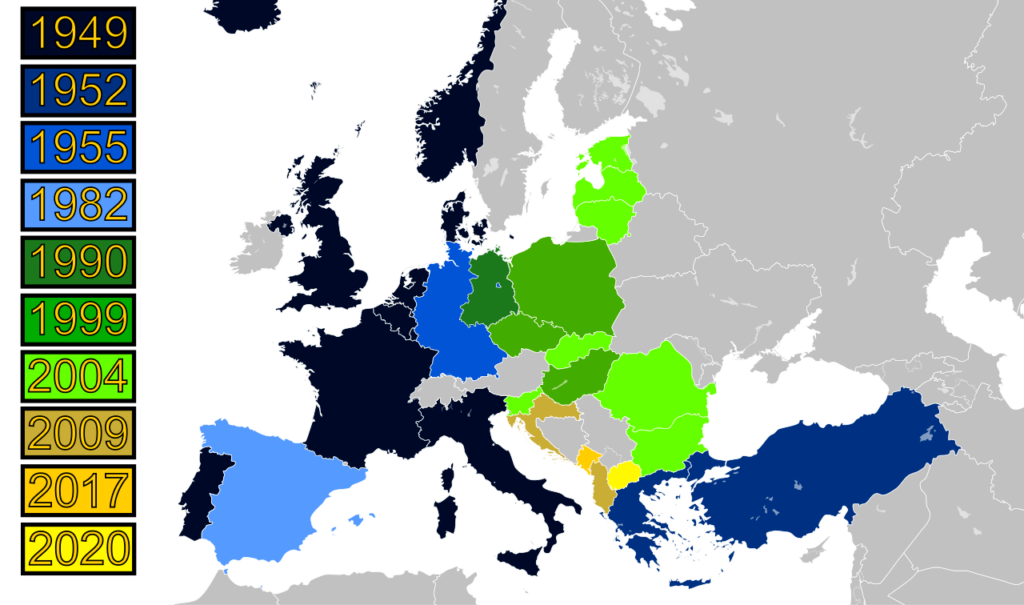
Wikimedia map of NATO expansion since 1949 created by Patrickneil. 

Bryce Greene

March 18, 2022

Originally posted on FAIR.org on March 4, 2022
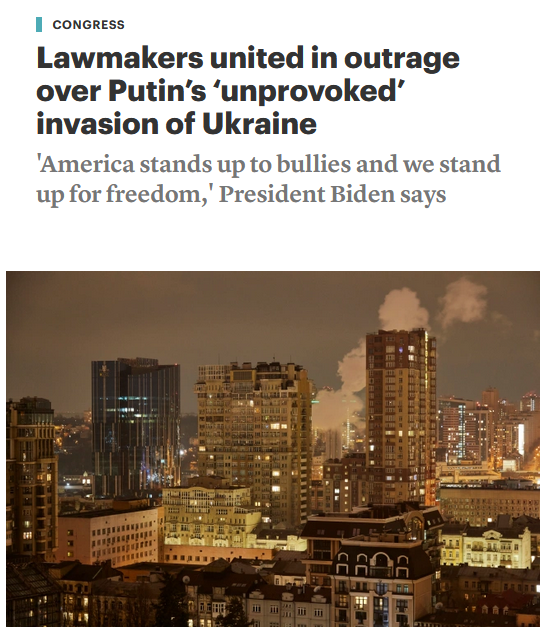
Russia’s invasion of Ukraine can fairly be called many things, but “unprovoked” (Roll Call, 2/24/22) is not one of them.

Many governments and media figures are rightly condemning Russian President Vladimir Putin’s attack on Ukraine as an act of aggression and a violation of international law. But in his first speech about the invasion, on February 24, US President Joe Biden also called the invasion “unprovoked.”

It’s a word that has been echoed repeatedly across the media ecosystem. “Putin’s forces entered Ukraine’s second-largest city on the fourth day of the unprovoked invasion,” Axios (2/27/22) reported; “Russia’s unprovoked invasion of Ukraine entered its second week Friday,” said CNBC (3/4/22). Vox (3/1/22) wrote of “Putin’s decision to launch an unprovoked and unnecessary war with the second-largest country in Europe.”

The “unprovoked” descriptor obscures a long history of provocative behavior from the United States in regards to Ukraine. This history is important to understanding how we got here, and what degree of responsibility the US bears for the current attack on Ukraine.

Ignoring expert advice

Diplomat George Kennan (New York Times, 5/2/98) said  NATO expansion would be “a tragic mistake.”

The story starts at the end of the Cold War, when the US was the only global hegemon. As part of the deal that finalized the reunification of Germany, the US promised Russia that NATO would not expand “one inch eastward.”  Despite this, it wasn’t long before talk of expansion began to circulate among policy makers.

In 1997, dozens of foreign policy veterans (including former Defense Secretary Robert McNamara and former CIA Director Stansfield Turner) sent a joint letter to then-President Bill Clinton calling “the current US-led effort to expand NATO…a policy error of historic proportions.” They predicted:

In Russia, NATO expansion, which continues to be opposed across the entire political spectrum, will strengthen the nondemocratic opposition, undercut those who favor reform and cooperation with the West [and] bring the Russians to question the entire post-Cold War settlement.

New York Times columnist Thomas Friedman (5/2/98) in 1998 asked famed diplomat George Kennan—architect of the US Cold War strategy of containment—about NATO expansion. Kennan’s response:

I think it is the beginning of a new cold war. I think the Russians will gradually react quite adversely and it will affect their policies. I think it is a tragic mistake. There was no reason for this whatsoever. No one was threatening anybody else.

Of course there is going to be a bad reaction from Russia, and then [the NATO expanders] will say that we always told you that is how the Russians are—but this is just wrong.

Despite these warnings, Poland, Hungary and the Czech Republic were added to NATO in 1999, with Bulgaria, Estonia, Latvia, Lithuania, Romania, Slovakia and Slovenia following in 2004.

US planners were warned again in 2008 by US Ambassador to Moscow William Burns (now director of the CIA under Joe Biden). WikiLeaks leaked a cable from Burns titled “Nyet Means Nyet: Russia’s NATO Enlargement Redlines” that included another prophetic warning worth quoting in full (emphasis added):

Ukraine and Georgia’s NATO aspirations not only touch a raw nerve in Russia, they engender serious concerns about the consequences for stability in the region.  Not only does Russia perceive encirclement, and efforts to undermine Russia’s influence in the region, but it also fears unpredictable and uncontrolled consequences which would seriously affect Russian security interests.

Experts tell us that Russia is particularly worried that the strong divisions in Ukraine over NATO membership, with much of the ethnic Russian community against membership, could lead to a major split, involving violence or at worst, civil war.  In that eventuality, Russia would have to decide whether to intervene; a decision Russia does not want to have to face.

A de facto NATO ally
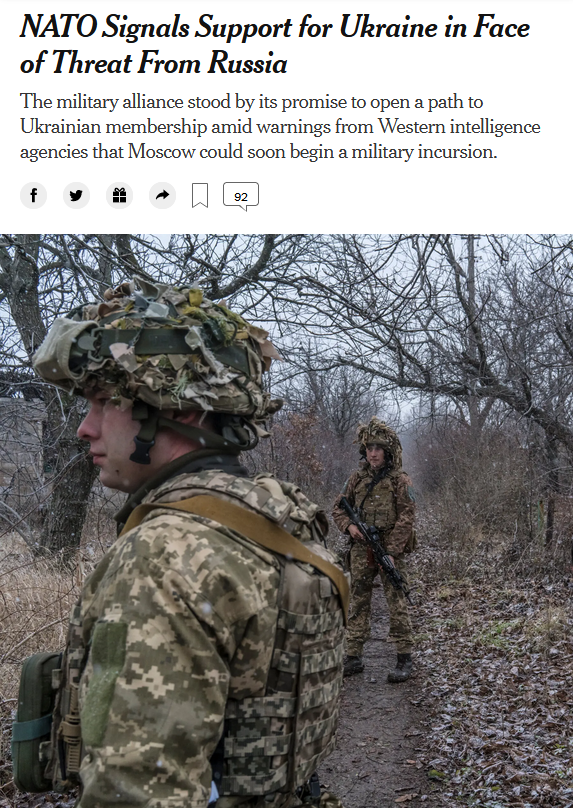
As Russia threatened to invade Ukraine over the threat of NATO expansion, NATO’s response was to emphasize that Ukraine would some day join the alliance (New York Times, 12/16/21).

But the US has pushed Russia to make such a decision. Though European countries are divided about whether or not Ukraine should join, many in the NATO camp have been adamant about maintaining the alliance’s “open door policy.” Even as US planners were warning of a Russian invasion, NATO Secretary-General Jens Stoltenberg reiterated NATO’s 2008 plans to integrate Ukraine into the alliance (New York Times, 12/16/21). The Biden administration has taken a more roundabout approach, supporting in the abstract “Kyiv’s right to choose its own security arrangements and alliances.” But the implication is obvious.

Even without officially being in NATO, Ukraine has become a de facto NATO ally—and Russia has paid close attention to these developments. In a December 2021 speech to his top military officials, Putin expressed his concerns:

Over the past few years, military contingents of NATO countries have been almost constantly present on Ukrainian territory under the pretext of exercises. The Ukrainian troop control system has already been integrated into NATO. This means that NATO headquarters can issue direct commands to the Ukrainian armed forces, even to their separate units and squads….

Kiev has long proclaimed a strategic course on joining NATO. Indeed, each country is entitled to pick its own security system and enter into military alliances. There would be no problem with that, if it were not for one “but.” International documents expressly stipulate the principle of equal and indivisible security, which includes obligations not to strengthen one’s own security at the expense of the security of other states….

In other words, the choice of pathways towards ensuring security should not pose a threat to other states, whereas Ukraine joining NATO is a direct threat to Russia’s security.

In an explainer piece, the New York Times (2/24/22) centered NATO expansion as a root cause of the war. Unfortunately, the Times omitted the critical context of NATO’s pledge not to expand, and the subsequent abandonment of that promise. This is an important context to understand the Russian view of US policies, especially so given the ample warnings from US diplomats and foreign policy experts.

The Maidan Coup of 2014

A major turning point in the US/Ukraine/Russia relationship was the 2014 violent and unconstitutional ouster of President Viktor Yanukovych, elected in 2010 in a vote heavily split between eastern and western Ukraine. His ouster came after months of protests led in part by far-right extremists (FAIR.org, 3/7/14). Weeks before his ouster, an unknown party leaked a phone call between US officials discussing who should and shouldn’t be part of the new government, and finding ways to “seal the deal.” After the ouster, a politician the officials designated as “the guy” even became prime minister.

The US involvement was part of a campaign aimed at exploiting the divisions in Ukrainian society to push the country into the US sphere of influence, pulling it out of the Russian sphere (FAIR.org, 1/28/22). In the aftermath of the overthrow, Russia illegally annexed Crimea from Ukraine, in part to secure a major naval base from the new Ukrainian government.

The New York Times (2/24/22) and Washington Post (2/28/22) both omitted the role the US played in these events. In US media, this critical moment in history is completely cleansed of US influence, erasing a critical step on the road to the current war.

Keeping civil war alive

In another response to the overthrow, an uprising in Ukraine’s Donbas region grew into a rebel movement that declared independence from Ukraine and announced the formation of their own republics. The resulting civil war claimed thousands of lives, but was largely paused  in 2015 with a ceasefire agreement known as the Minsk II accords.
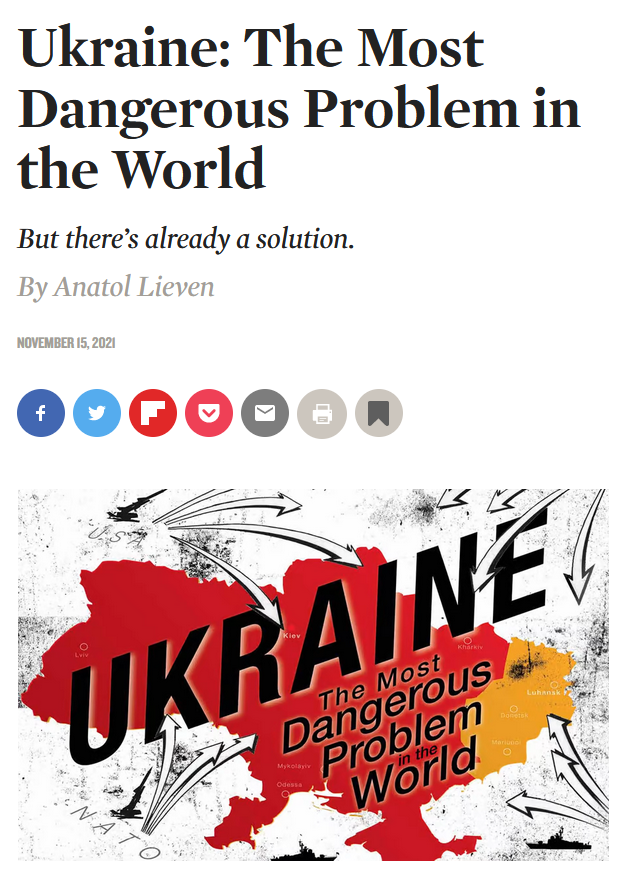
Anatol Lieven (The Nation, 11/15/21): “US administrations, the political establishment, and the mainstream media have quietly buried…the refusal of Ukrainian governments to implement the solution and the refusal of the United States to put pressure on them to do so.”

The deal, agreed to by Ukraine, Russia and other European countries, was designed to grant some form of autonomy to the breakaway regions in exchange for reintegrating them into the Ukrainian state. Unfortunately, the Ukrainian government refused to implement the autonomy provision of the accords. Anatol Lieven, a researcher with the Quincy Institute for Responsible Statecraft, wrote in The Nation (11/15/21):

The main reason for this refusal, apart from a general commitment to retain centralized power in Kiev, has been the belief that permanent autonomy for the Donbas would prevent Ukraine from joining NATO and the European Union, as the region could use its constitutional position within Ukraine to block membership.

Ukraine opted instead to prolong the Donbas conflict, and there was never significant pressure from the West to alter course. Though there were brief reports of the accords’ revival as recently as late January, Ukrainian security chief Oleksiy Danilov warned the West not to pressure Ukraine to implement the peace deal. “The fulfillment of the Minsk agreement means the country’s destruction,” he said (AP, 1/31/22). Danilov claimed that even when the agreement was signed eight years ago,  “it was already clear for all rational people that it’s impossible to implement.”

Lieven notes that the depth of Russian commitment has yet to be fully tested, but Putin has supported the Minsk accords, refraining from officially recognizing the Donbas republics until last week.

The New York Times (2/8/22) explainer on the Minsk accords blamed their failure on a disagreement between Ukraine and Russia over their implementation. This is inadequate to explain the failure of the agreements, however, given that Russia cannot affect Ukrainian parliamentary procedure. The Times quietly acknowledged that the law meant to define special status in the Donbas had been “shelved” by the Ukranians,  indicating that the country had stopped trying to solve the issue in favor of a stalemate.

There was no mention of the comments from a top Ukrainian official openly denouncing the peace accords. Nor was it acknowledged that the US could have used its influence to push Ukraine to solve the issue, but refrained from doing so.

Ukrainian missile crisis
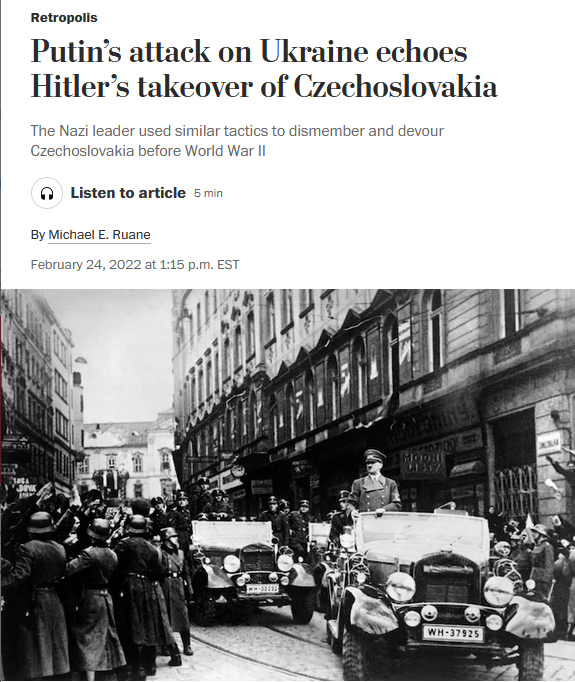
The Washington Post‘s Hitler analogy (2/24/22) is a bit much, considering that the Ukrainian government provides veterans benefits to militias that actually participated in the Holocaust (Kyiv Post, 12/24/18).

One under-discussed aspect of this crisis is the role of US missiles stationed in NATO countries. Many media outlets have claimed that Putin is Hitler-like (Washington Post, 2/24/22; Boston Globe, 2/24/22), hellbent on reconquering old Soviet states to “recreat[e] the Russian empire with himself as the Tsar,” as Clinton State Department official Strobe Talbot told Politico (2/25/22).

Pundits try to psychoanalyze Putin, asking “What is motivating him?” and answering by citing his televised speech on February 21 that recounted the history of Ukraine’s relationship with Russia.

This speech has been widely characterized as a call to reestablish the Soviet empire and a challenge to Ukraine’s right to exist as a sovereign nation. Corporate media ignore other public statements Putin has made in recent months. For example, at an expanded meeting of the Defense Ministry Board, Putin elaborated on what he considered to be the main military threat from US/NATO expansion to Ukraine:

It is extremely alarming that elements of the US global defense system are being deployed near Russia. The Mk 41 launchers, which are located in Romania and are to be deployed in Poland, are adapted for launching the Tomahawk strike missiles. If this infrastructure continues to move forward, and if US and NATO missile systems are deployed in Ukraine, their flight time to Moscow will be only 7–10 minutes, or even five minutes for hypersonic systems. This is a huge challenge for us, for our security.

The United States does not possess hypersonic weapons yet, but we know when they will have it…. They will supply hypersonic weapons to Ukraine and then use them as cover…to arm extremists from a neighbouring state and incite them against certain regions of the Russian Federation, such as Crimea, when they think circumstances are favorable.

Do they really think we do not see these threats? Or do they think that we will just stand idly watching threats to Russia emerge? This is the problem: We simply have no room to retreat.

Having these missiles so close to Russia—weapons that Russia (and China) see as part of a plan to give the United States the capacity to launch a nuclear first-strike without retaliation—seriously challenges the cold war deterrent of Mutually Assured Destruction, and more closely resembles a gun pointed at the Russian head for the remainder of the nuclear age. Would this be acceptable to any country?

Media refuse to present this crucial question to their audiences, instead couching Putin’s motives in purely aggressive terms.

Refusal to de-escalate
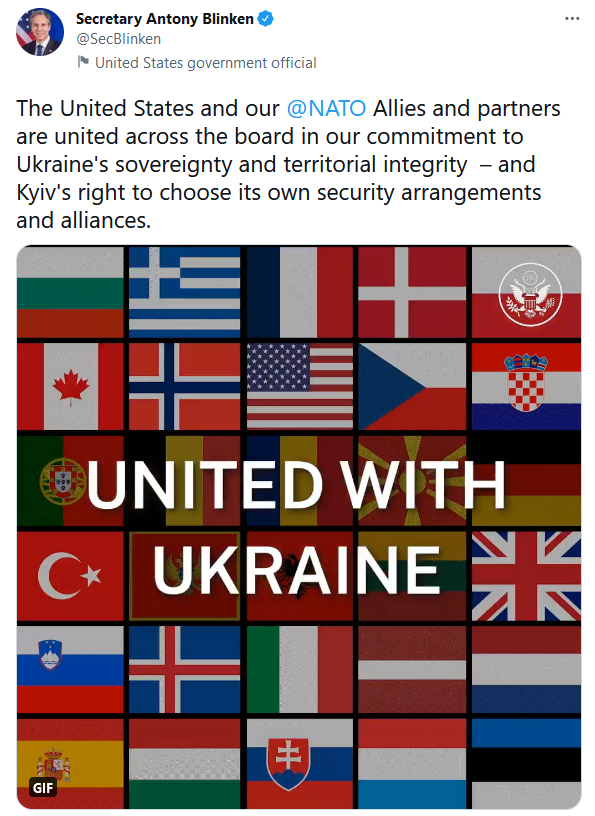
As the threat of war loomed, Secretary of State Antony Blinken (Twitter, 1/27/22) framed the issue of NATO expansion as “Kyiv’s right to choose its own security arrangements and alliances”—as though NATO were a public accommodation open to anyone who wanted to join.

By December 2021, US intelligence agencies were sounding the alarm that Russia was amassing troops at the Ukrainian border and planning to attack. Yet Putin was very clear about a path to deescalation: He called on the West to halt NATO expansion, negotiate Ukrainian neutrality in the East/West rivalry, remove US nuclear weapons from non proliferating countries, and remove missiles, troops and bases near Russia. These are demands the US would surely have made were it in Russia’s position.

Unfortunately, the US refused to negotiate on Russia’s core concerns. The US offered some serious steps towards a larger arms control arrangement (Antiwar.com, 2/2/22)—something the Russians acknowledged and appreciated—but ignored issues of NATO’s military activity in Ukraine, and the deployment of nuclear weapons in Eastern Europe (Antiwar.com, 2/17/22).

On NATO expansion, the State Department continued to insist that they would not compromise NATO’s open door policy—in other words, it asserted the right to expand NATO and to ignore Russia’s red line.

While the US has signaled that it would approve of an informal agreement to keep Ukraine from joining the alliance for a period of time, this clearly was not going to be enough for Russia, which still remembers the last broken agreement.

Instead of addressing Russian concerns about Ukraine’s NATO relationship, the US instead chose to pour hundreds of millions of dollars of weapons into Ukraine, exacerbating Putin’s expressed concerns. Ukrainian President Volodymyr Zelenskyy didn’t help matters by suggesting that Ukraine might begin a nuclear weapons program at the height of the tensions.

After Putin announced his recognition of the breakaway republics, Secretary of State Antony Blinken canceled talks with Putin, and began the process of implementing sanctions on Russia—all before Russian soldiers had set foot into Ukraine.

Had the US been genuinely interested in avoiding war, it would have taken every opportunity to de-escalate the situation. Instead, it did the opposite nearly every step of the way.

In its explainer piece, the Washington Post (2/28/22) downplayed the significance of the US’s rejection of Russia’s core concerns, writing: “Russia has said that it wants guarantees Ukraine will be barred from joining NATO—a non-starter for the Western alliance, which maintains an open-door policy.” NATO’s open door policy is simply accepted as an immutable policy that Putin just needs to deal with. This very assumption, so key to the Ukraine crisis, goes unchallenged in the US media


Related Posts

Below are TFF-related media mentions, comments, videos and social media posts published elsewhere but not on this homepage. We happen to catch and list only a fraction. Regarding video comments and debates, we recommend that you go to the TFF Video Channel on Substack where many of them are reproduced. Jan Oberg is a contributor to China Daily – 52 million daily clicks – and Global Times, CGTN and CCTV (the national television), China Investment, Xinhua News Agency and several others. Articles and videos on these media very often multiply into countless Chinese (and Western media) that re-post them from these main media. Thanks to The China Academy, his analyses, interviews and comments are frequently posted on YouTube channels such as Thinkers Forum and Wave Media. These videos are often re-posted on Bilibili (China’s YouTube), the China Content Center on TikTok, and on the Chinese edition of TikTok, Douyin.com. This means reaching hundreds of millions of viewers worldwide over a year. While there are too many to catch on all these...
A friendly quarrel while we agree that the US sanctions are a weapon of mass destruction and kill more people than wars do. And that we must talk much more about sanctions than we have so far. Jan Oberg, TFF director March 16, 2026 John Mearsheimer recently stated that U.S. sanctions murdered around 38 million people between 1971 and 2021 – see the video below. It is a dramatic figure, and it has spread quickly because it captures, in one sentence, the enormous human cost of modern sanctions. I share his concern about the destructive effects of economic coercion. But the specific number he cites — and the way he attributes it — deserves a friendly academic clarification. The figure comes from a 2023 Lancet Global Health article estimating the mortality effects of unilateral U.S. and EU sanctions over the past half‑century. This is the first point where Mearsheimer’s shorthand diverges from the text: the study...
Photos © TFF 2000 Read PressInfo 90 “Lift the Sanctions and Bring More Aid to Yugoslavia” See Pictures from Belgrade © TFF 2000 Please reprint, copy, archive, quote or re-post this item, but please retain the source.

Recent Articles

Tony Robinson October 4, 2026 Violence is easy to recognise when someone is being beaten, shot or killed. It becomes more difficult when nobody is holding a weapon. Poverty, discrimination, exploitation and repression can restrict a human life just as effectively, although they do so in very different ways and with very different consequences. Simply adding more categories to an ever-growing list of forms of violence does not really solve the problem. The more interesting question is what all these different situations have in common and why it makes sense to describe them using the same word. Human beings do not simply react to what happens around them. They remember the past, imagine things that do not yet exist, make plans and undertake projects. Workers organise because they imagine different working conditions; people migrate because they imagine another life somewhere else; social movements emerge because people refuse to accept the...
It’s a matter of principles, courage, vision and pulling together – while the militarist world is falling apart… Peter Langille October 3, 2026 “Here, then, is the problem which we present to you, stark and dreadful and inescapable: Shall we put an end to the human race; or shall mankind renounce war?”The Bertrand Russell—Albert Einstein Manifesto, July 9, 1955 ⁕ The forecast for what’s ahead is worrisome. The sharp rise in armed conflicts over the past three years is adding to what was already the highest level in over seventy years. Genocides, which should be prevented are supported. A shared climate emergency that jeopardises survival is ignored. Diverse polls now suggest that people are war-weary, worried and interested in a more effective United Nations. And, there are viable policy options for a more secure world! Yet governments are doubling-down, betting on more war and investing heavily. If current trends persist,...
Johan Galtung 1930-2024October 2015 Published here on October 3, 2026 Let us focus on Civilization for conflict analysis and remedies. Major forms of disorder use violence; war is state organized violence. The most belligerent states are the United States of America and Israel, both with civilization roots. National Evangelism, the US Protestant Christian civilization– more national than evangelical–justifies US warfare as exceptionalism of a people chosen by God, with a manifest destiny to run the world. Orthodox Judaism justifies Israeli warfare to conquer and expand from Nile to Euphrates as a religious right and duty to the Eternal One. The third most belligerent country, the UK, no longer believes it is God-chosen but chosen by the USA; not quite the same but something. But the root cause of global disorder lies in the Occident–with Islam–seeing itself as the single, universal civilization valid for all at all times, all others being...

TFF on Substack

Discover and subscribe to more peace materials on TFF Substack

Most Popular

Tony Robinson October 4, 2026 Violence is easy to recognise when someone is being beaten, shot or killed. It becomes more difficult when nobody is holding a weapon. Poverty, discrimination, exploitation and repression can restrict a human life just as effectively, although they do so in very different ways and with very different consequences. Simply adding more categories to an ever-growing list of forms of violence does not really solve the problem. The more interesting question is what all these different situations have in common and why it makes sense to describe them using the same word. Human beings do not simply react to what happens around them. They remember the past, imagine things that do not yet exist, make plans and undertake projects. Workers organise because they imagine different working conditions; people migrate because they imagine another life somewhere else; social movements emerge because people refuse to accept the...
It’s a matter of principles, courage, vision and pulling together – while the militarist world is falling apart… Peter Langille October 3, 2026 “Here, then, is the problem which we present to you, stark and dreadful and inescapable: Shall we put an end to the human race; or shall mankind renounce war?”The Bertrand Russell—Albert Einstein Manifesto, July 9, 1955 ⁕ The forecast for what’s ahead is worrisome. The sharp rise in armed conflicts over the past three years is adding to what was already the highest level in over seventy years. Genocides, which should be prevented are supported. A shared climate emergency that jeopardises survival is ignored. Diverse polls now suggest that people are war-weary, worried and interested in a more effective United Nations. And, there are viable policy options for a more secure world! Yet governments are doubling-down, betting on more war and investing heavily. If current trends persist,...
Johan Galtung 1930-2024October 2015 Published here on October 3, 2026 Let us focus on Civilization for conflict analysis and remedies. Major forms of disorder use violence; war is state organized violence. The most belligerent states are the United States of America and Israel, both with civilization roots. National Evangelism, the US Protestant Christian civilization– more national than evangelical–justifies US warfare as exceptionalism of a people chosen by God, with a manifest destiny to run the world. Orthodox Judaism justifies Israeli warfare to conquer and expand from Nile to Euphrates as a religious right and duty to the Eternal One. The third most belligerent country, the UK, no longer believes it is God-chosen but chosen by the USA; not quite the same but something. But the root cause of global disorder lies in the Occident–with Islam–seeing itself as the single, universal civilization valid for all at all times, all others being...
Read More
Living-Peace-Sign-Budapest-copy
Tony Robinson October 4, 2026 Violence is easy to recognise when someone is being beaten, shot or killed. It becomes more difficult when nobody is holding a weapon. Poverty, discrimination, exploitation and repression can restrict a human life just as effectively, although they do so in very different ways and with very different consequences. Simply adding more categories to an ever-growing list of forms of violence does not really solve the problem. The more interesting question is what all these different situations have in common and why it makes sense to describe them using the same word. Human beings do not simply react to what happens around them. They remember the past, imagine things that do not yet exist, make plans and undertake projects. Workers organise because they imagine different working conditions; people migrate because they imagine another life somewhere else; social movements emerge because people refuse to accept the...
b54a1f10-8c65-4f0b-9dd5-4abc0a7d04cc_2659x2659
It’s a matter of principles, courage, vision and pulling together – while the militarist world is falling apart… Peter Langille October 3, 2026 “Here, then, is the problem which we present to you, stark and dreadful and inescapable: Shall we put an end to the human race; or shall mankind renounce war?”The Bertrand Russell—Albert Einstein Manifesto, July 9, 1955 ⁕ The forecast for what’s ahead is worrisome. The sharp rise in armed conflicts over the past three years is adding to what was already the highest level in over seventy years. Genocides, which should be prevented are supported. A shared climate emergency that jeopardises survival is ignored. Diverse polls now suggest that people are war-weary, worried and interested in a more effective United Nations. And, there are viable policy options for a more secure world! Yet governments are doubling-down, betting on more war and investing heavily. If current trends persist,...
010
Johan Galtung 1930-2024October 2015 Published here on October 3, 2026 Let us focus on Civilization for conflict analysis and remedies. Major forms of disorder use violence; war is state organized violence. The most belligerent states are the United States of America and Israel, both with civilization roots. National Evangelism, the US Protestant Christian civilization– more national than evangelical–justifies US warfare as exceptionalism of a people chosen by God, with a manifest destiny to run the world. Orthodox Judaism justifies Israeli warfare to conquer and expand from Nile to Euphrates as a religious right and duty to the Eternal One. The third most belligerent country, the UK, no longer believes it is God-chosen but chosen by the USA; not quite the same but something. But the root cause of global disorder lies in the Occident–with Islam–seeing itself as the single, universal civilization valid for all at all times, all others being...
Screenshot 2026-10-02 011738
Jan ObergPhD, director, The Transnational Foundation for Peace and Future Research, TFFLund, Sweden October 2, 2026 This is my full original manuscript. The Chinese Academy of Social Science, CASS, makes two publications out if it. 1. China’s Five-year plan emphasized the capabilities of basic research and original innovation. It is regarded as the goal of the future social development, which, as required, should be significantly enhanced. Can you comment on the importance of original innovation in research and academic study? I believe it is easier to define “original innovation” in the natural sciences than in social sciences. The breaking points of what constitutes something new, or innovative, are not quite as sharp in the latter. But in both fields it is about opening up something that was closed, unseen, unexplored before – making manifest what was earlier latent. Innovations come in many forms and shapes – naming something that was not...
arctic-circle-map
The agreement is catastrophic both because of what it says and what it doesn’t mention. It reduces further the major asset of security policies: Freedom of action. Jan Oberg TFF director September 25, 2026 A couple of hours before the agreement was signed on September 22, 2026, I published the following 13 hypotheses about what it would most likely contain on TFF Substack (in English). I was wrong on only the first point. Contrary to what Trump had written on his Truth Social platform, it does not appear to come into force immediately. In fact, it turned out to be worse than even I had anticipated. After these hypotheses now come a number of reflections in light of what the agreement actually contains, and does not contain, as well as the way in which it has generally been presented by major media outlets and by the public-service broadcaster DR. My...
girl-5894831_1280
Below are TFF-related media mentions, comments, videos and social media posts published elsewhere but not on this homepage. We happen to catch and list only a fraction. Regarding video comments and debates, we recommend that you go to the TFF Video Channel on Substack where many of them are reproduced. Jan Oberg is a contributor to China Daily – 52 million daily clicks – and Global Times, CGTN and CCTV (the national television), China Investment, Xinhua News Agency and several others. Articles and videos on these media very often multiply into countless Chinese (and Western media) that re-post them from these main media. Thanks to The China Academy, his analyses, interviews and comments are frequently posted on YouTube channels such as Thinkers Forum and Wave Media. These videos are often re-posted on Bilibili (China’s YouTube), the China Content Center on TikTok, and on the Chinese edition of TikTok, Douyin.com. This means reaching hundreds of millions of viewers worldwide over a year. While there are too many to catch on all these...



