

March 9, 2022
One of the ideational-cultural causes of the NATO-Russian crisis is what one author has called American hubris. This is a neo-imperial attitude engendered in the U.S. as a result of America’s post-Cold War status, now waning, as the lone superpower.
Originally posted on Gordon Hahn’s homepage on March 3rd, 2022
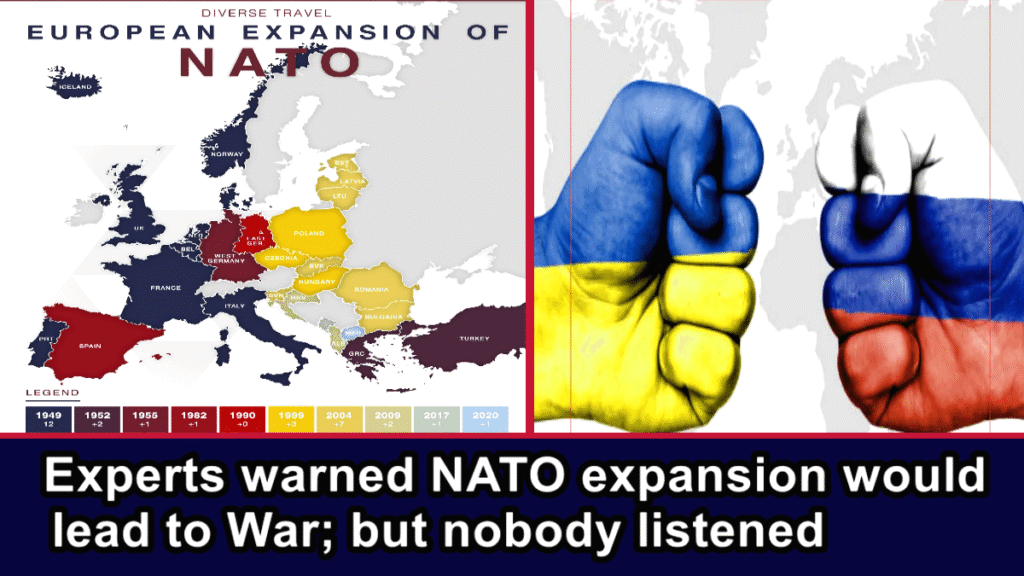
A classic example of such hubris is the American view that Russia has no ‘right’ to a sphere of influence. The deception attached to this is that there is no threat to Russia from NATO expansion, a policy that will deprive Russia of a sphere of influence along its western borders. Of course, possession of a sphere of influence – which the U.S. actually claims globally – is not a right that one is given by God or fate, but it is won by the exercise of power and effective diplomacy. Ambition to a sphere of influence along one’s borders is standard fare and usually not all that difficult to achieve for a great power like Russia. However, when countered by the combined power of the world’s still perhaps leading superpower and 30 allied countries (NATO), carving out and preserving such a sphere of influence can be a challenge. A quintessential expression of our American hubris, which denies Russia a sphere of influence on its borders while we ourselves claim and in many ways have achieved a global one, came in an interview former US ambassador to Moscow and Stanford professor Michael McFaul gave to the Russian opposition newspaper Novaya Gazeta recently. I’ll discuss only some of the most glaring examples here.
It takes an enormous degree of hubris to claim with a straight face, as McFaul did and not for the first time:
“This crisis – ‘Ukraine is joining NATO’, ‘Ukraine is attacking Donbass’ – is a complete deception on Putin’s part. There is no threat of NATO expansion, an invitation to Ukraine. A [NATO] membership action plan [MAP] has not even been proposed. Zelenskiy understands this, and Biden understands this, and Putin understands this – everyone understands this. And for me this means that Putin is simply creating a crisis out of thin air” (view article of Nova gazeta here).
This absurd statement needs to be unpacked. I actually discussed this very issue with McFaul on Facebook Messenger some 5-6 years ago. In response to McFaul’s claim that NATO expansion was not an issue, I said then and will now and documented in my book Ukraine Over the Edge (McFarland, 2018) and in an article on my homepage: during the Obama administration, for which McFaul was working at the time, at least four NATO summits declared that both Ukraine and Georgia will some day be NATO members. At the same time, earlier NATO and Ukraine had concluded and continued through the Obama administration to cooperate under a NATO-Ukraine partnership plan under which various joint maneuvers, training, and personal exchanges occurred all with the stated goal of preparing Ukraine for integration into the European ‘institutions’ [see Gordon M. Hahn, Ukraine Over the Edge (McFarland Publishers, 2018) and “The Reset, NATO Expansion, and the making of the Ukrainian Crisis,” (view article by Gordon Hahn here).
One would need to be both naïve, braindead, and ignorant of Russians’ long-term perspective in general and on potential threats from the West in particular, to accept rubbish about the absence of a threat of NATO expansion to Ukraine as truth.
What is more so patently absurd about McFaul’s claim that there is no threat of NATO expansion – a view he supports by noting Ukraine has still not been offered a MAP – is that less than two years ago (12 June 2020) during the administration of Donald trump, who McFaul claims is a dupe of Putin, NATO offered Ukraine an ‘Enhanced Opportunities Partnership (EOP). Of course, this also represents not threat of NATO expansion; just NATO expansion represents no potential military threat to Russia.
Again, as I have been writing for nearly 30 years now, states base their foreign and security policies, their force structures, and national security spending NOT ON THE BASIS OF THE INTENTIONS OF OTHER ACTORS BUT ON THE BASIS OF THEIR CAPABILITIES.
Any NATO expansion of membership or deployment of equipment near Russia’s borders requires any responsible Russian government to adjust its policies, strategies, forces, and budget accordingly, regardless of its authoritarian and/or corrupt nature. This alone is a problem, putting aside the obvious military threat.
Again, as I have been writing for decades, imagine how U.S. government, former government, and Beltway apparatchiks would react — imagine the headlines — if a Russian-dominated military alliance of NATO’s power was in Latin America, had declared that Mexico and Canada will someday be NATO members, and was increasing its relations with Mexico and Canada. Remember the Monroe Doctrine? As I recall it is still U.S. policy, and it provides our country a fairly expansive ‘sphere of influence’ of ’19th century thinking’ vintage.
Furthermore, after Putin made his request/demand for a legally binding agreement between NATO, Russia, and presumably Kiev that NATO will not expand, that is, offer membership to Ukraine, NATO and President Biden rejected this. If there are no plans to invite Ukraine into NATO, why not agree to codify this into a treaty agreement? This would be a book for Western diplomacy, which could trade a non-existent threat for something in return, say Putin’s agreement not to ‘invade Ukraine.’
Next McFaul regales the Russian public with the assertion that “(Putin) would like Ukraine’s fate to be discussed directly between Washington and Moscow. He said this many times, many times he even called this ‘Yalta 2.0’. Great powers are to gather and decide the fate of other countries in Europe. And to have such direct communications with Biden – that is what he would like” (View Nova Gazeta article here).
Now as I recall many Americans, especially Democrats like McFaul, tend to praise the co-architect of Yalta 1.0, Franklin Roosevelt. Putting that aside, let us take a look at how ‘the fate of Ukraine’ and other countries after the Cold War has been decided and by whom. It is well-known and I need not document here as I and many others elsewhere – including people like former President Bill Clinton in his memoirs and as quoted in archival documents from talks with then Russian President Boris Yeltsin have done already extensively done so – that Russia opposed NATO expansion in general and Soviet leader Mikhail Gorbachev received promises from numerous Western leaders that NATO would not expand ‘one inch’ beyond Eastern Germany after German reunification. Instead, NATO unilaterally expanded to now almost all of the countries between Cold War NATO territory and post-Soviet Russia against Yeltsin’s and then Putin’s wishes – that is Russia’s wishes (opinion polls show Russian overwhelmingly are opposed to NATO expansion).
Now you or McFaul might say: ‘But that was decided by NATO and the new member-state.’ However, these countries were in the throes of rather desperate circumstances: economic collapse, post-communist identity and cultural crises and divisions, and/or uncertainty about how Western-Russian relations would play out over their heads. Western powers enticed these countries into NATO with economic assistance, EU membership, and veiled warnings about a revanchist Russia well before a Russia provoked by NATO expansion became more though not essentially revanchist.
Also, from Serbia to Georgia to Ukraine to the Transcaucasus to Central Asia, Washington and NATO/EU member-states built networks of supporters in prospective NATO member-states through democracy-promotion assistance and then backed the resulting color revolutions that created a new power elite tied to the West and not Russia. In other words, regime change was used to create partners who would go through NATO’s ‘open door.’ The West essentially decided entry for member-states, offering them an offer they could hardly refuse and also one that economically depressed and politically divided, early post-Soviet Russia could not match.
A simple question: Would today’s Ukraine receive more or less economic and other forms of assistance, if Ukraine was today pursuing the restoration of economic and other ties to Russia that existed prior to 2014? Why – when Putin offered Yanukovych debt relief in November 2013 to stop him from signing the association agreement with the EU – did the EU not follow through with the economic assistance it was offering Yanukovych?
The answer is that NATO and EU expansion are intended to break Ukrainian ties with Russia as they a built with the West. The West rejects and has rejected ever since the Soviet collapse building security, economic, and other institutions for both the EU and all the post-communist and post-Soviet states. Not explicitly, of course, by implicitly by ignoring post-Soviet institutions: CIS, CSTO, the Customs Union, and the Eurasian Economic Union.
Turning around this attitude on ourselves, we might ask how Americans might react if Russia was the overwhelming hegemon at the Cold War’s end, and it succeeded or was attempting to bring in Mexico and/or Canada into the Collective Security Treaty Organization?
I will leave out of the stipulated counterfactual, say, that perhaps all Western Europe had already joined the Russian-led CSTO, which would make the proposition of a Canada and/or Mexico entering NATO all the less palatable. I think most reasonable Americans get the picture, leaving out the problem that in todays WOKE, Cancel Culture, authoritarianizing, post-imperial America there are few such Americans when it comes to Russia policy. The media, Republicans and Democrats alike have limited the American people to a vision of Russia that is hyper-simplified caricature of the country and its authoritarian leader and political system. In brief, it is not Stalinism 2.0.
McFaul notes: “Putin is pursuing and is doing it very openly – he wants guarantees from NATO that NATO will not expand to Ukraine. And I think that president Biden made it clear in their discussion that he is not prepared to give such a guarantee, and he has no authority for [giving] such guarantees” (view nova gazeta’s article here). Put simply: If Ukraine is not to be a member of Ukraine, then why doesn’t Biden and the West agree to say that Ukraine will not be a NATO member, instead of resolving at NATO summits that Ukraine will become a NATO member?
It is quite clear that Putin is well aware that Biden cannot unilaterally give any guarantees or other promises regarding any NATO policy, since he is quite aware that NATO is an alliance and its member-states must come to consensus and approve such policy changes. However, Putin, Mcfaul, Biden, and Zelenskiy are all aware that it is Washington that has the preponderance of power in the alliance and almost always get precisely what it wants.
Therefore, it is quite logical for Putin to address Russia’s complaints and requests to the U.S. president, and there is no attempt here by Putin to go over the heads of NATO and its member-states and cut a special deal with Biden, as perhaps McFaul is trying to imply with this statement.
Further, McFaul answers the interviewer’s question regarding whether a Ukrainian invasion of Donbass would be cause for Putin to invade: “I think no, because this is Ukraine’s territory. I just heard Mr. Ushakov, president Putin’s foreign policy advisor, state that: ‘No country should indicate to us what we should do with our armed forces inside our borders.’ I worked with Ushakov and I respect his point of view, but if this so for Russia, why isn’t it so for Ukraine? I would be amazed, and Mr. Biden would be amazed, and Mr. Burns, director of the CIA, would be surprised, if in some way Ukraine unleashed armed action against these people with Russian passports” in Donbass (view Nova Gazeta’s article here). Good point. But if NATO can expand to Ukraine, why cannot the CSTO expand to, say, Cuba, Venezuela, Ecuador? Is the Monroe Doctrine dead? If not, then the US has a very large sphere of influence – an entire hemisphere – extending far beyond its borders.
The other points in this quote are not so good. To be sure, Ukraine should have sovereign control over all of its own territory, including Crimea, but since NATO chose to build post-Cold War Europe and seemingly Eurasia on the basis of its overwhelming power and consequent ‘right’ to the pursuit of NATO and EU expansion and regional and global hegemony, to bomb Serbia’s territory, to support materially and morally the overthrow of regimes on Serbian, Georgian, and (twice) Ukrainian territory, and to lie about who killed whom on the Maidan on 20 February 2014, then Moscow has the ‘right’ to annex Crimea and protect Donbass separatists.
Of course, there are no ‘rights’ in international affairs between states unless they can come to binding international agreements. On McFaul’s last point in this quote regarding potential amazement if Ukraine attacked Donbass, he should be aware that it was Kiev that attacked Donbass to instigate the civil war just as it was the same Maidan elements that shot both police and demonstrators on the Maidan on 20 February 2014 sparking the violent overthrow of the Yanukovych regime.
There was virtually no violence – far less than that leveled by snipers from the Maidan’s neo-fascist wing on 20 February – when Donbass rebels responded to Maidan’s illegal seizure of power with their illegal seizures of power. Putin’s mistake and violation of international law in occupying Crimea was also a response to the Maidan revolt. The West went on to ignore the reality of the snipers’ massacre – a terrorist attack by any other name – and the U.S. ambassador Geoffrey Pyatt even charged Russia with sending in ‘wet teams’ and that it was these wet teams that did the sniping. Such perfidy tends to produce overreactions from authoritarian leaders, and the West has accused Putin of being anything from a Stalin to a Hitler, though I suspect a Stalin, a Hitler, or even an Obama would respond with far greater violence if so provoked.
The latter would simply use proxies, cutouts, and false flag operations.
McFual’s next words acknowledge that it was Mikheil Saakashvili who started the 2008 August war in South Ossetiya, not Moscow. Saying that if Zelenskiy was to ask him if he should move on Donbass militarily, the former US ambassador said that he would advise “not to do it under any circumstances: he would fall into the trap set by Mr. Putin, as happened once in Georgia in 2008” (View Nova Gazeta’s article here).
Of course, here we have another caricature. There is no evidence of a dastardly Putin ‘trap’. In 2008 there was a gradual escalation in violence between Georgian and Ossetiya forces that Saakashvili drastically escalated by declaring an invasion and firing hundreds of inaccurate Grad missiles on the sleeping capitol of South Ossetiya leading the tens, if not hundreds, of civilian deaths and the deaths of 19 Russian peacekeepers. At the time there were tens if not hundreds of US advisors working in the Georgian Defense Ministry and training Tbilisi’s armed forces (OSSETIYA TIMELINE).
I will skip the nonsense about Javelins not being a threat to the Russian army, the response to which is the same as to the next point made by McFaul. He suddenly shifts from the discussion of a possible Ukrainian attack on Donbass to a possible attack on Russia, claiming “Putin discusses this.” I, for one, have never heard Putin say Ukraine might attack Russia, but upon the basis of this little slight of hand, McFaul accuses Putin of “hypocrisy.”
This is the level of argumentation our American ‘elite’ now is limited to. I experienced this from McFaul himself in the mentioned Messenger exchange. After responding to his claim of NATO expansion not being on the agenda, I noted the NATO summits declaring that it was and the growing level of NATO-Ukrainian military cooperation explicitly stated by NATO as intended to bring Kiev into NATO (‘European institutions’), and his counter to these facts was: “You don’t understand diplomacy.”
At that point I understood the discussion was pointless, and my limited role in the field of American Rusology relieved him of any felt need to continue. We dropped the conversation.
But perhaps there was something else going on. McFaul had no argument to counter my own. This is not surprising coming from someone who has considered himself democracy-promoter in Russia and elsewhere, who now openly sides with the new authoritarian order rising in the US under his party. We get a sense of McFaul’s commitment to democratic values, from a Tweet he issued after the war in Ukraine began. In it, he called for all those who have a view different from his own to be censored across the country.
Forces of good….who, however, censor?! It is clear McFaul still lacks the confidence to debate with those who disagree with him. But that is the state of the Union or at least the ‘Democrat’ party nowadays. The moral high ground is rapidly disappearing here in the West. And if it dies here, it dies everywhere; ironically killed by ‘Democrats’ and ‘democracy-promoters.’
This lack of confidence among the US Democrat Party-state nomenklatura is evident in their censorship and repression of those who disagree with them on domestic and foreign policy. Here is a short list of issues that McFaul and other apparatchiks will never address other than the most important one, NATO expansion, which must be defended at all costs:
(1) The West’s broken promise not to expand NATO “one inch past reunified Germany;”
(2) Its financing of revolutionaries in Russia, Russia’s neighbors and its allies;
(3) Support for the 20 February 2014 violent putsch in Kiev sparked by a snipers’ attack carried out not by President Viktor Yanukovych’s police but by members of the neo-Fascist wing of the Maidan protest movement itself that killed both tens of police and some one hundred demonstrators;
(4) The West’s immediate support for the new Maidan regime born in the blood of its ‘martyrs’;
(5) Both the West’s and the Maidan regime’s eight-year cover up of this false flag operation;
(6) The Maidan government’s April declaration of war against its own citizens – the Donbass separatists – without attempting to negotiate;
(7) The Maidan-tied neo-Fascists’ immolation pogrom against peaceful anti-Maidan picketers in Odessa on 2 May 2014, for which no one was indicted or apparently even investigated;
(8) Eight years of the Ukrainian army firing indiscriminately on Donbass residents – part of the “13,000 killed in Putin’s war”;
(9) 6-7 years of the Maidan regime failing to fulfill its obligations under the Minsk 2 ceasefire agreement (refusing to pass a law on the breakaway Donbass regions’ autonomy or to negotiate with the separatists, as required under Minsk); and
(10) The inordinate presence in the Maidan regime/government of neo-Fascists, who are the actual white supremacists, not the Western media calls constitutionalist Americans, and who model themselves on the World War II era rabidly anti-Semitic, neo-Fascist Ukrainian Partisan Army (UPA) and Organization of Ukrainian Nationalists (OUN), who slaughtered tens of thousands of Jews, Poles, and communists and were temporarily allied with the Nazis, against whom their forefathers fought.
Now when Putin presses the issue, the response from Kiev is: Minsk can never be fulfilled; a massive escalation in artillery and mortar attacks on Donbass by the Ukrainian army and/or the neo-Fascist-dominated informal armed formations, such as the National Corps and DUK of Right Sector, the latter (DUK) being led by the neo-Fascist Dmitro Yarosh, who is also an official advisor to the Ukrainian military’s chief of staff; and Zelenskiy’s threat to seek nuclear weapons. If this were occurring say in Mexico, what would be our reaction? We all know the answer: Iraq and Afghanistan.
•
Although there is more distortion in the noted interview that I could address, I will drop this ‘discussion’ for now. I don’t mean to focus on McFaul. He is no exception. He is just representative of the entire US nomenklatura. They will seek to crush rather than to compromise or engage in open debate.
Adding a personal caveat. I thank Michael for supporting me decades ago and contacting me with an expression of concern after my first wife passed away almost seven years ago.
But I will not live by lies nor will I tolerate them. The divisions between those who stand on constitutional principles and truth-seeking, on the one hand, and those seduced by radical ideologies, lust for power, arrogance, and/or hate, on the other hand, that now plague America in good part is driven by its national hubris. This conflict is forcing all of us to decide whether we wish to serve one or another Leviathan – the Democrat Party-state, the economic fascist Great Reset, Putin’s Russia, neo-Communist China – or republican constitutional government and factual truths. Only the latter choice can bring the good, reason, humility, avoid war with Russia, and serve the cause of sound diplomacy.
Please support TFF’s work for peace through research and public education. We are all-volunteer, people-financed and do not accept money from governments or corporations. In other words, one of the very last free research think tanks in this world – and for a noble purpose: Peace by peaceful – intelligent – means. Thanks!
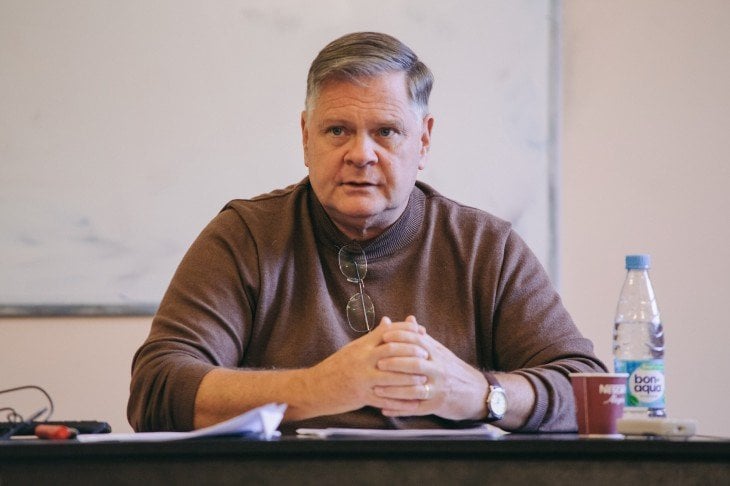
Gordon M. Hahn, Ph.D., is an Expert Analyst at Corr Analytics and a Senior Researcher at the Center for Terrorism and Intelligence Studies (CETIS), Akribis Group. Dr. Hahn is the author of The Russian Dilemma: Security, Vigilance, and Relations with the West from Ivan III to Putin (McFarland, 2021), Ukraine Over the Edge: Russia, the West, and the “New Cold War” (McFarland, 2018), The Caucasus Emirate Mujahedin: Global Jihadism in Russia’s North Caucasus and Beyond (McFarland, 2014), Russia’s Islamic Threat (Yale University Press, 2007), and Russia’s Revolution From Above: Reform, Transition and Revolution in the Fall of the Soviet Communist Regime, 1985-2000 (Transaction, 2002). He also has published numerous think tank reports, academic articles, analyses, and commentaries in both English and Russian language media.
Dr. Hahn also has taught at Boston, American, Stanford, San Jose State, and San Francisco State Universities and as a Fulbright Scholar at Saint Petersburg State University, Russia and has been a senior associate and visiting fellow at the Center for Strategic and International Studies, the Kennan Institute in Washington DC, and the Hoover Institution.





