
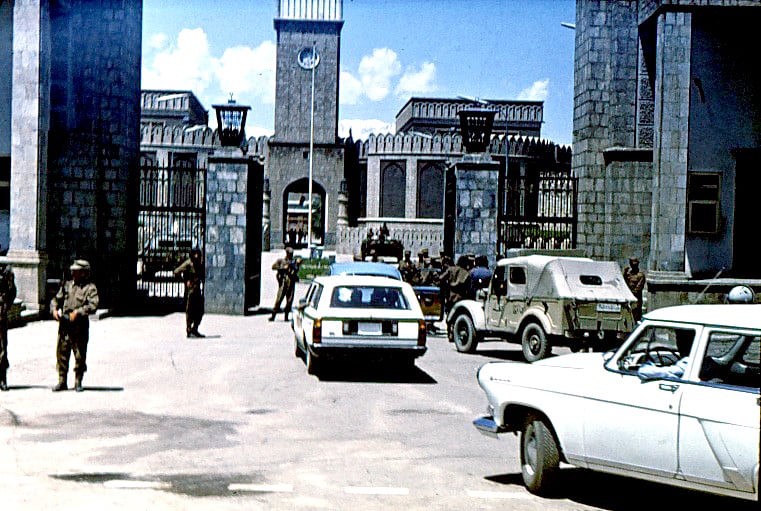
John Pilger: The Great Game of Smashing Nations

Hear this on Spotify

John Pilger

September 9, 2021

More than a generation ago, Afghanistan won its freedom, which the U.S., Britain and their “allies” destroyed.

As a tsunami of crocodile tears engulfs Western politicians, history is suppressed. More than a generation ago, Afghanistan won its freedom, which the United States, Britain and their “allies” destroyed.

In 1978, a liberation movement led by the People’s Democratic Party of Afghanistan (PDPA) overthrew the dictatorship of Mohammad Dawd, the cousin of King Zahir Shah. It was an immensely popular revolution that took the British and Americans by surprise.

Foreign journalists in Kabul, reported The New York Times, were surprised to find that “nearly every Afghan they interviewed said [they were] delighted with the coup.” The Wall Street Journal reported that “150,000 persons … marched to honor the new flag … the participants appeared genuinely enthusiastic.”

The Washington Post reported that “Afghan loyalty to the government can scarcely be questioned.” Secular, modernist and, to a considerable degree, socialist, the government declared a program of visionary reforms that included equal rights for women and minorities. Political prisoners were freed and police files publicly burned.

Under the monarchy, life expectancy was 35; 1-in-3 children died in infancy. Ninety percent of the population was illiterate. The new government introduced free medical care. A mass literacy campaign was launched.

For women, the gains had no precedent; by the late 1980s, half the university students were women, and women made up 40 percent of Afghanistan’s doctors, 70 percent of its teachers and 30 percent of its civil servants. 

Backed by the West

So radical were the changes that they remain vivid in the memories of those who benefited. Saira Noorani, a female surgeon who fled Afghanistan in 2001, recalled:

“Every girl could go to high school and university. We could go where we wanted and wear what we liked … We used to go to cafes and the cinema to see the latest Indian films on a Friday … it all started to go wrong when the mujahedin started winning … these were the people the West supported.”

For the United States, the problem with the PDPA government was that it was supported by the Soviet Union. Yet it was never the “puppet” derided in the West, neither was the coup against the monarchy “Soviet backed,” as the American and British press claimed at the time.

President Jimmy Carter’s secretary of state, Cyrus Vance, later wrote in his memoirs: “We had no evidence of any Soviet complicity in the coup.”

In the same administration was Zbigniew Brzezinski, Carter’s national security adviser, a Polish émigré and fanatical anti-communist and moral extremist whose enduring influence on American presidents expired only with his death in 2017.

On July 3, 1979, unknown to the American people and Congress, Carter authorized a $500 million “covert action” program to overthrow Afghanistan’s first secular, progressive government.  This was code-named by the CIA Operation Cyclone.

Zbigniew Brzezinski in 1977. (Library of Congress)

The $500 million bought, bribed and armed a group of tribal and religious zealots known as the mujahedin. 

In his semi-official history, Washington Post reporter Bob Woodward wrote that the CIA spent $70 million on bribes alone. He describes a meeting between a CIA agent known as “Gary” and a warlord called Amniat-Melli:

“Gary placed a bundle of cash on the table: $500,000 in one-foot stacks of $100 bills. He believed it would be more impressive than the usual $200,000, the best way to say we’re here, we’re serious, here’s money, we know you need it … Gary would soon ask CIA headquarters for and receive $10 million in cash.”

Recruited from all over the Muslim world, America’s secret army was trained in camps in Pakistan run by Pakistani intelligence, the CIA and Britain’s MI6.

Others were recruited at an Islamic College in Brooklyn, New York – within sight of the doomed Twin Towers. One of the recruits was a Saudi engineer called Osama bin Laden.

The aim was to spread Islamic fundamentalism in Central Asia and destabilize and eventually destroy the Soviet Union. 

‘Larger Interests’
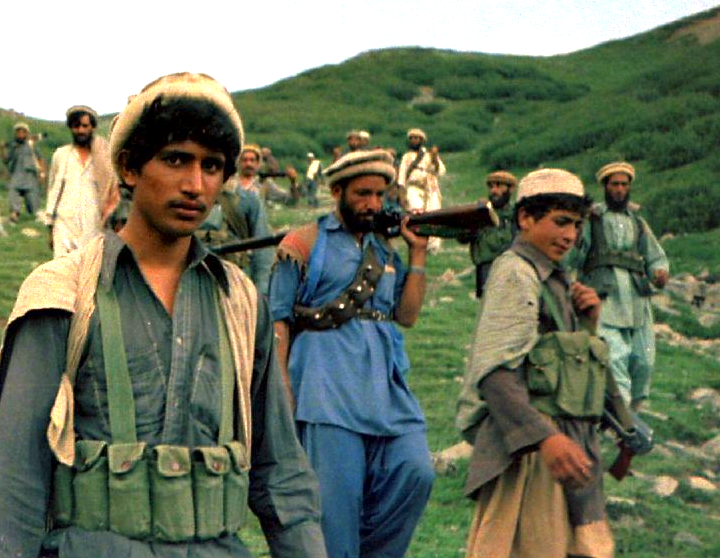
In August 1979, the U.S. embassy in Kabul reported that “the United States’ larger interests … would be served by the demise of the PDPA government, despite whatever setbacks this might mean for future social and economic reforms in Afghanistan.”

Read again the words above I have italicized. It is not often that such cynical intent is spelt out as clearly.  The U.S. was saying that a genuinely progressive Afghan government and the rights of Afghan women could go to hell.

Six months later, the Soviets made their fatal move into Afghanistan in response to the American-created jihadist threat on their doorstep. Armed with CIA-supplied Stinger missiles and celebrated as “freedom fighters” by Margaret Thatcher, the mujahedin eventually drove the Red Army out of Afghanistan.

The mujahedin were dominated by war lords who controlled the heroin trade and terrorized rural women. Later, in the early 1990s the Taliban would emerge, an ultra-puritanical faction, whose mullahs wore black and punished banditry, rape and murder but banished women from public life.

In the 1980s, I made contact with the Revolutionary Association of the Women of Afghanistan, known as RAWA, which had tried to alert the world to the suffering of Afghan women. During the Taliban time they concealed cameras beneath their burqas to film evidence of atrocities, and did the same to expose the brutality of the Western-backed mujahedin.

“Marina” of RAWA told me, “We took the videotape to all the main media groups, but they didn’t want to know ….”

April 28, 1998: Demonstration of the Revolutionary Association of the Women of Afghanistan in Peshawar, Pakistan, “to condemn the sixth anniversary of swarming of fundamentalists into Kabul.” (RAWA, CC BY 3.0, Wikimedia Commons)

In 1992, the enlightened PDPA government was overrun. The president, Mohammad Najibullah, had gone to the United Nations to appeal to for help. On his return, he was hanged from a street light.

The Game

“I confess that [countries] are pieces on a chessboard,” said Lord Curzon in 1898, “upon which is being played out a great game for the domination of the world.”

The viceroy of India was referring in particular to Afghanistan. A century later, Prime Minister Tony Blair used slightly different words.

“This is a moment to seize,” he said following 9/11. “The Kaleidoscope has been shaken. The pieces are in flux. Soon they will settle again. Before they do, let us re-order this world around us.”

On Afghanistan, he added this: “We will not walk away [but ensure] some way out of the poverty that is your miserable existence.”
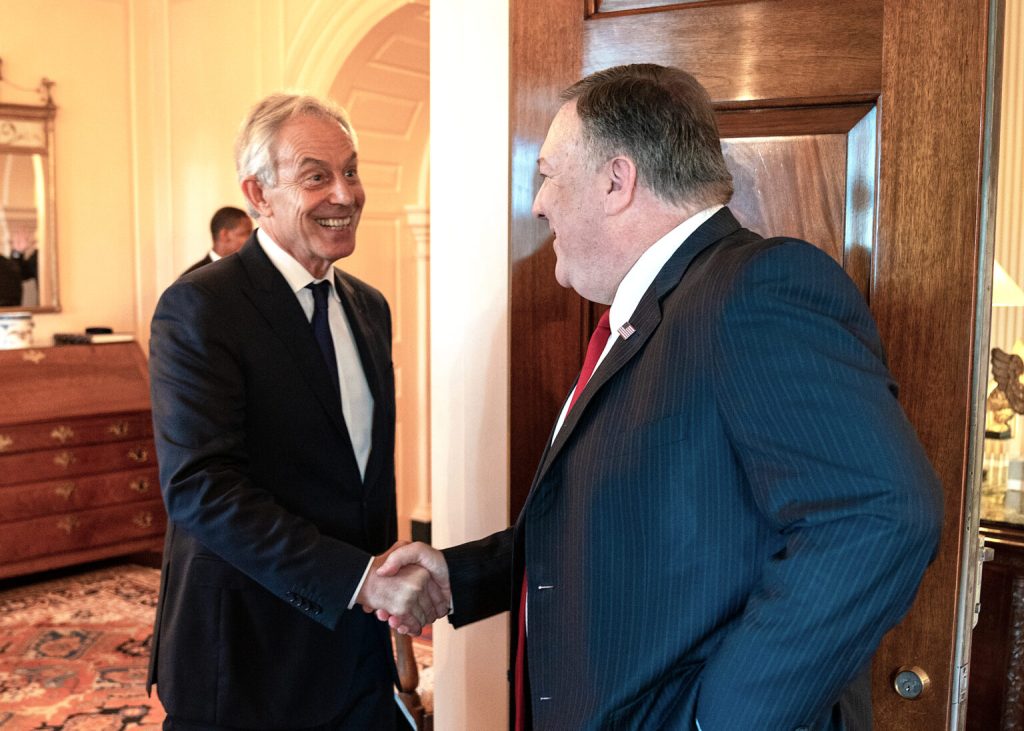
July 17, 2019: Former U.K. Prime Minister Tony Blair, left, with U.S. Secretary of State Michael Pompeo. (State Department)

Blair echoed his mentor, President George W. Bush, who spoke to the victims of his bombs from the Oval Office: “The oppressed people of Afghanistan will know the generosity of America. As we strike military targets, we will also drop food, medicine and supplies to the starving and suffering … “

Almost every word was false. Their declarations of concern were cruel illusions for an imperial savagery “we” in the West rarely recognize as such.

Orifa

In 2001, Afghanistan was stricken and depended on emergency relief convoys from Pakistan. As the journalist Jonathan Steele reported, the invasion indirectly caused the deaths of some 20,000 people as supplies to drought victims stopped and people fled their homes.

Eighteen months later, I found unexploded American cluster bombs in the rubble of Kabul which were often mistaken for yellow relief packages dropped from the air. They blew the limbs off foraging, hungry children.

In the village of Bibi Maru, I watched a woman called Orifa kneel at the graves of her husband, Gul Ahmed, a carpet weaver, and seven other members of her family, including six children, and two children who were killed next door.

An American F-16 aircraft had come out of a clear blue sky and dropped an Mk82 500-pound bomb on Orifa’s mud, stone and straw house. Orifa was away at the time. When she returned, she gathered the body parts.

Months later, a group of Americans came from Kabul and gave her an envelope with 15 notes: a total of $15. “Two dollars for each of my family killed,” she said.

The invasion of Afghanistan was a fraud.

In the wake of 9/11, the Taliban sought to distant themselves from Osama bin Laden. They were, in many respects, an American client with which the administration of Bill Clinton had done a series of secret deals to allow the building of a $3 billion natural gas pipeline by a U.S. oil company consortium.

In high secrecy, Taliban leaders had been invited to the U.S. and entertained by the CEO of the Unocal company in his Texas mansion and by the CIA at its headquarters in Virginia. One of the deal-makers was Dick Cheney, later George W. Bush’s vice president.

In 2010, I was in Washington and arranged to interview the mastermind of Afghanistan’s modern era of suffering, Zbigniew Brzezinski. I quoted to him his autobiography in which he admitted that his grand scheme for drawing the Soviets into Afghanistan had created “a few stirred up Muslims”.

“Do you have any regrets?” I asked.

“Regrets! Regrets! What regrets?”

When we watch the current scenes of panic at Kabul airport, and listen to journalists and generals in distant TV studios bewailing the withdrawal of “our protection,” isn’t it time to heed the truth of the past so that all this suffering never happens again?

John Pilger’s 2003 film, Breaking the Silence, about the “war on terror” is available to view here.  

TFF keeps bringing you essentially important quality analyses that contrast the mainstream narratives – like this one. We hope you are generous enough to sometimes support our work since we are exclusively people-financed and all volunteers – since these are today’s conditions for truly free peace and future research:


2 Responses

  1. In the days of the withdrawal of the US and its allies’ troops and local traitors, all the media in the west wanted to talk about was the terrible situation the conspirators were now suffering from. Well, and then they talked about the Afghan women, how they would now fall back into the dark ages, and all that the liberators of the Western world had done for them during the last 20 years, would now be in vain. When I look at the picture above of “Cabul antes do Taleban” from the seventies, I remember how I met the Afghans in their homes, shops and markets in the seventies. Who exactly was it that destroyed these 3 young women’s’ hopes and dreams of prosperity and enlightenment; not to talk about the men and women and their grandmothers, in their small houses of clay far away from the cities, living in peace with their goats and chicken; and the children that had now started to go to school at last. All that hypocritical talk about thousands of soldiers and their deadly weapons as the great protector of human rights in Afghanistan is nauseating. I am glad you left, I only hope you will stay away forever, so the Afghans can get a chance to get back on their own feet.

  2. Many thanks, dear Gitte Hector. This is a very important comment because you obviously knew the country back then and can compare. Thanks a lot for sharing – and I share what you say about the nauseating nature of the media and the politics as well as your wish that they will stay away forever. I guess we both long for the day when the US Empire – not the US – but its empire, militarism and racism – in the sense of contempt for those considered weaker – will be gone. Best, Jan O.

Related Posts

Tony Robinson October 4, 2026 Violence is easy to recognise when someone is being beaten, shot or killed. It becomes more difficult when nobody is holding a weapon. Poverty, discrimination, exploitation and repression can restrict a human life just as effectively, although they do so in very different ways and with very different consequences. Simply adding more categories to an ever-growing list of forms of violence does not really solve the problem. The more interesting question is what all these different situations have in common and why it makes sense to describe them using the same word. Human beings do not simply react to what happens around them. They remember the past, imagine things that do not yet exist, make plans and undertake projects. Workers organise because they imagine different working conditions; people migrate because they imagine another life somewhere else; social movements emerge because people refuse to accept the...
The agreement is catastrophic both because of what it says and what it doesn’t mention. It reduces further the major asset of security policies: Freedom of action. Jan Oberg TFF director September 25, 2026 A couple of hours before the agreement was signed on September 22, 2026, I published the following 13 hypotheses about what it would most likely contain on TFF Substack (in English). I was wrong on only the first point. Contrary to what Trump had written on his Truth Social platform, it does not appear to come into force immediately. In fact, it turned out to be worse than even I had anticipated. After these hypotheses now come a number of reflections in light of what the agreement actually contains, and does not contain, as well as the way in which it has generally been presented by major media outlets and by the public-service broadcaster DR. My...
Below are TFF-related media mentions, comments, videos and social media posts published elsewhere but not on this homepage. We happen to catch and list only a fraction. Regarding video comments and debates, we recommend that you go to the TFF Video Channel on Substack where many of them are reproduced. Jan Oberg is a contributor to China Daily – 52 million daily clicks – and Global Times, CGTN and CCTV (the national television), China Investment, Xinhua News Agency and several others. Articles and videos on these media very often multiply into countless Chinese (and Western media) that re-post them from these main media. Thanks to The China Academy, his analyses, interviews and comments are frequently posted on YouTube channels such as Thinkers Forum and Wave Media. These videos are often re-posted on Bilibili (China’s YouTube), the China Content Center on TikTok, and on the Chinese edition of TikTok, Douyin.com. This means reaching hundreds of millions of viewers worldwide over a year. While there are too many to catch on all these...

Recent Articles

Tony Robinson October 4, 2026 Violence is easy to recognise when someone is being beaten, shot or killed. It becomes more difficult when nobody is holding a weapon. Poverty, discrimination, exploitation and repression can restrict a human life just as effectively, although they do so in very different ways and with very different consequences. Simply adding more categories to an ever-growing list of forms of violence does not really solve the problem. The more interesting question is what all these different situations have in common and why it makes sense to describe them using the same word. Human beings do not simply react to what happens around them. They remember the past, imagine things that do not yet exist, make plans and undertake projects. Workers organise because they imagine different working conditions; people migrate because they imagine another life somewhere else; social movements emerge because people refuse to accept the...
It’s a matter of principles, courage, vision and pulling together – while the militarist world is falling apart… Peter Langille October 3, 2026 “Here, then, is the problem which we present to you, stark and dreadful and inescapable: Shall we put an end to the human race; or shall mankind renounce war?”The Bertrand Russell—Albert Einstein Manifesto, July 9, 1955 ⁕ The forecast for what’s ahead is worrisome. The sharp rise in armed conflicts over the past three years is adding to what was already the highest level in over seventy years. Genocides, which should be prevented are supported. A shared climate emergency that jeopardises survival is ignored. Diverse polls now suggest that people are war-weary, worried and interested in a more effective United Nations. And, there are viable policy options for a more secure world! Yet governments are doubling-down, betting on more war and investing heavily. If current trends persist,...
Johan Galtung 1930-2024October 2015 Published here on October 3, 2026 Let us focus on Civilization for conflict analysis and remedies. Major forms of disorder use violence; war is state organized violence. The most belligerent states are the United States of America and Israel, both with civilization roots. National Evangelism, the US Protestant Christian civilization– more national than evangelical–justifies US warfare as exceptionalism of a people chosen by God, with a manifest destiny to run the world. Orthodox Judaism justifies Israeli warfare to conquer and expand from Nile to Euphrates as a religious right and duty to the Eternal One. The third most belligerent country, the UK, no longer believes it is God-chosen but chosen by the USA; not quite the same but something. But the root cause of global disorder lies in the Occident–with Islam–seeing itself as the single, universal civilization valid for all at all times, all others being...

TFF on Substack

Discover and subscribe to more peace materials on TFF Substack

Most Popular

Tony Robinson October 4, 2026 Violence is easy to recognise when someone is being beaten, shot or killed. It becomes more difficult when nobody is holding a weapon. Poverty, discrimination, exploitation and repression can restrict a human life just as effectively, although they do so in very different ways and with very different consequences. Simply adding more categories to an ever-growing list of forms of violence does not really solve the problem. The more interesting question is what all these different situations have in common and why it makes sense to describe them using the same word. Human beings do not simply react to what happens around them. They remember the past, imagine things that do not yet exist, make plans and undertake projects. Workers organise because they imagine different working conditions; people migrate because they imagine another life somewhere else; social movements emerge because people refuse to accept the...
It’s a matter of principles, courage, vision and pulling together – while the militarist world is falling apart… Peter Langille October 3, 2026 “Here, then, is the problem which we present to you, stark and dreadful and inescapable: Shall we put an end to the human race; or shall mankind renounce war?”The Bertrand Russell—Albert Einstein Manifesto, July 9, 1955 ⁕ The forecast for what’s ahead is worrisome. The sharp rise in armed conflicts over the past three years is adding to what was already the highest level in over seventy years. Genocides, which should be prevented are supported. A shared climate emergency that jeopardises survival is ignored. Diverse polls now suggest that people are war-weary, worried and interested in a more effective United Nations. And, there are viable policy options for a more secure world! Yet governments are doubling-down, betting on more war and investing heavily. If current trends persist,...
Johan Galtung 1930-2024October 2015 Published here on October 3, 2026 Let us focus on Civilization for conflict analysis and remedies. Major forms of disorder use violence; war is state organized violence. The most belligerent states are the United States of America and Israel, both with civilization roots. National Evangelism, the US Protestant Christian civilization– more national than evangelical–justifies US warfare as exceptionalism of a people chosen by God, with a manifest destiny to run the world. Orthodox Judaism justifies Israeli warfare to conquer and expand from Nile to Euphrates as a religious right and duty to the Eternal One. The third most belligerent country, the UK, no longer believes it is God-chosen but chosen by the USA; not quite the same but something. But the root cause of global disorder lies in the Occident–with Islam–seeing itself as the single, universal civilization valid for all at all times, all others being...
Read More
Living-Peace-Sign-Budapest-copy
Tony Robinson October 4, 2026 Violence is easy to recognise when someone is being beaten, shot or killed. It becomes more difficult when nobody is holding a weapon. Poverty, discrimination, exploitation and repression can restrict a human life just as effectively, although they do so in very different ways and with very different consequences. Simply adding more categories to an ever-growing list of forms of violence does not really solve the problem. The more interesting question is what all these different situations have in common and why it makes sense to describe them using the same word. Human beings do not simply react to what happens around them. They remember the past, imagine things that do not yet exist, make plans and undertake projects. Workers organise because they imagine different working conditions; people migrate because they imagine another life somewhere else; social movements emerge because people refuse to accept the...
b54a1f10-8c65-4f0b-9dd5-4abc0a7d04cc_2659x2659
It’s a matter of principles, courage, vision and pulling together – while the militarist world is falling apart… Peter Langille October 3, 2026 “Here, then, is the problem which we present to you, stark and dreadful and inescapable: Shall we put an end to the human race; or shall mankind renounce war?”The Bertrand Russell—Albert Einstein Manifesto, July 9, 1955 ⁕ The forecast for what’s ahead is worrisome. The sharp rise in armed conflicts over the past three years is adding to what was already the highest level in over seventy years. Genocides, which should be prevented are supported. A shared climate emergency that jeopardises survival is ignored. Diverse polls now suggest that people are war-weary, worried and interested in a more effective United Nations. And, there are viable policy options for a more secure world! Yet governments are doubling-down, betting on more war and investing heavily. If current trends persist,...
010
Johan Galtung 1930-2024October 2015 Published here on October 3, 2026 Let us focus on Civilization for conflict analysis and remedies. Major forms of disorder use violence; war is state organized violence. The most belligerent states are the United States of America and Israel, both with civilization roots. National Evangelism, the US Protestant Christian civilization– more national than evangelical–justifies US warfare as exceptionalism of a people chosen by God, with a manifest destiny to run the world. Orthodox Judaism justifies Israeli warfare to conquer and expand from Nile to Euphrates as a religious right and duty to the Eternal One. The third most belligerent country, the UK, no longer believes it is God-chosen but chosen by the USA; not quite the same but something. But the root cause of global disorder lies in the Occident–with Islam–seeing itself as the single, universal civilization valid for all at all times, all others being...
Screenshot 2026-10-02 011738
Jan ObergPhD, director, The Transnational Foundation for Peace and Future Research, TFFLund, Sweden October 2, 2026 This is my full original manuscript. The Chinese Academy of Social Science, CASS, makes two publications out if it. 1. China’s Five-year plan emphasized the capabilities of basic research and original innovation. It is regarded as the goal of the future social development, which, as required, should be significantly enhanced. Can you comment on the importance of original innovation in research and academic study? I believe it is easier to define “original innovation” in the natural sciences than in social sciences. The breaking points of what constitutes something new, or innovative, are not quite as sharp in the latter. But in both fields it is about opening up something that was closed, unseen, unexplored before – making manifest what was earlier latent. Innovations come in many forms and shapes – naming something that was not...
arctic-circle-map
The agreement is catastrophic both because of what it says and what it doesn’t mention. It reduces further the major asset of security policies: Freedom of action. Jan Oberg TFF director September 25, 2026 A couple of hours before the agreement was signed on September 22, 2026, I published the following 13 hypotheses about what it would most likely contain on TFF Substack (in English). I was wrong on only the first point. Contrary to what Trump had written on his Truth Social platform, it does not appear to come into force immediately. In fact, it turned out to be worse than even I had anticipated. After these hypotheses now come a number of reflections in light of what the agreement actually contains, and does not contain, as well as the way in which it has generally been presented by major media outlets and by the public-service broadcaster DR. My...
girl-5894831_1280
Below are TFF-related media mentions, comments, videos and social media posts published elsewhere but not on this homepage. We happen to catch and list only a fraction. Regarding video comments and debates, we recommend that you go to the TFF Video Channel on Substack where many of them are reproduced. Jan Oberg is a contributor to China Daily – 52 million daily clicks – and Global Times, CGTN and CCTV (the national television), China Investment, Xinhua News Agency and several others. Articles and videos on these media very often multiply into countless Chinese (and Western media) that re-post them from these main media. Thanks to The China Academy, his analyses, interviews and comments are frequently posted on YouTube channels such as Thinkers Forum and Wave Media. These videos are often re-posted on Bilibili (China’s YouTube), the China Content Center on TikTok, and on the Chinese edition of TikTok, Douyin.com. This means reaching hundreds of millions of viewers worldwide over a year. While there are too many to catch on all these...



