
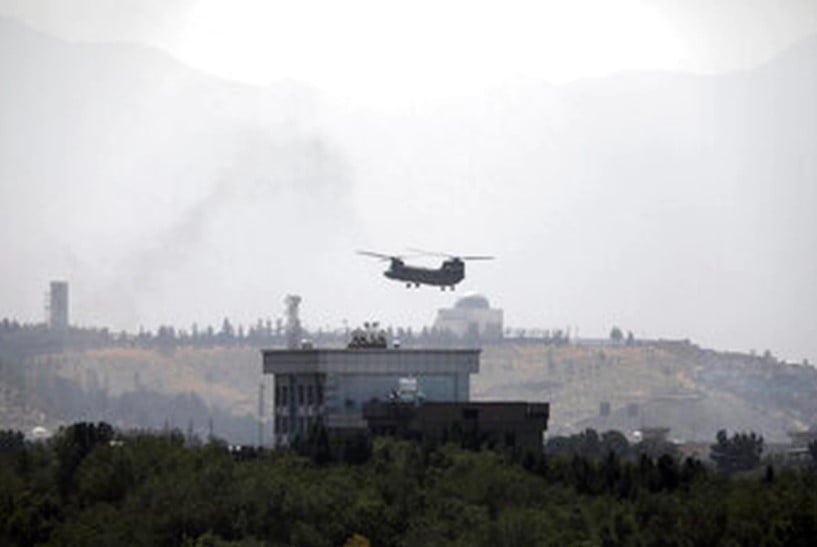
August 25, 2021
I have been silent for a while. I’ve been silent about Afghanistan for longer. But too many things are going unsaid.
I won’t try to evoke the emotions, somehow both swirling and yet leaden: the grief, the anger, the sense of futility. Instead, as so often before, I will use my mind to shield my heart. And in the process, perhaps help you make some sense of what has happened.
For those of you who don’t know me, here is my background — the perspective from which I write tonight.
I covered the fall of the Taliban for NPR, making my way into their former capital, Kandahar, in December 2001, a few days after the collapse of their regime. Descending the last great hill into the desert city, I saw a dusty ghost town. Pickup trucks with rocket-launchers strapped to the struts patrolled the streets. People pulled on my militia friends’ sleeves, telling them where to find a Taliban weapons cache, or a last hold-out. But most remained indoors.
Originally published at sarahchayes.org
It was Ramadan. A few days later, at the holiday ending the month-long fast, the pent-up joy erupted. Kites took to the air. Horsemen on gorgeous, caparisoned chargers tore across a dusty common in sprint after sprint, with a festive audience cheering them on. This was Kandahar, the Taliban heartland. There was no panicked rush for the airport.
I reported for a month or so, then passed off to Steve Inskeep, now Morning Edition host. Within another couple of months, I was back, not as a reporter this time, but to try actually to do something. I stayed for a decade.
I ran two non-profits in Kandahar, living in an ordinary house and speaking Pashtu, and eventually went to work for two commanders of the international troops, and then the chairman of the Joint Chiefs of Staff. (You can read about that time, and its lessons, in my first two books, The Punishment of Virtue and Thieves of State.)
From that standpoint — speaking as an American, as an adoptive Kandahari, and as a former senior U.S. government official — here are the key factors I see in today’s climax of a two-decade long fiasco:
Afghan government corruption, and the U.S. role enabling and reinforcing it. The last speaker of the Afghan parliament, Rahman Rahmani, I recently learned, is a multimillionaire, thanks to monopoly contracts to provide fuel and security to U.S. forces at their main base, Bagram. Is this the type of government people are likely to risk their lives to defend?
Two decades ago, young people in Kandahar were telling me how the proxy militias American forces had armed and provided with U.S. fatigues were shaking them down at checkpoints.
By 2007, delegations of elders would visit me — the only American whose door was open and who spoke Pashtu so there would be no intermediaries to distort or report their words. Over candied almonds and glasses of green tea, they would get to some version of this: “The Taliban hit us on this cheek, and the government hits us on that cheek.” The old man serving as the group’s spokesman would physically smack himself in the face.
I and too many other people to count spent years of our lives trying to convince U.S. decision-makers that Afghans could not be expected to take risks on behalf of a government that was as hostile to their interests as the Taliban were. Note: it took me a while, and plenty of my own mistakes, to come to that realization. But I did.
For two decades, American leadership on the ground and in Washington proved unable to take in this simple message. I finally stopped trying to get it across when, in 2011, an interagency process reached the decision that the U.S. would not address corruption in Afghanistan.
It was now explicit policy to ignore one of the two factors that would determine the fate of all our efforts. That’s when I knew today was inevitable.
Americans like to think of ourselves as having valiantly tried to bring democracy to Afghanistan. Afghans, so the narrative goes, just weren’t ready for it, or didn’t care enough about democracy to bother defending it. Or we’ll repeat the cliche that Afghans have always rejected foreign intervention; we’re just the latest in a long line.
I was there. Afghans did not reject us. They looked to us as exemplars of democracy and the rule of law. They thought that’s what we stood for.
And what did we stand for? What flourished on our watch? Cronyism, rampant corruption, a Ponzi scheme disguised as a banking system, designed by U.S. finance specialists during the very years that other U.S. finance specialists were incubating the crash of 2008. A government system where billionaires get to write the rules.
Is that American democracy?
Well…?
Pakistan. The involvement of that country’s government — in particular its top military brass — in its neighbor’s affairs is the second factor that would determine the fate of the U.S. mission.
You may have heard that the Taliban first emerged in the early 1990s, in Kandahar. That is incorrect. I conducted dozens of conversations and interviews over the course of years, both with actors in the drama and ordinary people who watched events unfold in Kandahar and in Quetta, Pakistan. All of them said the Taliban first emerged in Pakistan.
The Taliban were a strategic project of the Pakistani military intelligence agency, the ISI. It even conducted market surveys in the villages around Kandahar, to test the label and the messaging. “Taliban” worked well.
The image evoked was of the young students who apprenticed themselves to village religious leaders. They were known as sober, studious, and gentle. These Taliban, according to the ISI messaging, had no interest in government. They just wanted to get the militiamen who infested the city to stop extorting people at every turn in the road.
Both label and message were lies.
Within a few years, Usama bin Laden found his home with the Taliban, in their de facto capital, Kandahar, hardly an hour’s drive from Quetta. Then he organized the 9/11 attacks. Then he fled to Pakistan, where we finally found him, living in a safe house in Abbottabad, practically on the grounds of the Pakistani military academy.
Even knowing what I knew, I was shocked. I never expected the ISI to be that brazen.
Meanwhile, ever since 2002, the ISI had been re-configuring the Taliban: helping it regroup, training and equipping units, developing military strategy, saving key operatives when U.S. personnel identified and targeted them. That’s why the Pakistani government got no advance warning of the Bin Laden raid. U.S. officials feared the ISI would warn him.
By 2011, my boss, the outgoing chairman of the Joint Chiefs of Staff, Adm. Mike Mullen, testified to the Senate Armed Services Committee that the Taliban were a “virtual arm of the ISI.”
And now this.
Do we really suppose the Taliban, a rag-tag, disjointed militia hiding out in the hills, as we’ve so long been told, was able to execute such a sophisticated campaign plan with no international backing? Where do we suppose that campaign plan came from? Who gave the orders? Where did all those men, all that materiel, the endless supply of money to buy off local Afghan army and police commanders, come from? How is it that new officials were appointed in Kandahar within a day of the city’s fall?
The new governor, mayor, director of education, and chief of police all speak with a Kandahari accent. But no one I know has ever heard of them. I speak with a Kandahari accent, too. Quetta is full of Pashtuns — the main ethnic group in Afghanistan — and people of Afghan descent and their children. Who are these new officials?
Over those same years, by the way, the Pakistani military also provided nuclear technology to Iran and North Korea. But for two decades, while all this was going on, the United States insisted on considering Pakistan an ally. We still do.
Hamid Karzai. During my conversations in the early 2000s about the Pakistani government’s role in the Taliban’s initial rise, I learned this breathtaking fact: Hamid Karzai, the U.S. choice to pilot Afghanistan after we ousted their regime, was in fact the go-between who negotiated those very Taliban’s initial entry into Afghanistan in 1994.
I spent months probing the stories. I spoke to servants in the Karzai household. I spoke to a former Mujahideen commander, Mullah Naqib, who admitted to being persuaded by the label and the message Karzai was peddling.
The old commander also admitted he was at his wits’ end at the misbehavior of his own men. I spoke with his chief lieutenant, who disagreed with his tribal elder and commander, and took his own men off to neighboring Helmand Province to keep fighting.
I heard that Karzai’s own father broke with him over his support for this ISI project. Members of Karzai’s household and Quetta neighbors told me about Karzai’s frequent meetings with armed Taliban at his house there, in the months leading up to their seizure of power.
And lo. Karzai abruptly emerges from this vortex, at the head of a “coordinating committee” that will negotiate the Taliban’s return to power? Again?
It was like a repeat of that morning of May, 2011, when I first glimpsed the pictures of the safe-house where Usama bin Laden had been sheltered. Once again — even knowing everything I knew — I was shocked. I was shocked for about four seconds. Then everything seemed clear.
It is my belief that Karzai was a key go-between negotiating this surrender, just as he did in 1994, this time enlisting other discredited figures from Afghanistan’s past, as they were useful to him. Former co-head of the Afghan government, Abdullah Abdullah, could speak to his old battle-buddies, the Mujahideen commanders of the north and west, and their comrades within the Afghan armed forces.
You may have heard some of their names as they surrendered their cities in recent days: Ismail Khan, Dostum, Atta Muhammad Noor. The other person mentioned together with Karzai is Gulbuddin Hikmatyar — a bona fide Taliban commander, who could take the lead in some conversations with them and with the ISI.
As Americans have witnessed in our own context — the #MeToo movement, for example, the uprising after the murder of George Floyd, or the January 6 attack on the U.S. Capitol — surprisingly abrupt events are often months or years in the quiet making. The abrupt collapse of 20 years’ effort in Afghanistan is, in my view, one of those cases.
Thinking this hypothesis through, I find myself wondering: what role did U.S. Special Envoy Zalmay Khalilzad play? And old friend of Karzai’s, he was the one who ran the negotiations with the Taliban for the Trump Administration, in which the Afghan government was forced to make concession after concession.
Could President Biden truly have found no one else for that job, to replace an Afghan-American with obvious conflicts of interest, who was close to former Vice President Dick Cheney and who lobbied in favor of an oil pipeline through Afghanistan when the Taliban were last in power?
Self-Delusion. How many times did you read stories about the Afghan security forces’ steady progress? How often, over the past two decades, did you hear some U.S. official proclaim that the Taliban’s eye-catching attacks in urban settings were signs of their “desperation” and their “inability to control territory?” How many heart-warming accounts did you hear about all the good we were doing, especially for women and girls?
Who were we deluding? Ourselves?
What else are we deluding ourselves about?
One final point. I hold U.S. civilian leadership, across four administrations, largely responsible for today’s outcome.
Military commanders certainly participated in the self-delusion. I can and did find fault with generals I worked for or observed. But the U.S. military is subject to civilian control. And the two primary problems identified above — corruption and Pakistan — are civilian issues. They are not problems men and women in uniform can solve. But faced with calls to do so, no top civilian decision-maker was willing to take either of these problems on. The political risk, for them, was too high.
Today, as many of those officials enjoy their retirement, who is suffering the cost?
Originally published at sarahchayes.org
About the author

Sarah Chayes’s remarkable trajectory has led her from reporting from Paris for National Public Radio and covering the fall of the Taliban in Afghanistan to running a soap factory in downtown Kandahar in the midst of a reigniting insurgency. She went on to advise the topmost levels of the U.S. military, serving as special adviser to two commanders of the international forces in Kabul and then Chairman of the Joint Chiefs of Staff Mike Mullen. She left the Pentagon for a five-year stint at the Carnegie Endowment for International Peace, where she extracted the broadly relevant core from those experiences.
Internationally recognized for her innovative thinking on corruption and its implications, she has uncovered the unrecognized reality that severe and structured corruption can prompt international crises, such as revolutions and other uprisings, violent insurgency, and environmental devastation. Corruption of this sort is the operating system of sophisticated networks, which weave together government officials, business magnates and private charities, and out and out criminals, and represents, in Sarah’s view, the primary threat to democracy in our lifetimes.
Author of the prize-winning Thieves of State: Why Corruption Threatens Global Security, she has just finished On Corruption In America — And What Is at Stake.
Please help TFF to publish more like this. We are entirely people-financed and therefore truly independent and trustworthy






2 Responses
Sarah, brilliant!! Jonathan
Unlike many pundits who pontificate about Afghanistan without knowing much about the country, its history and people, Sarah Chayes has lived in Afghanistan, knows Afghanistan well and has written about it since the fall of the Taliban in 2001. Furthermore, she is also very familiar with US’s encounter with Afghanistan, its achievements, as well as corruption, ineptitude and deliberate self-deception. In this article she reveals some of the little-known facts behind the main reasons for the collapse of the US-backed Afghan government and about some Afghan & US officials who might have played a role in helping the Taliban’s return to power. Pointing out those faults honestly is not treason but the greatest service to both the United States and Afghanistan, only if US officials had listened to those warnings before it was too late. According to some estimates, out of about $2.3 trillion that the United States spent on Afghanistan, only $144 billion were allocated for the reconstruction of the country since 2001, but $88 billion of that amount was spent on recruiting and training Afghan army and security forces, which fell apart as soon as Taliban forces approached the cities. Another $15.5 billion spent between 2008 and 2017 was documented as “waste, fraud and abuse” by the U.S. Special Inspector General for Afghanistan Reconstruction. Therefore, less than 2% of total U.S. spending on Afghanistan was devoted to reconstruction. Are we surprised that the vast majority of ordinary Afghans owed no allegiance to the occupying forces!