
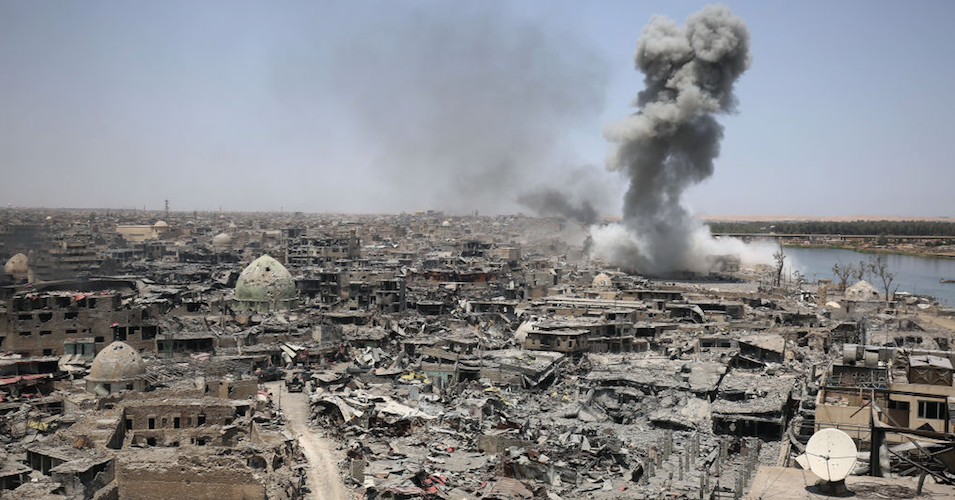
U.S. bombs and bullets have claimed at least hundreds of thousands of civilian lives this century. Here, a U.S. airstrike against Islamic State militants in densely-populated Mosul, Iraq on July 9, 2017 is shown. (Photo: Ahmad Al-Rubaye/AFP/Getty Images)

March 29, 2021

Medea Benjamin, Nicolas J.S. Davies

Unbeknownst to many Americans, the U.S. military and its allies are engaged in bombing and killing people in other countries on a daily basis. 

On February 25th, President Biden ordered U.S. air forces to drop seven 500-pound bombs on Iraqi forces in Syria, reportedly killing 22 people. The U.S. airstrike has predictably failed to halt rocket attacks on deeply unpopular U.S. bases in Iraq, which the Iraqi National Assembly passed a resolution to close over a year ago. 

The Western media reported the U.S. airstrike as an isolated and exceptional incident, and there has been significant blowback from the U.S. public, Congress and the world community, condemning the strikes as illegal and a dangerous escalation of yet another Middle East conflict. 

Originally published at Commondreams

But unbeknownst to many Americans, the U.S. military and its allies are engaged in bombing and killing people in other countries on a daily basis. The U.S. and its allies have dropped more than 326,000 bombs and missiles on people in other countries since 2001 (see table below), including over 152,000 in Iraq and Syria. 

That’s an average of 46 bombs and missiles per day, day in day out, year in year out, for nearly 20 years. In 2019, the last year for which we have fairly complete records, the average was 42 bombs and missiles per day, including 20 per day in Afghanistan alone.

So, if those seven 500-pound bombs were the only bombs the U.S. and its allies dropped on February 25th, it would have been an unusually quiet day for U.S. and allied air forces, and for their enemies and victims on the ground, compared to an average day in 2019 or most of the past 20 years.

On the other hand, if the unrelenting U.S. air assault on countries across the Greater Middle East finally began to diminish over the past year, this bombing may have been an unusual spike in violence. But which of these was it, and how would we know?

We don’t know, because our government doesn’t want us to. From January 2004 until February 2020, the U.S. military kept track of how many bombs and missiles it dropped on Afghanistan, Iraq and Syria, and published those figures in regular, monthly Airpower Summaries, which were readily available to journalists and the public.

But in March 2020, the Trump administration abruptly stopped publishing U.S. Airpower Summaries, and the Biden administration has so far not published any either. 

As with the human casualties and mass destruction that these hundreds of thousands of airstrikes cause, the U.S. and international media only report on a tiny fraction of them. Without regular U.S. Airpower Summaries, comprehensive databases of airstrikes in other war-zones and serious mortality studies in the countries involved, the American public and the world are left almost completely in the dark about the death and destruction our country’s leaders keep wreaking in our name.

The disappearance of Airpower Summaries has made it impossible to get a clear picture of the current scale of U.S. airstrikes.

Here are up-to-date figures on U.S. and allied airstrikes, from 2001 to the present, highlighting the secrecy in which they have abruptly been shrouded for the past year:

Numbers of bombs and missiles dropped on other countries by the U.S. & its allies since 2001

screen_shot_2021-03-04_at_12.47.01_pm.pn

These figures are based on U.S. Airpower Summaries for Afghanistan, Iraq, and Syria; the Bureau of Investigative Journalism’s count of drone strikes in Pakistan, Somalia and Yemen; the Yemen Data Project‘s count of Saudi-led airstrikes in Yemen; the New America Foundation’s database of foreign airstrikes in Libya; and other published statistics. Figures for 2021 are only through January.

There are several categories of airstrikes that are not included in this table, meaning that the true numbers of airstrikes are certainly higher. These include:

  • Helicopter strikes: Military Times published an article in February 2017 titled, “The U.S. military’s stats on deadly airstrikes are wrong. Thousands have gone unreported.” The largest pool of airstrikes not included in U.S. Airpower Summaries are strikes by attack helicopters. The U.S. Army told the authors its helicopters had conducted 456 otherwise unreported airstrikes in Afghanistan in 2016. The authors explained that the non-reporting of helicopter strikes has been consistent throughout the post-9/11 wars, and they still did not know how many actual missiles were fired in those 456 attacks in Afghanistan in the one year they investigated.
  • AC-130 gunships: The airstrike that destroyed the Doctors Without Borders hospital in Kunduz, Afghanistan in 2015 was not conducted with bombs or missiles, but by a Lockheed-Boeing AC-130 gunship. These machines of mass destruction, usually manned by U.S. Air Force special operations forces, are designed to circle a target on the ground, pouring howitzer shells and cannon fire into it, often until it is completely destroyed. The U.S. has used AC-130s in Afghanistan, Iraq, Libya, Somalia, and Syria.
  • Strafing runs: U.S. Airpower Summaries for 2004-2007 included a note that their tally of “strikes with munitions dropped… does not include 20mm and 30mm cannon or rockets.” But the 30mm cannons on A-10 Warthogs and other ground attack planes are powerful weapons, originally designed to destroy Soviet tanks. A-10s fire 65 depleted uranium shells per second to blanket an area with deadly and indiscriminate fire, but that does not count as a “weapons release” in U.S. Airpower Summaries.
  • “Counter-insurgency” and “counter-terrorism” operations in other parts of the world. The United States formed a military coalition with 11 West African countries in 2005, and now has a drone base in Niger, but we have not found a database of U.S. and allied air strikes in that region, or in the Philippines, Latin America or elsewhere. 

It was clearly no coincidence that Trump stopped publishing Airpower Summaries right after the February 2020 U.S. withdrawal agreement with the Taliban, reinforcing the false impression that the war in Afghanistan was over. In fact, U.S. bombing resumed after only an 11-day pause. 

As our table shows, 2018 and 2019 were back-to-back record years for U.S. airstrikes in Afghanistan. But how about 2020? Without the official records, we don’t know whether the withdrawal agreement led to a serious reduction in airstrikes or not.

President Biden has foolishly tried to use airstrikes in Syria as “leverage” with Iran, instead of simply rejoining the Iran nuclear agreement as he promised during the election campaign. Biden is likewise trailing along in Trump’s footsteps by shrouding U.S. airstrikes in the secrecy that Trump used to obscure his failure to “end the endless wars.” 

It is entirely possible that the highly publicized February 25th airstrikes, like Trump’s April 2017 missile strikes on Syria, were a diversion from much heavier, but largely unreported, U.S. bombing already under way elsewhere, in that case the frightful destruction of Mosul, Iraq’s former second city.  

The only way that Biden can reassure the American public that he is not using Trump’s wall of secrecy to continue America’s devastating airwars, notably in Afghanistan, is to end this secrecy now, and resume the publication of complete and accurate U.S. Airpower Summaries.

President Biden cannot restore the world’s respect for American leadership, or the American public’s support for our foreign policy, by piling more lies, secrets and atrocities on top of those he has inherited.

If he keeps trying to do so, he might well find himself following in Trump’s footsteps in yet another way: as the failed, one-term president of a destructive and declining empire.

Originally published at Commondreams

Medea Benjamin

Medea Benjamin, co-founder of Global Exchange and CODEPINK: Women for Peace, is the author of the 2018 book, “Inside Iran: The Real History and Politics of the Islamic Republic of Iran“. Her previous books include: “Kingdom of the Unjust: Behind the U.S.-Saudi Connection” (2016); “Drone Warfare: Killing by Remote Control” (2013); “Don’t Be Afraid Gringo: A Honduran Woman Speaks from the Heart” (1989), and (with Jodie Evans) “Stop the Next War Now (Inner Ocean Action Guide)” (2005). Follow her on Twitter: @medeabenjamin

Nicolas J.S. Davies

Nicolas J.S. Davies is the author of “Blood On Our Hands: the American Invasion and Destruction of Iraq” (2010). He also wrote the chapters on “Obama at War” in “Grading the 44th President: a Report Card on Barack Obama’s First Term as a Progressive Leader” (2012).

Please help TFF remain truly independent by contributing if you benefited from this article

One Response

  1. It is when we see these figures that are (were) openly available that we discover the grotesque scale of violence meted out by US forces on unfortunate Middle Eastern countries, most of them since the falsely-labelled “war on terror”. What they show is US military’s addiction to war, bombing and killing under both Republican and Democratic Administrations. There are two ways that this terrible record of slaughter and destruction can come to an end, either by a mass mobilisation of progressive forces in the United States to bring about a change of direction and to move away from over-the-top militarism, or a global uprising against US military adventures abroad. Let’s hope that the change comes from democratic forces at home, because the second option will be very ugly and costly.

Related Posts

Jan Oberg, TFF director April 9, 2026 I was recently invited to have a good, long talk about the world – and, of course, about peace too – with Boris Malagurski on his Weight of Chains Channel on YouTube. It was a real joy and seems to have been greatly appreciated by the viewers too. Mr Malagurski and I shall of course be grateful if you share this conversation in your circles – of course, only if you like what you see and hear 😉☮️ And remember that this one – like hundreds of others with TFF Associates – can be enjoyed at our TFF Video Collection.
A friendly quarrel while we agree that the US sanctions are a weapon of mass destruction and kill more people than wars do. And that we must talk much more about sanctions than we have so far. Jan Oberg, TFF director March 16, 2026 John Mearsheimer recently stated that U.S. sanctions murdered around 38 million people between 1971 and 2021 – see the video below. It is a dramatic figure, and it has spread quickly because it captures, in one sentence, the enormous human cost of modern sanctions. I share his concern about the destructive effects of economic coercion. But the specific number he cites — and the way he attributes it — deserves a friendly academic clarification. The figure comes from a 2023 Lancet Global Health article estimating the mortality effects of unilateral U.S. and EU sanctions over the past half‑century. This is the first point where Mearsheimer’s shorthand diverges from the text: the study...
By Jan ObergTFF co-founder and director February 11, 2026 PART 3 — ECONOMICS, TRADE & FINANCIAL SOVEREIGNTY A. Trade Measures & Market Signaling Economic pressure can be applied instantly and scaled without violence. Immediate Measures (within a week) Government boycott US goods and services  A very powerful signal which over time will be felt. Targeted tariffs on selected U.S. goods Symbolic but high-visibility sectors send a clear message. Suspend trade facilitation talks A peaceful pause that signals deep concern. Freeze U.S. participation in public procurement – military procurement in particular A nonviolent way to reduce influence. Competition law review of U.S. corporations A legal tool to scrutinise market dominance. Longer-Term Measures EU–Asia–Africa trade corridors Reducing reliance on U.S. markets. European supply chains for critical minerals Strategic autonomy in resource access. European Strategic Trade Authority Monitoring coercive practices globally. Euro-denominated commodity markets Weakening the dollar’s pricing monopoly. The EU must resume contacts and negotiations with Russia, focusing on energy cooperation To...

Recent Articles

Tony Robinson October 4, 2026 Violence is easy to recognise when someone is being beaten, shot or killed. It becomes more difficult when nobody is holding a weapon. Poverty, discrimination, exploitation and repression can restrict a human life just as effectively, although they do so in very different ways and with very different consequences. Simply adding more categories to an ever-growing list of forms of violence does not really solve the problem. The more interesting question is what all these different situations have in common and why it makes sense to describe them using the same word. Human beings do not simply react to what happens around them. They remember the past, imagine things that do not yet exist, make plans and undertake projects. Workers organise because they imagine different working conditions; people migrate because they imagine another life somewhere else; social movements emerge because people refuse to accept the...
It’s a matter of principles, courage, vision and pulling together – while the militarist world is falling apart… Peter Langille October 3, 2026 “Here, then, is the problem which we present to you, stark and dreadful and inescapable: Shall we put an end to the human race; or shall mankind renounce war?”The Bertrand Russell—Albert Einstein Manifesto, July 9, 1955 ⁕ The forecast for what’s ahead is worrisome. The sharp rise in armed conflicts over the past three years is adding to what was already the highest level in over seventy years. Genocides, which should be prevented are supported. A shared climate emergency that jeopardises survival is ignored. Diverse polls now suggest that people are war-weary, worried and interested in a more effective United Nations. And, there are viable policy options for a more secure world! Yet governments are doubling-down, betting on more war and investing heavily. If current trends persist,...
Johan Galtung 1930-2024October 2015 Published here on October 3, 2026 Let us focus on Civilization for conflict analysis and remedies. Major forms of disorder use violence; war is state organized violence. The most belligerent states are the United States of America and Israel, both with civilization roots. National Evangelism, the US Protestant Christian civilization– more national than evangelical–justifies US warfare as exceptionalism of a people chosen by God, with a manifest destiny to run the world. Orthodox Judaism justifies Israeli warfare to conquer and expand from Nile to Euphrates as a religious right and duty to the Eternal One. The third most belligerent country, the UK, no longer believes it is God-chosen but chosen by the USA; not quite the same but something. But the root cause of global disorder lies in the Occident–with Islam–seeing itself as the single, universal civilization valid for all at all times, all others being...

TFF on Substack

Discover and subscribe to more peace materials on TFF Substack

Most Popular

Tony Robinson October 4, 2026 Violence is easy to recognise when someone is being beaten, shot or killed. It becomes more difficult when nobody is holding a weapon. Poverty, discrimination, exploitation and repression can restrict a human life just as effectively, although they do so in very different ways and with very different consequences. Simply adding more categories to an ever-growing list of forms of violence does not really solve the problem. The more interesting question is what all these different situations have in common and why it makes sense to describe them using the same word. Human beings do not simply react to what happens around them. They remember the past, imagine things that do not yet exist, make plans and undertake projects. Workers organise because they imagine different working conditions; people migrate because they imagine another life somewhere else; social movements emerge because people refuse to accept the...
It’s a matter of principles, courage, vision and pulling together – while the militarist world is falling apart… Peter Langille October 3, 2026 “Here, then, is the problem which we present to you, stark and dreadful and inescapable: Shall we put an end to the human race; or shall mankind renounce war?”The Bertrand Russell—Albert Einstein Manifesto, July 9, 1955 ⁕ The forecast for what’s ahead is worrisome. The sharp rise in armed conflicts over the past three years is adding to what was already the highest level in over seventy years. Genocides, which should be prevented are supported. A shared climate emergency that jeopardises survival is ignored. Diverse polls now suggest that people are war-weary, worried and interested in a more effective United Nations. And, there are viable policy options for a more secure world! Yet governments are doubling-down, betting on more war and investing heavily. If current trends persist,...
Johan Galtung 1930-2024October 2015 Published here on October 3, 2026 Let us focus on Civilization for conflict analysis and remedies. Major forms of disorder use violence; war is state organized violence. The most belligerent states are the United States of America and Israel, both with civilization roots. National Evangelism, the US Protestant Christian civilization– more national than evangelical–justifies US warfare as exceptionalism of a people chosen by God, with a manifest destiny to run the world. Orthodox Judaism justifies Israeli warfare to conquer and expand from Nile to Euphrates as a religious right and duty to the Eternal One. The third most belligerent country, the UK, no longer believes it is God-chosen but chosen by the USA; not quite the same but something. But the root cause of global disorder lies in the Occident–with Islam–seeing itself as the single, universal civilization valid for all at all times, all others being...
Read More
Living-Peace-Sign-Budapest-copy
Tony Robinson October 4, 2026 Violence is easy to recognise when someone is being beaten, shot or killed. It becomes more difficult when nobody is holding a weapon. Poverty, discrimination, exploitation and repression can restrict a human life just as effectively, although they do so in very different ways and with very different consequences. Simply adding more categories to an ever-growing list of forms of violence does not really solve the problem. The more interesting question is what all these different situations have in common and why it makes sense to describe them using the same word. Human beings do not simply react to what happens around them. They remember the past, imagine things that do not yet exist, make plans and undertake projects. Workers organise because they imagine different working conditions; people migrate because they imagine another life somewhere else; social movements emerge because people refuse to accept the...
b54a1f10-8c65-4f0b-9dd5-4abc0a7d04cc_2659x2659
It’s a matter of principles, courage, vision and pulling together – while the militarist world is falling apart… Peter Langille October 3, 2026 “Here, then, is the problem which we present to you, stark and dreadful and inescapable: Shall we put an end to the human race; or shall mankind renounce war?”The Bertrand Russell—Albert Einstein Manifesto, July 9, 1955 ⁕ The forecast for what’s ahead is worrisome. The sharp rise in armed conflicts over the past three years is adding to what was already the highest level in over seventy years. Genocides, which should be prevented are supported. A shared climate emergency that jeopardises survival is ignored. Diverse polls now suggest that people are war-weary, worried and interested in a more effective United Nations. And, there are viable policy options for a more secure world! Yet governments are doubling-down, betting on more war and investing heavily. If current trends persist,...
010
Johan Galtung 1930-2024October 2015 Published here on October 3, 2026 Let us focus on Civilization for conflict analysis and remedies. Major forms of disorder use violence; war is state organized violence. The most belligerent states are the United States of America and Israel, both with civilization roots. National Evangelism, the US Protestant Christian civilization– more national than evangelical–justifies US warfare as exceptionalism of a people chosen by God, with a manifest destiny to run the world. Orthodox Judaism justifies Israeli warfare to conquer and expand from Nile to Euphrates as a religious right and duty to the Eternal One. The third most belligerent country, the UK, no longer believes it is God-chosen but chosen by the USA; not quite the same but something. But the root cause of global disorder lies in the Occident–with Islam–seeing itself as the single, universal civilization valid for all at all times, all others being...
Screenshot 2026-10-02 011738
Jan ObergPhD, director, The Transnational Foundation for Peace and Future Research, TFFLund, Sweden October 2, 2026 This is my full original manuscript. The Chinese Academy of Social Science, CASS, makes two publications out if it. 1. China’s Five-year plan emphasized the capabilities of basic research and original innovation. It is regarded as the goal of the future social development, which, as required, should be significantly enhanced. Can you comment on the importance of original innovation in research and academic study? I believe it is easier to define “original innovation” in the natural sciences than in social sciences. The breaking points of what constitutes something new, or innovative, are not quite as sharp in the latter. But in both fields it is about opening up something that was closed, unseen, unexplored before – making manifest what was earlier latent. Innovations come in many forms and shapes – naming something that was not...
arctic-circle-map
The agreement is catastrophic both because of what it says and what it doesn’t mention. It reduces further the major asset of security policies: Freedom of action. Jan Oberg TFF director September 25, 2026 A couple of hours before the agreement was signed on September 22, 2026, I published the following 13 hypotheses about what it would most likely contain on TFF Substack (in English). I was wrong on only the first point. Contrary to what Trump had written on his Truth Social platform, it does not appear to come into force immediately. In fact, it turned out to be worse than even I had anticipated. After these hypotheses now come a number of reflections in light of what the agreement actually contains, and does not contain, as well as the way in which it has generally been presented by major media outlets and by the public-service broadcaster DR. My...
girl-5894831_1280
Below are TFF-related media mentions, comments, videos and social media posts published elsewhere but not on this homepage. We happen to catch and list only a fraction. Regarding video comments and debates, we recommend that you go to the TFF Video Channel on Substack where many of them are reproduced. Jan Oberg is a contributor to China Daily – 52 million daily clicks – and Global Times, CGTN and CCTV (the national television), China Investment, Xinhua News Agency and several others. Articles and videos on these media very often multiply into countless Chinese (and Western media) that re-post them from these main media. Thanks to The China Academy, his analyses, interviews and comments are frequently posted on YouTube channels such as Thinkers Forum and Wave Media. These videos are often re-posted on Bilibili (China’s YouTube), the China Content Center on TikTok, and on the Chinese edition of TikTok, Douyin.com. This means reaching hundreds of millions of viewers worldwide over a year. While there are too many to catch on all these...




