
The Guns of August – Lowering the Flag on the American Century

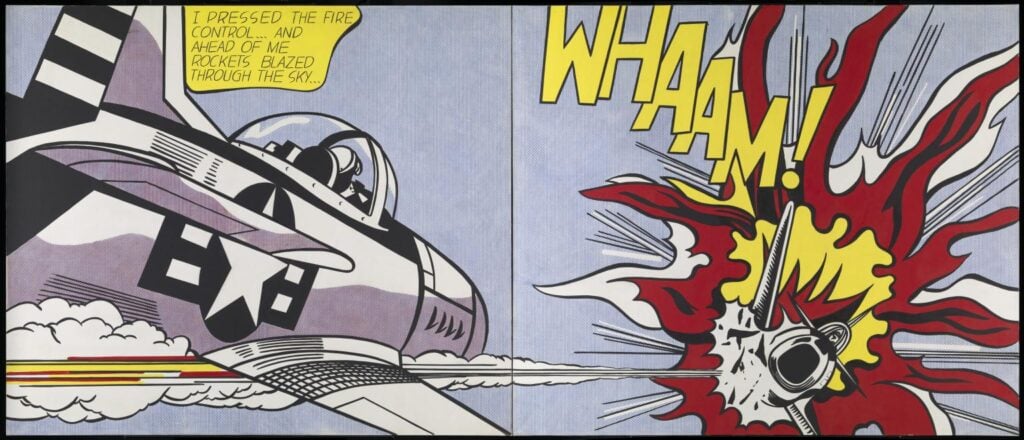
Whaam! 1963 is a large, two-canvas painting by the American pop artist Roy Lichtenstein that takes its composition from a comic book strip.

What would the world be like if the U.S. lost control globally?

Chalmers Johnson (1931-2010)

March 17, 2021

In 1962, the historian Barbara Tuchman published a book about the start of World War I and called it The Guns of August. It went on to win a Pulitzer Prize. She was, of course, looking back at events that had occurred almost 50 years earlier and had at her disposal documents and information not available to participants. They were acting, as Vietnam-era Secretary of Defense Robert McNamara put it, in the fog of war.

So where are we this August of 2010, with guns blazing in one war in Afghanistan even as we try to extricate ourselves from another in Iraq?  Where are we, as we impose sanctions on Iran and North Korea (and threaten worse), while sending our latest wonder weapons, pilotless drones armed with bombs and missiles, into Pakistan’s tribal borderlands, Yemen, and who knows where else, tasked with endless “targeted killings” which, in blunter times, used to be called assassinations?  Where exactly are we, as we continue to garrison much of the globe even as our country finds itself incapable of paying for basic services?

Originally published by Huffington Post in 2017

I wish I had a crystal ball to peer into and see what historians will make of our own guns of August in 2060. The fog of war, after all, is just a stand-in for what might be called “the fog of the future,” the inability of humans to peer with any accuracy far into the world to come.  Let me nonetheless try to offer a few glimpses of what that foggy landscape some years ahead might reveal, and even hazard a few predictions about what possibilities await still-imperial America.

Let me begin by asking: What harm would befall the United States if we actually decided, against all odds, to close those hundreds and hundreds of bases, large and small, that we garrison around the world?  What if we actually dismantled our empire, and came home? Would Genghis Khan-like hordes descend on us?  Not likely.  Neither a land nor a sea invasion of the U.S. is even conceivable.

Would 9/11-type attacks accelerate?  It seems far likelier to me that, as our overseas profile shrank, the possibility of such attacks would shrink with it.

Would various countries we’ve invaded, sometimes occupied, and tried to set on the path of righteousness and democracy decline into “failed states?” Probably some would, and preventing or controlling this should be the function of the United Nations or of neighboring states. (It is well to remember that the murderous Cambodian regime of Pol Pot was finally brought to an end not by us, but by neighboring Vietnam.)

Sagging Empire

In other words, the main fears you might hear in Washington — if anyone even bothered to wonder what would happen, should we begin to dismantle our empire — would prove but chimeras.  They would, in fact, be remarkably similar to Washington’s dire predictions in the 1970s about states all over Asia, then Africa, and beyond falling, like so many dominoes, to communist domination if we did not win the war in Vietnam.

What, then, would the world be like if the U.S. lost control globally — Washington’s greatest fear and deepest reflection of its own overblown sense of self-worth — as is in fact happening now despite our best efforts?  What would that world be like if the U.S. just gave it all up? What would happen to us if we were no longer the “sole superpower” or the world’s self-appointed policeman?

In fact, we would still be a large and powerful nation-state with a host of internal and external problems. An immigration and drug crisis on our southern border, soaring health-care costs, a weakening education system, an aging population, an aging infrastructure, an unending recession — none of these are likely to go away soon, nor are any of them likely to be tackled in a serious or successful way as long as we continue to spend our wealth on armies, weapons, wars, global garrisons, and bribes for petty dictators.

Even without our interference, the Middle East would continue to export oil, and if China has been buying up an ever larger share of what remains underground in those lands, perhaps that should spur us into conserving more and moving more rapidly into the field of alternative energies.

Rising Power

Meanwhile, whether we dismantle our empire or not, China will become (if it isn’t already) the world’s next superpower. It, too, faces a host of internal problems, including many of the same ones we have. However, it has a booming economy, a favorable balance of payments vis-à-vis much of the rest of the world (particularly the U.S., which is currently running an annual trade deficit with China of $227 billion), and a government and population determined to develop the country into a powerful, economically dominant nation-state.

Fifty years ago, when I began my academic career as a scholar of China and Japan, I was fascinated by the modern history of both countries. My first book dealt with the way the Japanese invasion of China in the 1930s spurred Mao Zedong and the Chinese Communist Party he headed on a trajectory to power, thanks to its nationalist resistance to that foreign invader.

Incidentally, it is not difficult to find many examples of this process in which a domestic political group gains power because it champions resistance to foreign troops.  In the immediate post-WWII period, it occurred in Vietnam, Indonesia, and Malaysia; with the collapse of the Soviet Union in 1991, all over Eastern Europe; and today, it is surely occurring in Afghanistan and probably in Iraq as well.

Once the Cultural Revolution began in China in 1966, I temporarily lost interest in studying the country. I thought I knew where that disastrous internal upheaval was taking China and so turned back to Japan, which by then was well launched on its amazing recovery from World War II, thanks to state-guided, but not state-owned, economic growth.

This pattern of economic development, sometimes called the “developmental state,” differed fundamentally from both Soviet-type control of the economy and the laissez-faire approach of the U.S.  Despite Japan’s success, by the 1990s its increasingly sclerotic bureaucracy had led the country into a prolonged period of deflation and stagnation.  Meanwhile, post-U.S.S.R. Russia, briefly in thrall to U.S. economic advice, fell captive to rapacious oligarchs who dismantled the command economy only to enrich themselves.

In China, Communist Party leader Deng Xiaoping and his successors were able to watch developments in Japan and Russia, learning from them both.  They have clearly adopted effective aspects of both systems for their economy and society. With a modicum of luck, economic and otherwise, and a continuation of its present well-informed, rational leadership, China should continue to prosper without either threatening its neighbors or the United States.

To imagine that China might want to start a war with the U.S. — even over an issue as deeply emotional as the ultimate political status of Taiwan — would mean projecting a very different path for that country than the one it is currently embarked on.

Lowering the Flag on the American Century

Thirty-five years from now, America’s official century of being top dog (1945-2045) will have come to an end; its time may, in fact, be running out right now. We are likely to begin to look ever more like a giant version of England at the end of its imperial run, as we come face-to-face with, if not necessarily to terms with, our ageing infrastructure, declining international clout, and sagging economy. It may, for all we know, still be Hollywood’s century decades from now, and so we may still make waves on the cultural scene, just as Britain did in the 1960s with the Beatles and Twiggy. Tourists will undoubtedly still visit some of our natural wonders and perhaps a few of our less scruffy cities, partly because the dollar-exchange rate is likely to be in their favour.

If, however, we were to dismantle our empire of military bases and redirect our economy toward productive, instead of destructive, industries; if we maintained our volunteer armed forces primarily to defend our own shores (and perhaps to be used at the behest of the United Nations); if we began to invest in our infrastructure, education, health care, and savings, then we might have a chance to reinvent ourselves as a productive, normal nation. Unfortunately, I don’t see that happening. Peering into that foggy future, I simply can’t imagine the U.S. dismantling its empire voluntarily, which doesn’t mean that, like all sets of imperial garrisons, our bases won’t go someday.

Instead, I foresee the U.S. drifting along, much as the Obama administration seems to be drifting along in the war in Afghanistan. The common talk among economists today is that high unemployment may linger for another decade.  Add in low investment and depressed spending (except perhaps by the government) and I fear T.S. Eliot had it right when he wrote: “This is the way the world ends, not with a bang but a whimper.”

I have always been a political analyst rather than an activist. That is one reason why I briefly became a consultant to the CIA’s top analytical branch, and why I now favor disbanding the Agency. Not only has the CIA lost its raison d’être by allowing its intelligence gathering to become politically tainted, but its clandestine operations have created a climate of impunity in which the U.S. can assassinate, torture, and imprison people at will worldwide.

Just as I lost interest in China when that country’s leadership headed so blindly down the wrong path during the Cultural Revolution, so I’m afraid I’m losing interest in continuing to analyze and dissect the prospects for the U.S. over the next few years. I applaud the efforts of young journalists to tell it like it is, and of scholars to assemble the data that will one day enable historians to describe where and when we went astray.  I especially admire insights from the inside, such as those of ex-military men like Andrew Bacevich and Chuck Spinney. And I am filled with awe by men and women who are willing to risk their careers, incomes, freedom, and even lives to protest — such as the priests and nuns of SOA Watch, who regularly picket the School of the Americas and call attention to the presence of American military bases and misbehavior in South America.

I’m impressed as well with Pfc. Bradley Manning, if he is indeed the person responsible for potentially making public 92,000 secret documents about the war in Afghanistan. Daniel Ellsberg has long been calling for someone to do what he himself did when he released the Pentagon Papers during the Vietnam War. He must be surprised that his call has now been answered — and in such an unlikely way.

My own role these past 20 years has been that of Cassandra, whom the gods gave the gift of foreseeing the future, but also cursed because no one believed her. I wish I could be more optimistic about what’s in store for the U.S.  Instead, there isn’t a day that our own guns of August don’t continue to haunt me.

Copyright 2010 Chalmers Johnson

If you found thisgood, important or even necessary – please let us see it here. You then help us produce more truly independent public education in the service of peace.

Chalmers Johnson (1931-2010) was the author of Blowback (2000), The Sorrows of Empire (2004), and Nemesis: The Last Days of the American Republic (2006), among other works.  His newest book, Dismantling the Empire: America’s Last Best Hope (Metropolitan Books), has just been published.  To listen to Timothy MacBain’s latest TomCast audio interview in which Johnson discusses America’s empire of bases and his new book, click here or, to download it here. Here his page on Wikipedia. More articles by the author here. And his books on Goodreads.


Related Posts

A friendly quarrel while we agree that the US sanctions are a weapon of mass destruction and kill more people than wars do. And that we must talk much more about sanctions than we have so far. Jan Oberg, TFF director March 16, 2026 John Mearsheimer recently stated that U.S. sanctions murdered around 38 million people between 1971 and 2021 – see the video below. It is a dramatic figure, and it has spread quickly because it captures, in one sentence, the enormous human cost of modern sanctions. I share his concern about the destructive effects of economic coercion. But the specific number he cites — and the way he attributes it — deserves a friendly academic clarification. The figure comes from a 2023 Lancet Global Health article estimating the mortality effects of unilateral U.S. and EU sanctions over the past half‑century. This is the first point where Mearsheimer’s shorthand diverges from the text: the study...
Jan Oberg February 19, 2026 What a thrill to be interviewed by former British diplomat Ian Proud! Don’t waste a minute: acquaint yourself with him here on his homepage, which he elegantly calls “Proud Diplomat.” Notice also his book, A Misfit In Moscow. Ian is, of course, also on Substack, where he calls himself The Peace Monger, and recently he set up his own PeaceMonger Channel on YouTube. For once, I was not interviewed as if I were a military geopolitical expert, where I normally have to twist the whole thing in the direction of peace. No, we both had a focus on peace – why it has been disappeared by research, politics and the media, but also what can be done to shape a more peaceful future for us all. One idea we came up with was that of connecting people through citizens diplomacy – in an era where...
By Jan ObergTFF co-founder and director February 11, 2026 PART 3 — ECONOMICS, TRADE & FINANCIAL SOVEREIGNTY A. Trade Measures & Market Signaling Economic pressure can be applied instantly and scaled without violence. Immediate Measures (within a week) Government boycott US goods and services  A very powerful signal which over time will be felt. Targeted tariffs on selected U.S. goods Symbolic but high-visibility sectors send a clear message. Suspend trade facilitation talks A peaceful pause that signals deep concern. Freeze U.S. participation in public procurement – military procurement in particular A nonviolent way to reduce influence. Competition law review of U.S. corporations A legal tool to scrutinise market dominance. Longer-Term Measures EU–Asia–Africa trade corridors Reducing reliance on U.S. markets. European supply chains for critical minerals Strategic autonomy in resource access. European Strategic Trade Authority Monitoring coercive practices globally. Euro-denominated commodity markets Weakening the dollar’s pricing monopoly. The EU must resume contacts and negotiations with Russia, focusing on energy cooperation To...

Recent Articles

Tony Robinson October 4, 2026 Violence is easy to recognise when someone is being beaten, shot or killed. It becomes more difficult when nobody is holding a weapon. Poverty, discrimination, exploitation and repression can restrict a human life just as effectively, although they do so in very different ways and with very different consequences. Simply adding more categories to an ever-growing list of forms of violence does not really solve the problem. The more interesting question is what all these different situations have in common and why it makes sense to describe them using the same word. Human beings do not simply react to what happens around them. They remember the past, imagine things that do not yet exist, make plans and undertake projects. Workers organise because they imagine different working conditions; people migrate because they imagine another life somewhere else; social movements emerge because people refuse to accept the...
It’s a matter of principles, courage, vision and pulling together – while the militarist world is falling apart… Peter Langille October 3, 2026 “Here, then, is the problem which we present to you, stark and dreadful and inescapable: Shall we put an end to the human race; or shall mankind renounce war?”The Bertrand Russell—Albert Einstein Manifesto, July 9, 1955 ⁕ The forecast for what’s ahead is worrisome. The sharp rise in armed conflicts over the past three years is adding to what was already the highest level in over seventy years. Genocides, which should be prevented are supported. A shared climate emergency that jeopardises survival is ignored. Diverse polls now suggest that people are war-weary, worried and interested in a more effective United Nations. And, there are viable policy options for a more secure world! Yet governments are doubling-down, betting on more war and investing heavily. If current trends persist,...
Johan Galtung 1930-2024October 2015 Published here on October 3, 2026 Let us focus on Civilization for conflict analysis and remedies. Major forms of disorder use violence; war is state organized violence. The most belligerent states are the United States of America and Israel, both with civilization roots. National Evangelism, the US Protestant Christian civilization– more national than evangelical–justifies US warfare as exceptionalism of a people chosen by God, with a manifest destiny to run the world. Orthodox Judaism justifies Israeli warfare to conquer and expand from Nile to Euphrates as a religious right and duty to the Eternal One. The third most belligerent country, the UK, no longer believes it is God-chosen but chosen by the USA; not quite the same but something. But the root cause of global disorder lies in the Occident–with Islam–seeing itself as the single, universal civilization valid for all at all times, all others being...

TFF on Substack

Discover and subscribe to more peace materials on TFF Substack

Most Popular

Tony Robinson October 4, 2026 Violence is easy to recognise when someone is being beaten, shot or killed. It becomes more difficult when nobody is holding a weapon. Poverty, discrimination, exploitation and repression can restrict a human life just as effectively, although they do so in very different ways and with very different consequences. Simply adding more categories to an ever-growing list of forms of violence does not really solve the problem. The more interesting question is what all these different situations have in common and why it makes sense to describe them using the same word. Human beings do not simply react to what happens around them. They remember the past, imagine things that do not yet exist, make plans and undertake projects. Workers organise because they imagine different working conditions; people migrate because they imagine another life somewhere else; social movements emerge because people refuse to accept the...
It’s a matter of principles, courage, vision and pulling together – while the militarist world is falling apart… Peter Langille October 3, 2026 “Here, then, is the problem which we present to you, stark and dreadful and inescapable: Shall we put an end to the human race; or shall mankind renounce war?”The Bertrand Russell—Albert Einstein Manifesto, July 9, 1955 ⁕ The forecast for what’s ahead is worrisome. The sharp rise in armed conflicts over the past three years is adding to what was already the highest level in over seventy years. Genocides, which should be prevented are supported. A shared climate emergency that jeopardises survival is ignored. Diverse polls now suggest that people are war-weary, worried and interested in a more effective United Nations. And, there are viable policy options for a more secure world! Yet governments are doubling-down, betting on more war and investing heavily. If current trends persist,...
Johan Galtung 1930-2024October 2015 Published here on October 3, 2026 Let us focus on Civilization for conflict analysis and remedies. Major forms of disorder use violence; war is state organized violence. The most belligerent states are the United States of America and Israel, both with civilization roots. National Evangelism, the US Protestant Christian civilization– more national than evangelical–justifies US warfare as exceptionalism of a people chosen by God, with a manifest destiny to run the world. Orthodox Judaism justifies Israeli warfare to conquer and expand from Nile to Euphrates as a religious right and duty to the Eternal One. The third most belligerent country, the UK, no longer believes it is God-chosen but chosen by the USA; not quite the same but something. But the root cause of global disorder lies in the Occident–with Islam–seeing itself as the single, universal civilization valid for all at all times, all others being...
Read More
Living-Peace-Sign-Budapest-copy
Tony Robinson October 4, 2026 Violence is easy to recognise when someone is being beaten, shot or killed. It becomes more difficult when nobody is holding a weapon. Poverty, discrimination, exploitation and repression can restrict a human life just as effectively, although they do so in very different ways and with very different consequences. Simply adding more categories to an ever-growing list of forms of violence does not really solve the problem. The more interesting question is what all these different situations have in common and why it makes sense to describe them using the same word. Human beings do not simply react to what happens around them. They remember the past, imagine things that do not yet exist, make plans and undertake projects. Workers organise because they imagine different working conditions; people migrate because they imagine another life somewhere else; social movements emerge because people refuse to accept the...
b54a1f10-8c65-4f0b-9dd5-4abc0a7d04cc_2659x2659
It’s a matter of principles, courage, vision and pulling together – while the militarist world is falling apart… Peter Langille October 3, 2026 “Here, then, is the problem which we present to you, stark and dreadful and inescapable: Shall we put an end to the human race; or shall mankind renounce war?”The Bertrand Russell—Albert Einstein Manifesto, July 9, 1955 ⁕ The forecast for what’s ahead is worrisome. The sharp rise in armed conflicts over the past three years is adding to what was already the highest level in over seventy years. Genocides, which should be prevented are supported. A shared climate emergency that jeopardises survival is ignored. Diverse polls now suggest that people are war-weary, worried and interested in a more effective United Nations. And, there are viable policy options for a more secure world! Yet governments are doubling-down, betting on more war and investing heavily. If current trends persist,...
010
Johan Galtung 1930-2024October 2015 Published here on October 3, 2026 Let us focus on Civilization for conflict analysis and remedies. Major forms of disorder use violence; war is state organized violence. The most belligerent states are the United States of America and Israel, both with civilization roots. National Evangelism, the US Protestant Christian civilization– more national than evangelical–justifies US warfare as exceptionalism of a people chosen by God, with a manifest destiny to run the world. Orthodox Judaism justifies Israeli warfare to conquer and expand from Nile to Euphrates as a religious right and duty to the Eternal One. The third most belligerent country, the UK, no longer believes it is God-chosen but chosen by the USA; not quite the same but something. But the root cause of global disorder lies in the Occident–with Islam–seeing itself as the single, universal civilization valid for all at all times, all others being...
Screenshot 2026-10-02 011738
Jan Oberg PhD, director, The Transnational Foundation for Peace and Future Research, TFFLund, Sweden October 2, 2026 This is my full original manuscript. The Chinese Academy of Social Science, CASS, makes two publications out if it. 1. China’s Five-year plan emphasized the capabilities of basic research and original innovation. It is regarded as the goal of the future social development, which, as required, should be significantly enhanced. Can you comment on the importance of original innovation in research and academic study? I believe it is easier to define “original innovation” in the natural sciences than in social sciences. The breaking points of what constitutes something new, or innovative, are not quite as sharp in the latter. But in both fields it is about opening up something that was closed, unseen, unexplored before – making manifest what was earlier latent. Innovations come in many forms and shapes – naming something that was...
arctic-circle-map
The agreement is catastrophic both because of what it says and what it doesn’t mention. It reduces further the major asset of security policies: Freedom of action. Jan Oberg TFF director September 25, 2026 A couple of hours before the agreement was signed on September 22, 2026, I published the following 13 hypotheses about what it would most likely contain on TFF Substack (in English). I was wrong on only the first point. Contrary to what Trump had written on his Truth Social platform, it does not appear to come into force immediately. In fact, it turned out to be worse than even I had anticipated. After these hypotheses now come a number of reflections in light of what the agreement actually contains, and does not contain, as well as the way in which it has generally been presented by major media outlets and by the public-service broadcaster DR. My...
girl-5894831_1280
Below are TFF-related media mentions, comments, videos and social media posts published elsewhere but not on this homepage. We happen to catch and list only a fraction. Regarding video comments and debates, we recommend that you go to the TFF Video Channel on Substack where many of them are reproduced. Jan Oberg is a contributor to China Daily – 52 million daily clicks – and Global Times, CGTN and CCTV (the national television), China Investment, Xinhua News Agency and several others. Articles and videos on these media very often multiply into countless Chinese (and Western media) that re-post them from these main media. Thanks to The China Academy, his analyses, interviews and comments are frequently posted on YouTube channels such as Thinkers Forum and Wave Media. These videos are often re-posted on Bilibili (China’s YouTube), the China Content Center on TikTok, and on the Chinese edition of TikTok, Douyin.com. This means reaching hundreds of millions of viewers worldwide over a year. While there are too many to catch on all these...



