
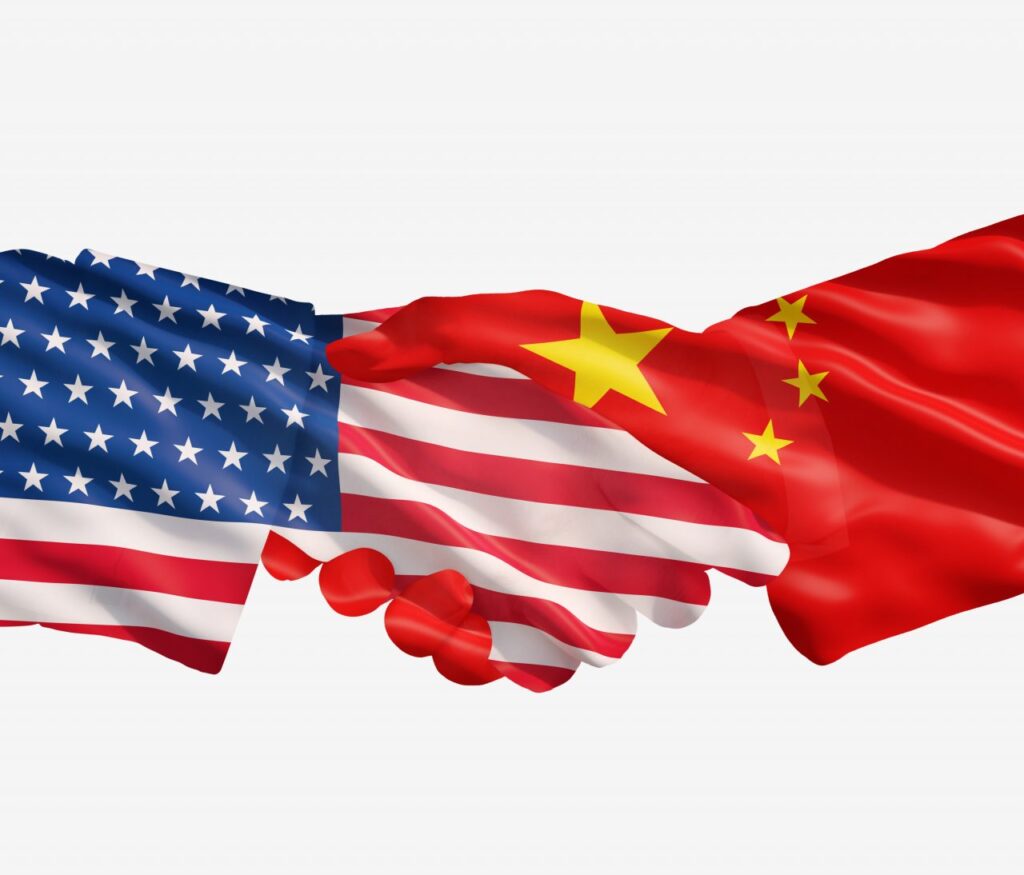
The Second Cold War is coming: It will be quite different from the one with the Soviet Union

Cooperation would be much better for all, more desirable and perfectly possible.
But some want confrontation.

Roberto Savio

February 2, 2020

It will be quite different from the Cold War with the Soviet Union…

While the Coronavirus has rightly taken much of our attention, a fundamental geopolitical realignment has been taking shape in the world, and it will become clearer in 2021. The realignment is the start of a Second Cold War, which hopefully will not become a ‘hot’ war. The new Cold War will be between China and the West, but it will be quite different from the one with the Soviet Union. The world has changed significantly since 1989, the year of the fall of the Berlin Wall.

Originally posted on Wall Street International, December 29, 2020

The gap between the two opposing camps is now much smaller. The Soviet Union, a military giant with little industrial development, had the advantage of presenting itself as the champion of an international ideology.

This was somehow also a flag of the West, which made the call for freedom and democracy its identity. Today, China harbours no real international flag, and the West is besieged by internal contradictions, from the battle of illiberal democracies such as Hungary under Viktor Orban to the nationalist, xenophobic, populist waves running in every country and the dramatic increase of social inequality and degradation of jobs, quality of life, and perspectives about the future.

All this makes the Western banner much less forceful than after the Second World War. Today, it would be probably impossible to create the United Nations or adopt the Declaration of Human Rights, because of the current fragmentation of the world.

In the meantime, China is experiencing an industrial, scientific and technological development that was never in the reach of the Soviet Union.

Finally, let us add the demographic factor: China, with its 1.4 billion people, has a very different strength from the 291 million the USSR had in 1989. Russia has now shrunk to 147 million: much less than Nigeria’s 208 million, not to mention Pakistan’s 220 million.

This new Western alliance is taking place without many noticing. NATO is no longer dealing with the North Atlantic, as by its constitution, and the mighty Soviet military power is not as significant in today’s Russian Federation.

In his unsophisticated drive to make the United States not dependent on any other country, even if a historical ally, Donald Trump took his distance from NATO. President Macron has described NATO as “brain dead”. And Europe has discovered that living under the American shield could be a delusive perception.

So, the current European Commission has embarked on a strong policy to make Europe a competitive international player, giving priority in investments to green technology, artificial intelligence, digital development, reinforcement of European patents, and curbing the unchecked power of American Big Tech.

And now that Great Britain has left the European Union, some of the divides of the 28 (now 27), like that of European defense are gone. There is even an allotment of eight billion dollars for the embryo of a European army, which of course pales in comparison with the 732 billion of the United States.

However, few noticed that in November NATO Secretary-General Jens Stoltenberg chaired a group of experts, which recommended, without opposition, that the first task of the Alliance would be to answer to the threat coming from the “systematic rivals” of Russia and China.

To include China in the centre of NATO’s agenda is such a change that it means reinventing completely the transatlantic alliance.

The old terms of the Cold War are coming back, like old barrels with new content. The final document calls for “coexistence”, the need to maintain military and technological superiority, establish new treaties for control of armaments and no to the proliferation of advanced weapons. It also underlines that there are fields for cooperation, from trade to climate control.

The Trump period has been an unexpected bonus for China. Barack Obama had made great efforts to create an Asian trade agreement – the Trans Pacific Partnership (TPP) – which would exclude China and included Australia, Brunei, Canada, Chile, Japan, Malaysia, Mexico, New Zealand, Peru, Singapore, Vietnam and the United States. It was signed on 4 February 2016.

In January 2017, Trump took the presidency and promptly withdrew from the treaty. Partly this had to do with his obsession of undoing whatever Obama had done, but it was also because of his strong belief that US should not enter any treaty because this would condition the US, which could benefit more from bilateral relations, in which the US would always be the big boy in the room. “America first” in fact meant “America alone”.

The result is that for four years China has been able to act as the champion of multilateralism and of climate control, while for the US it was simply a question of tariffs with its policy focused on Chinese exports. China has basically been able to duck the issue, and the trade balance between Beijing and Washington is more imbalanced in favor of China than ever before.

Trump engaged in some fight against 5G and Huawei, but made little secret of admiration for strongmen, from Kim Jong-un to Vladimir Putin and Xi Jinping.

And, during those four years, China has been able to continue its program of global expansion. Not only on its famous project – the Silk Road – with open connections for its trade with the world; but also on establishing the biggest trading bloc in history: the Regional Comprehensive Economic Partnership (RCEP) which destroyed any trace of the TPP, which had excluded China.

RCEP is based on China, and the United States is out. The treaty was signed in November 2020, and Trump was so obsessed with his theory about fraud in the US presidential election that he did not even comment. But the RCEP has 15 member countries: Australia, Brunei, Cambodia, China, Indonesia, Japan, Laos. Malaya, Myanmar, New Zealand, the Philippines, Singapore, South Korea, Thailand and Vietnam.

The bloc has 30 per cent of the world’s population (2.2 billion), and 30 per cent of the world’s GDP (26.2 trillion dollars). Only India, which is under the authoritarian and xenophobic leadership of Narendra Modi, remained out, complaining that it would be invaded by cheap Chinese products. But in fact, India is poising itself as the regional alternative to China, even if it is far behind in economic and technological terms. But it is a young country, with 50 per cent of its population under the age of 25 years, while in China it is only 31 per cent.

Asia is projected to become by far the most important geopolitical and economic area of the world. According to the McKinsey consulting company, in 2040 it will account for 50 percent of world trade, and 40 percent of the total consumption of goods and services.

Europe, and also the United States, are convinced that they can compete with China, and avoid it becoming a world power. But this means a total realignment of international relations, and in particular, a new alliance between Europe and the United States, and a policy, as during the Cold War, of shaping a group of countries that are willing to side with the West.

China will carry out the same policy, and we will certainly see a new group of nonaligned countries as a reaction to the conflict. For instance, in this moment, an influential group of academics and diplomats is campaigning in Latin America for the region to remain nonaligned in the coming conflict.

The December issue of Foreign Affairs, the most influential space for American debate on international issues, has come out with an essay entitled Competition with China Could Be Short and Sharp, in which it openly speaks of a possible armed conflict in the next ten years.

The authors see a strong quickening of competition in the near future and see several handicaps for China. The first, its lack of democracy, which is going to insulate China (at this moment it is doubtful that the US, with Trump as a beacon and an example, will be credible). Then, more substantially, is that China’s window of opportunity is closing fast:

“Since 2007, China’s annual economic growth has dropped by more than half, and productivity by 10 per cent. Meanwhile, debt has ballooned eightfold and is on pace to become 335 per cent by the end of the year. China has little hope of reversing those trends because it will lose 200 million working-age adults and will gain 300 million senior citizens in 30 years. Meanwhile, global anti-China sentiments have soared to levels not seen since the 1989 Tiananmen Square massacre. Nearly a dozen countries have suspended or cancelled participation in the Belt and Road Initiative (BRI) project. Another 16 countries, including eight of the world’s largest economies, have banned or severely restricted the use of Huawei products in their 5G networks. India has been turning hard against China since a clash on their shared border killed 20 soldiers in June. Japan has ramped up military spending, turned amphibious ships into aircraft carriers, and strung missile launchers along with the Ryukyu Islands, near Taiwan. The European Union has labeled China a “systemic rival”, and the United Kingdom, France and Germany are sending naval patrols to counter Beijing’s expansion in the South China Sea and the Indian Ocean. On multiple fronts, China is facing the blowback created by its own behavior”.

It is interesting to see how American intelligence is prisoner of a sense of superiority. China, thanks also to Trump, has been able to acquire at least a foothold everywhere. Of course, they do not have the 1176 military bases that Washington has all over the world, but they are working on that.

Anyhow, the Foreign Affairs essay recommends urgently increasing the defences of Taiwan which, after Hong Kong, is the last piece of China not under Beijing. And they make the point that war is quite possible in a short space of time, possibly within ten years. However, with time, “the possibility of a war might fade, as the United States shows that Beijing cannot overturn the existing order by force, and Washington gradually grows more confident in its ability to outperform a slowing China”.

It is difficult to follow the American conviction that the world is theirs and that Pax Americana is immutable.

In fact, in the 16th century, the United States did not exist and, according to most economists, China accounted for 50 per cent of the world’s GDP. Now Chinese technological development is on the verge of overtaking the US. According to the World Bank, in terms of buying power, China had already overtaken the US last year. Chinese currency and gold reserves are double those of the US.

What is true is that within ten years we will have an enormous development of Artificial Intelligence, and for the time being the US looks to have the advantage. But the latest developments in AI all point to autolearning systems. And in that sense, the quantity of data makes the difference, and China has double the number of people than the US and Europe together.

But why would China be tempted to start a war against the US? It would unsettle a system based on trade, where China is by far the biggest winner. It would be an exceedingly difficult war to win because the scale of operations would dwarf the Chinese military. And how could the US launch a war against China? Once aerial bombing is done, (unless it goes atomic, which is the sure recipe for the destruction of the planet), you have to, as military jargon has it, put boots on land. Is invading China thinkable?

So, it would be important to discourage any escalation, and not only for the next ten years. War is always a danger because human stupidity, as Einstein said, is as limitless as the universe.

The same authors of the Foreign Affairs essay recall the First World War, as something that should never have happened. But signs of an escalation continue. Last week, former NATO Secretary Anders Fogh Rasmussen gave an interview, in which he said that NATO must win the technological battle against China. And President Biden’s new National Security Advisor-designate, Jake Sullivan, has just made an appeal to the European Union, seeking solidarity with the United States and not subscribing to any commercial agreement with China.

The Second Cold War is coming…

Please help TFF remain truly independent and highly productive by contributing if you benefited from this article

Roberto Savio is a journalist, communication expert, political commentator, activist for social and climate justice and advocate of global governance. He has spent most of his career with Inter Press Service, the news agency which he founded in 1964 along with Argentine journalist Pablo Piacentini.


One Response

  1. Human stupidity is limitless as Einstein stated and former NATO secretary Anders Fogh Rasmussen is a great example of this. As JFK in his peace speech put it in 1963 we must learn, start looking inwards, seek truth and especially reexamine our own attitudes. 58 Years ago! And what have we achieved? Nothing! Because our attitudes haven’t changed thanks to the real powers within the USA. It would be refreshing if we in Europe could reinvent NATO as a true defense pact, an EU-pact stopping the incessant provocations we have experienced so far. Stop militarization of our societies and enter into real cooperation with any country with sincere intentions towards peaceful coexistence.

Related Posts

Jan Oberg May 15, 2026 Go to this Fox News page and scroll the whole way down: President Donald Trump tells the world that his meeting with President Xi Jinping yielded a lot of very concrete political and economic results – of course, only where the Chinese side, according to him, agreed with him. He does not mention the Taiwan issue, but Secretary of State, Marco Rubio, says that it did not feature prominently in their talks and that the US policy on Taiwan has not changed. Then go to China Daily – or Global Times – and you will see that for the Chinese it is framework, principles, structure of cooperation etc. that matters – all embedded in the overall idea of “constructive bilateral relationship of strategic stability.” Nowhere is any concrete agreement or deal – all that Trump refers to – mentioned. At the general level, this gives you insights into the very different social...
The MIMAC – Military-Industrial-Media-Academic Complex – drives the world’s rampant militarism and wars without end. Here is a short reflection of how it works against all interests of humanity. #5 deals with why there is no real enemy or threat images/analysis. It’s all ex-post constructions. And, btw, theTFF Peace Pulse is now on Rumble.
Jan Oberg, TFF director April 9, 2026 I was recently invited to have a good, long talk about the world – and, of course, about peace too – with Boris Malagurski on his Weight of Chains Channel on YouTube. It was a real joy and seems to have been greatly appreciated by the viewers too. Mr Malagurski and I shall of course be grateful if you share this conversation in your circles – of course, only if you like what you see and hear 😉☮️ And remember that this one – like hundreds of others with TFF Associates – can be enjoyed at our TFF Video Collection.

Recent Articles

Tony Robinson October 4, 2026 Violence is easy to recognise when someone is being beaten, shot or killed. It becomes more difficult when nobody is holding a weapon. Poverty, discrimination, exploitation and repression can restrict a human life just as effectively, although they do so in very different ways and with very different consequences. Simply adding more categories to an ever-growing list of forms of violence does not really solve the problem. The more interesting question is what all these different situations have in common and why it makes sense to describe them using the same word. Human beings do not simply react to what happens around them. They remember the past, imagine things that do not yet exist, make plans and undertake projects. Workers organise because they imagine different working conditions; people migrate because they imagine another life somewhere else; social movements emerge because people refuse to accept the...
It’s a matter of principles, courage, vision and pulling together – while the militarist world is falling apart… Peter Langille October 3, 2026 “Here, then, is the problem which we present to you, stark and dreadful and inescapable: Shall we put an end to the human race; or shall mankind renounce war?”The Bertrand Russell—Albert Einstein Manifesto, July 9, 1955 ⁕ The forecast for what’s ahead is worrisome. The sharp rise in armed conflicts over the past three years is adding to what was already the highest level in over seventy years. Genocides, which should be prevented are supported. A shared climate emergency that jeopardises survival is ignored. Diverse polls now suggest that people are war-weary, worried and interested in a more effective United Nations. And, there are viable policy options for a more secure world! Yet governments are doubling-down, betting on more war and investing heavily. If current trends persist,...
Johan Galtung 1930-2024October 2015 Published here on October 3, 2026 Let us focus on Civilization for conflict analysis and remedies. Major forms of disorder use violence; war is state organized violence. The most belligerent states are the United States of America and Israel, both with civilization roots. National Evangelism, the US Protestant Christian civilization– more national than evangelical–justifies US warfare as exceptionalism of a people chosen by God, with a manifest destiny to run the world. Orthodox Judaism justifies Israeli warfare to conquer and expand from Nile to Euphrates as a religious right and duty to the Eternal One. The third most belligerent country, the UK, no longer believes it is God-chosen but chosen by the USA; not quite the same but something. But the root cause of global disorder lies in the Occident–with Islam–seeing itself as the single, universal civilization valid for all at all times, all others being...

TFF on Substack

Discover and subscribe to more peace materials on TFF Substack

Most Popular

Tony Robinson October 4, 2026 Violence is easy to recognise when someone is being beaten, shot or killed. It becomes more difficult when nobody is holding a weapon. Poverty, discrimination, exploitation and repression can restrict a human life just as effectively, although they do so in very different ways and with very different consequences. Simply adding more categories to an ever-growing list of forms of violence does not really solve the problem. The more interesting question is what all these different situations have in common and why it makes sense to describe them using the same word. Human beings do not simply react to what happens around them. They remember the past, imagine things that do not yet exist, make plans and undertake projects. Workers organise because they imagine different working conditions; people migrate because they imagine another life somewhere else; social movements emerge because people refuse to accept the...
It’s a matter of principles, courage, vision and pulling together – while the militarist world is falling apart… Peter Langille October 3, 2026 “Here, then, is the problem which we present to you, stark and dreadful and inescapable: Shall we put an end to the human race; or shall mankind renounce war?”The Bertrand Russell—Albert Einstein Manifesto, July 9, 1955 ⁕ The forecast for what’s ahead is worrisome. The sharp rise in armed conflicts over the past three years is adding to what was already the highest level in over seventy years. Genocides, which should be prevented are supported. A shared climate emergency that jeopardises survival is ignored. Diverse polls now suggest that people are war-weary, worried and interested in a more effective United Nations. And, there are viable policy options for a more secure world! Yet governments are doubling-down, betting on more war and investing heavily. If current trends persist,...
Johan Galtung 1930-2024October 2015 Published here on October 3, 2026 Let us focus on Civilization for conflict analysis and remedies. Major forms of disorder use violence; war is state organized violence. The most belligerent states are the United States of America and Israel, both with civilization roots. National Evangelism, the US Protestant Christian civilization– more national than evangelical–justifies US warfare as exceptionalism of a people chosen by God, with a manifest destiny to run the world. Orthodox Judaism justifies Israeli warfare to conquer and expand from Nile to Euphrates as a religious right and duty to the Eternal One. The third most belligerent country, the UK, no longer believes it is God-chosen but chosen by the USA; not quite the same but something. But the root cause of global disorder lies in the Occident–with Islam–seeing itself as the single, universal civilization valid for all at all times, all others being...
Read More
Living-Peace-Sign-Budapest-copy
Tony Robinson October 4, 2026 Violence is easy to recognise when someone is being beaten, shot or killed. It becomes more difficult when nobody is holding a weapon. Poverty, discrimination, exploitation and repression can restrict a human life just as effectively, although they do so in very different ways and with very different consequences. Simply adding more categories to an ever-growing list of forms of violence does not really solve the problem. The more interesting question is what all these different situations have in common and why it makes sense to describe them using the same word. Human beings do not simply react to what happens around them. They remember the past, imagine things that do not yet exist, make plans and undertake projects. Workers organise because they imagine different working conditions; people migrate because they imagine another life somewhere else; social movements emerge because people refuse to accept the...
b54a1f10-8c65-4f0b-9dd5-4abc0a7d04cc_2659x2659
It’s a matter of principles, courage, vision and pulling together – while the militarist world is falling apart… Peter Langille October 3, 2026 “Here, then, is the problem which we present to you, stark and dreadful and inescapable: Shall we put an end to the human race; or shall mankind renounce war?”The Bertrand Russell—Albert Einstein Manifesto, July 9, 1955 ⁕ The forecast for what’s ahead is worrisome. The sharp rise in armed conflicts over the past three years is adding to what was already the highest level in over seventy years. Genocides, which should be prevented are supported. A shared climate emergency that jeopardises survival is ignored. Diverse polls now suggest that people are war-weary, worried and interested in a more effective United Nations. And, there are viable policy options for a more secure world! Yet governments are doubling-down, betting on more war and investing heavily. If current trends persist,...
010
Johan Galtung 1930-2024October 2015 Published here on October 3, 2026 Let us focus on Civilization for conflict analysis and remedies. Major forms of disorder use violence; war is state organized violence. The most belligerent states are the United States of America and Israel, both with civilization roots. National Evangelism, the US Protestant Christian civilization– more national than evangelical–justifies US warfare as exceptionalism of a people chosen by God, with a manifest destiny to run the world. Orthodox Judaism justifies Israeli warfare to conquer and expand from Nile to Euphrates as a religious right and duty to the Eternal One. The third most belligerent country, the UK, no longer believes it is God-chosen but chosen by the USA; not quite the same but something. But the root cause of global disorder lies in the Occident–with Islam–seeing itself as the single, universal civilization valid for all at all times, all others being...
Screenshot 2026-10-02 011738
Jan ObergPhD, director, The Transnational Foundation for Peace and Future Research, TFFLund, Sweden October 2, 2026 This is my full original manuscript. The Chinese Academy of Social Science, CASS, makes two publications out if it. 1. China’s Five-year plan emphasized the capabilities of basic research and original innovation. It is regarded as the goal of the future social development, which, as required, should be significantly enhanced. Can you comment on the importance of original innovation in research and academic study? I believe it is easier to define “original innovation” in the natural sciences than in social sciences. The breaking points of what constitutes something new, or innovative, are not quite as sharp in the latter. But in both fields it is about opening up something that was closed, unseen, unexplored before – making manifest what was earlier latent. Innovations come in many forms and shapes – naming something that was not...
arctic-circle-map
The agreement is catastrophic both because of what it says and what it doesn’t mention. It reduces further the major asset of security policies: Freedom of action. Jan Oberg TFF director September 25, 2026 A couple of hours before the agreement was signed on September 22, 2026, I published the following 13 hypotheses about what it would most likely contain on TFF Substack (in English). I was wrong on only the first point. Contrary to what Trump had written on his Truth Social platform, it does not appear to come into force immediately. In fact, it turned out to be worse than even I had anticipated. After these hypotheses now come a number of reflections in light of what the agreement actually contains, and does not contain, as well as the way in which it has generally been presented by major media outlets and by the public-service broadcaster DR. My...
girl-5894831_1280
Below are TFF-related media mentions, comments, videos and social media posts published elsewhere but not on this homepage. We happen to catch and list only a fraction. Regarding video comments and debates, we recommend that you go to the TFF Video Channel on Substack where many of them are reproduced. Jan Oberg is a contributor to China Daily – 52 million daily clicks – and Global Times, CGTN and CCTV (the national television), China Investment, Xinhua News Agency and several others. Articles and videos on these media very often multiply into countless Chinese (and Western media) that re-post them from these main media. Thanks to The China Academy, his analyses, interviews and comments are frequently posted on YouTube channels such as Thinkers Forum and Wave Media. These videos are often re-posted on Bilibili (China’s YouTube), the China Content Center on TikTok, and on the Chinese edition of TikTok, Douyin.com. This means reaching hundreds of millions of viewers worldwide over a year. While there are too many to catch on all these...



