
Keeping the Empire Running: Britain’s Global Military Footprint

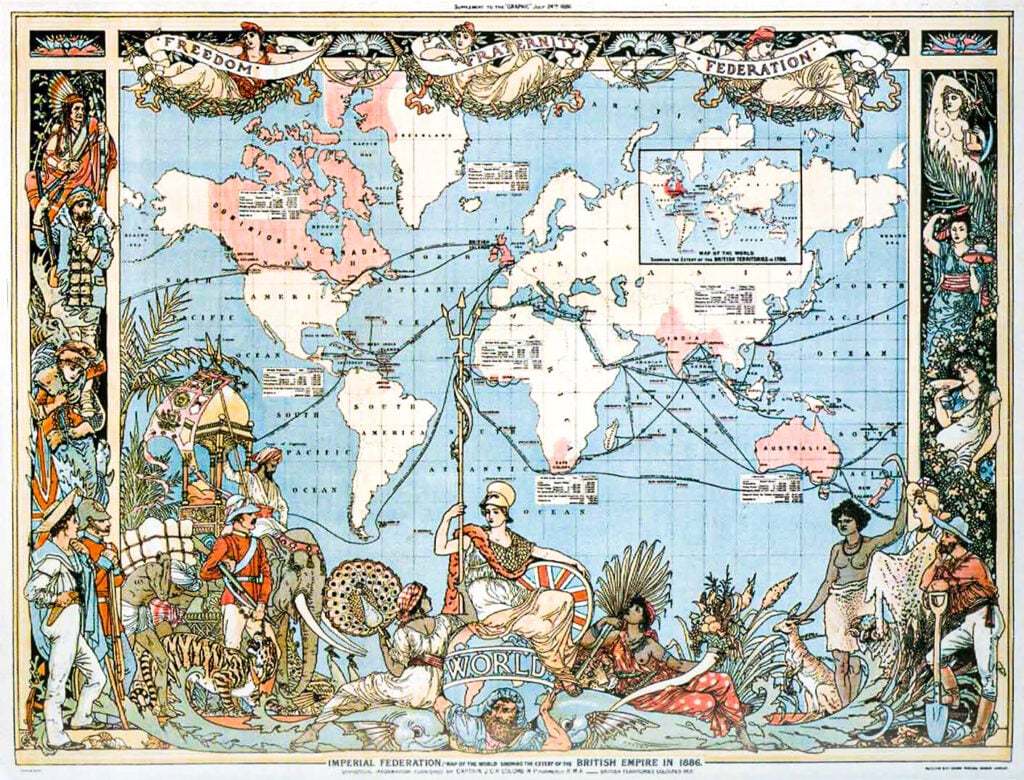
The British Empire in 1886

Britain leaves the EU on December 31, 2020. We mark this historical event by looking at its global, imperial military footprint and the mind-boggling waste of scarce resources its prime minister is proud of standing behind in times that are already extremely hard for the citizens.

A few nostalgic types still believe that the Union Jack continues to flutter to sighs and reverence over outposts of the world, from the tropics to the desert. They would be right, if only to a point. Britain, it turns out, has a rather expansive global reach when it comes to bases, military installations and testing sites. While not having the obese heft and lumbering brawn of the United States, it makes a good go of it. Globally, the UK military has a presence in 145 sites in 42 countries.

Originally posted by Off Guardian on November 29, 2020

Such figures tally with Ian Cobain’s prickly observation in The History Thieves: that the British were the only people “perpetually at war.”

Phil Miller’s rich overview of Britain’s military footprint for Declassified UK shows it to be heavy.

The size of the global military presence is far larger than previously thought and is likely to mean that the UK has the second largest military network in the world, after the United States.”

The UK military, for instance, has a presence in five countries in the Asia-Pacific: naval facilities in Singapore; garrisons in Brunei, drone testing facilities in Australia; three facilities in Nepal; a quick reaction force in Afghanistan. Cyprus remains a favourite with 17 military installations. In Africa, British personnel can be found in Kenya, Somalia, Djibouti, Malawi, Sierra Leone, Nigeria and Mali. Then come the ever dubious ties to Arab monarchies.

The nature of having such bases is to be kind to your host, despite him being theocratic, barking mad, or an old fashioned despot with fetishes. Despite the often silly pronouncements by British policymakers that they take issue with authoritarians, exceptions numerous in number abound.

The UK has never had a problem with authoritarians it can work with or despots it can coddle. A closer look at such relations usually reveal the same ingredients: capital, commerce, perceptions of military necessity. The approach to Oman, a state marked by absolute rule, is a case in point.

Click and subscribe so you
do not miss anything from us

Since 1798, Britain has had a hand in ensuring the success, and the survivability, of the House of Al Said. On September 12, UK Defence Secretary Ben Wallace announced that a further £23.8 million would go to enhancing the British Joint Logistics Support Base at Duqm port, thereby tripling “the size of the existing UK base and help facilitate Royal Navy deployments to the Indian Ocean”. The Ministry of Defence also went so far as to describe a “renewal” of a “hugely valuable relationship,” despite the signing of a new Joint Defence Agreement in February 2019.

The agreement had been one of the swan song acts of the ailing Sultan Qaboos bin Said, whose passing this year was genuinely mourned in British political circles. Prime Minister Boris Johnson called him “an exceptionally wise and respected leader who will be missed enormously.” Papers of record wrote in praise of a reformer and a developer. “The longest serving Arab ruler,” observed a sycophantic column in The Guardian, “Qaboos was an absolute monarch, albeit a relatively benevolent and popular one.”

The same Sultan, it should be said, had little fondness for freedom of expression, assembly and association, encouraged the arrests and harassment of government critics and condoned sex discrimination. But he was of the “one of us” labels: trained at the Royal Military Academy Sandhurst, an unwavering Anglophile, installed on the throne by Britain in the 1970 palace coup during the all but forgotten Dhofar Rebellion.

“Strategically,” Cobain reminds us, “the Dhofar war was one of the most important conflicts of the 20th century, as the victors could expect to control the Strait of Hormuz and the flow of oil.” The British made sure their man won.

Public mention of greater British military involvement in foreign theatres can be found, though they rarely make front page acts. The business of projecting such power, especially in the Britannic model, should be careful, considered, even gnomic. Britain, for instance, is rallying to the US-led call to contain the Yellow Peril in the Asia Pacific, a nice reminder to Beijing that old imperial misdeeds should never be a bar to repetition.

The head of the British Army, General Sir Mark Carleton-Smith, spoke in September about there being “a market for a more persistent presence from the British Army (in Asia). It’s an area that saw a much more consistent Army presence in the Eighties, but with 9/11 we naturally receded from it.” The time had come “to redress that imbalance”.

The UK Chief of Defence Staff, General Sir Nick Carter, prefers to be more enigmatic about the “future of Global Britain.” To deal with an “ever more complex and dynamic strategic context,” he suggests the “Integrated Operating Concept”. Britain had to:

… “compete below the threshold of war in order to deter war, and to prevent one’s adversaries from achieving their objectives in fait accompli strategies.”

Gone are the old thuggeries of imperial snatch and grab; evident are matters of flexibility in terms of competition. “Competing involves a campaign posture that includes continuous operating on our terms and in places of our choosing.”

This entails a thought process involving “several dimensions to escalate and deescalate up and down multiple ladders – as if it were a spider’s web.” The general attempts to illustrate this gibberish with the following example:

One might actively constrain in the cyber domain to protect critical national infrastructure in the maritime Domain.”

In 2017, there were already more than just murmurings from Johnson, then Foreign Secretary, and Defence Secretary Michael Fallon, that a greater British presence in the Asia-Pacific was warranted. Fallon was keen to stress the reasons for deeper involvement, listing them to a group of Australian journalists.

The tensions have been rising in the region, not just from the tests by North Korea but also escalating tension in the South China Sea with the building program that’s gone there on the islands and the need to keep those routes open.”

With such chatter about the China threat you could be forgiven for believing that British presence in the Asia-Pacific was minimal. But that would ignore, for instance, the naval logistics base at Singapore’s Sembawang Wharf, permanently staffed by eight British military personnel with an eye on the busy Malacca Strait. A more substantial presence can also be found in the Sultanate of Brunei, comprising an infantry battalion of Gurkhas and an Army Air Corps Flight of Bell 212 helicopters.

The MOD is particularly keen on the surroundings, as they offer “tropical climate and terrain … well suited to jungle training”.

Over the next four years, the UK military can expect to get an extra £16.5 billion – a 10% increase in funding and a fond salute to militarists. “I have decided that the era of cutting our defence budget must end, and ends now,” declared Johnson. “Our plans will safeguard hundreds of thousands of jobs in the defence industry, protecting livelihoods across the UK and keeping the British people safe.”

The prime minister was hoping to make that announcement accompanied by the “Integrated Defence and Security Review” long championed by his now-departed chief special adviser, Dominic Cummings. Cummings might have been ejected from the gladiatorial arena of Downing Street politics, but the ideas in the Review are unlikely to buck old imperial trends. At the very least, there will be a promise of more military bases to reflect a posture General Carter describes rather obscurely as “engaged and forward deployed”.

Related Posts

OK, Trump did not get it. But he got a full endorsement of a possible future US regime change in Venezuela. And that is what Ms Machado has advocated. Jan Oberg October 10, 2025 On October 10, 2025, the Norwegian Nobel Committee awarded its Peace Prize to Venezuelan opposition figure María Corina Machado. The citation praised her “tireless work promoting democratic rights.” But Ms Machado has openly called for U.S. military intervention in Venezuela, stating on CBS: “The only way to stop the suppression is by force—U.S. force.” She or her party has received funding from the National Endowment for Democracy (NED), a U.S. government-backed body known as a CIA front organisation and for supporting regime-change operations worldwide. And in 2018, she sent a letter to Israeli Prime Minister Benjamin Netanyahu, asking him to use “force and influence” to help dismantle Venezuela’s government—citing alleged ties to terrorism, Iran and narcotrafficking....
Officially, the drones were not identified. By simply thinking critically – which journalists and selected experts no longer do – there may be a good reason for that. And this article will never be mentioned in Denmark… Jan Oberg October 3, 2025 Drones over Denmark. No damage. No trace. No answers. Yet the headlines scream “Russian threat,” and Prime Minister Mette Frederiksen speaks with a certainty that defies logic: “We don’t know they were Russian—but we know Russia is the biggest threat to Europe.” It could be nobody else – unless you make an interest analysis which I did two days ago. This is not security policy. It’s theatre. And the audience is being played. Let’s rewind. These drones—unphotographed, untracked, unclaimed—appear and vanish like ghosts. Airports shut down. Panic spreads. Military budgets swell. And the narrative hardens: Russia is behind it. But what if that’s not just wrong but deliberately...
Drones over Nordic airports. No damage. No trace. No answers. Most assume Russia—but what if that’s not so? Why is there so much we are not told? This article explores the strategic ambiguity behind recent drone incursions and asks: Who else might benefit from sending drones into NATO airspace? From Ukraine’s surprising drone supremacy to Russia’s possible signalling, the silence itself may be the loudest message. These are the kinds of questions decent, intelligent investigative journalists and commentators could easily research. Why don’t they? Jan Oberg September 29, 2025 Did you, dear reader, know or think of this? That the most powerful weapon in today’s conflicts might be the one that leaves no trace – and no answers. Just enough fear to justify the next move? Recently, drones have repeatedly appeared over Nordic airports and near some military facilities. They cause no damage – for which reason the designation “hybrid attack” is...

Recent Articles

Tony Robinson October 4, 2026 Violence is easy to recognise when someone is being beaten, shot or killed. It becomes more difficult when nobody is holding a weapon. Poverty, discrimination, exploitation and repression can restrict a human life just as effectively, although they do so in very different ways and with very different consequences. Simply adding more categories to an ever-growing list of forms of violence does not really solve the problem. The more interesting question is what all these different situations have in common and why it makes sense to describe them using the same word. Human beings do not simply react to what happens around them. They remember the past, imagine things that do not yet exist, make plans and undertake projects. Workers organise because they imagine different working conditions; people migrate because they imagine another life somewhere else; social movements emerge because people refuse to accept the...
It’s a matter of principles, courage, vision and pulling together – while the militarist world is falling apart… Peter Langille October 3, 2026 “Here, then, is the problem which we present to you, stark and dreadful and inescapable: Shall we put an end to the human race; or shall mankind renounce war?”The Bertrand Russell—Albert Einstein Manifesto, July 9, 1955 ⁕ The forecast for what’s ahead is worrisome. The sharp rise in armed conflicts over the past three years is adding to what was already the highest level in over seventy years. Genocides, which should be prevented are supported. A shared climate emergency that jeopardises survival is ignored. Diverse polls now suggest that people are war-weary, worried and interested in a more effective United Nations. And, there are viable policy options for a more secure world! Yet governments are doubling-down, betting on more war and investing heavily. If current trends persist,...
Johan Galtung 1930-2024October 2015 Published here on October 3, 2026 Let us focus on Civilization for conflict analysis and remedies. Major forms of disorder use violence; war is state organized violence. The most belligerent states are the United States of America and Israel, both with civilization roots. National Evangelism, the US Protestant Christian civilization– more national than evangelical–justifies US warfare as exceptionalism of a people chosen by God, with a manifest destiny to run the world. Orthodox Judaism justifies Israeli warfare to conquer and expand from Nile to Euphrates as a religious right and duty to the Eternal One. The third most belligerent country, the UK, no longer believes it is God-chosen but chosen by the USA; not quite the same but something. But the root cause of global disorder lies in the Occident–with Islam–seeing itself as the single, universal civilization valid for all at all times, all others being...

TFF on Substack

Discover and subscribe to more peace materials on TFF Substack

Most Popular

Tony Robinson October 4, 2026 Violence is easy to recognise when someone is being beaten, shot or killed. It becomes more difficult when nobody is holding a weapon. Poverty, discrimination, exploitation and repression can restrict a human life just as effectively, although they do so in very different ways and with very different consequences. Simply adding more categories to an ever-growing list of forms of violence does not really solve the problem. The more interesting question is what all these different situations have in common and why it makes sense to describe them using the same word. Human beings do not simply react to what happens around them. They remember the past, imagine things that do not yet exist, make plans and undertake projects. Workers organise because they imagine different working conditions; people migrate because they imagine another life somewhere else; social movements emerge because people refuse to accept the...
It’s a matter of principles, courage, vision and pulling together – while the militarist world is falling apart… Peter Langille October 3, 2026 “Here, then, is the problem which we present to you, stark and dreadful and inescapable: Shall we put an end to the human race; or shall mankind renounce war?”The Bertrand Russell—Albert Einstein Manifesto, July 9, 1955 ⁕ The forecast for what’s ahead is worrisome. The sharp rise in armed conflicts over the past three years is adding to what was already the highest level in over seventy years. Genocides, which should be prevented are supported. A shared climate emergency that jeopardises survival is ignored. Diverse polls now suggest that people are war-weary, worried and interested in a more effective United Nations. And, there are viable policy options for a more secure world! Yet governments are doubling-down, betting on more war and investing heavily. If current trends persist,...
Johan Galtung 1930-2024October 2015 Published here on October 3, 2026 Let us focus on Civilization for conflict analysis and remedies. Major forms of disorder use violence; war is state organized violence. The most belligerent states are the United States of America and Israel, both with civilization roots. National Evangelism, the US Protestant Christian civilization– more national than evangelical–justifies US warfare as exceptionalism of a people chosen by God, with a manifest destiny to run the world. Orthodox Judaism justifies Israeli warfare to conquer and expand from Nile to Euphrates as a religious right and duty to the Eternal One. The third most belligerent country, the UK, no longer believes it is God-chosen but chosen by the USA; not quite the same but something. But the root cause of global disorder lies in the Occident–with Islam–seeing itself as the single, universal civilization valid for all at all times, all others being...
Read More
Living-Peace-Sign-Budapest-copy
Tony Robinson October 4, 2026 Violence is easy to recognise when someone is being beaten, shot or killed. It becomes more difficult when nobody is holding a weapon. Poverty, discrimination, exploitation and repression can restrict a human life just as effectively, although they do so in very different ways and with very different consequences. Simply adding more categories to an ever-growing list of forms of violence does not really solve the problem. The more interesting question is what all these different situations have in common and why it makes sense to describe them using the same word. Human beings do not simply react to what happens around them. They remember the past, imagine things that do not yet exist, make plans and undertake projects. Workers organise because they imagine different working conditions; people migrate because they imagine another life somewhere else; social movements emerge because people refuse to accept the...
b54a1f10-8c65-4f0b-9dd5-4abc0a7d04cc_2659x2659
It’s a matter of principles, courage, vision and pulling together – while the militarist world is falling apart… Peter Langille October 3, 2026 “Here, then, is the problem which we present to you, stark and dreadful and inescapable: Shall we put an end to the human race; or shall mankind renounce war?”The Bertrand Russell—Albert Einstein Manifesto, July 9, 1955 ⁕ The forecast for what’s ahead is worrisome. The sharp rise in armed conflicts over the past three years is adding to what was already the highest level in over seventy years. Genocides, which should be prevented are supported. A shared climate emergency that jeopardises survival is ignored. Diverse polls now suggest that people are war-weary, worried and interested in a more effective United Nations. And, there are viable policy options for a more secure world! Yet governments are doubling-down, betting on more war and investing heavily. If current trends persist,...
010
Johan Galtung 1930-2024October 2015 Published here on October 3, 2026 Let us focus on Civilization for conflict analysis and remedies. Major forms of disorder use violence; war is state organized violence. The most belligerent states are the United States of America and Israel, both with civilization roots. National Evangelism, the US Protestant Christian civilization– more national than evangelical–justifies US warfare as exceptionalism of a people chosen by God, with a manifest destiny to run the world. Orthodox Judaism justifies Israeli warfare to conquer and expand from Nile to Euphrates as a religious right and duty to the Eternal One. The third most belligerent country, the UK, no longer believes it is God-chosen but chosen by the USA; not quite the same but something. But the root cause of global disorder lies in the Occident–with Islam–seeing itself as the single, universal civilization valid for all at all times, all others being...
Screenshot 2026-10-02 011738
Jan ObergPhD, director, The Transnational Foundation for Peace and Future Research, TFFLund, Sweden October 2, 2026 This is my full original manuscript. The Chinese Academy of Social Science, CASS, makes two publications out if it. 1. China’s Five-year plan emphasized the capabilities of basic research and original innovation. It is regarded as the goal of the future social development, which, as required, should be significantly enhanced. Can you comment on the importance of original innovation in research and academic study? I believe it is easier to define “original innovation” in the natural sciences than in social sciences. The breaking points of what constitutes something new, or innovative, are not quite as sharp in the latter. But in both fields it is about opening up something that was closed, unseen, unexplored before – making manifest what was earlier latent. Innovations come in many forms and shapes – naming something that was not...
arctic-circle-map
The agreement is catastrophic both because of what it says and what it doesn’t mention. It reduces further the major asset of security policies: Freedom of action. Jan Oberg TFF director September 25, 2026 A couple of hours before the agreement was signed on September 22, 2026, I published the following 13 hypotheses about what it would most likely contain on TFF Substack (in English). I was wrong on only the first point. Contrary to what Trump had written on his Truth Social platform, it does not appear to come into force immediately. In fact, it turned out to be worse than even I had anticipated. After these hypotheses now come a number of reflections in light of what the agreement actually contains, and does not contain, as well as the way in which it has generally been presented by major media outlets and by the public-service broadcaster DR. My...
girl-5894831_1280
Below are TFF-related media mentions, comments, videos and social media posts published elsewhere but not on this homepage. We happen to catch and list only a fraction. Regarding video comments and debates, we recommend that you go to the TFF Video Channel on Substack where many of them are reproduced. Jan Oberg is a contributor to China Daily – 52 million daily clicks – and Global Times, CGTN and CCTV (the national television), China Investment, Xinhua News Agency and several others. Articles and videos on these media very often multiply into countless Chinese (and Western media) that re-post them from these main media. Thanks to The China Academy, his analyses, interviews and comments are frequently posted on YouTube channels such as Thinkers Forum and Wave Media. These videos are often re-posted on Bilibili (China’s YouTube), the China Content Center on TikTok, and on the Chinese edition of TikTok, Douyin.com. This means reaching hundreds of millions of viewers worldwide over a year. While there are too many to catch on all these...





