
The world needs to understand what is wrong with America

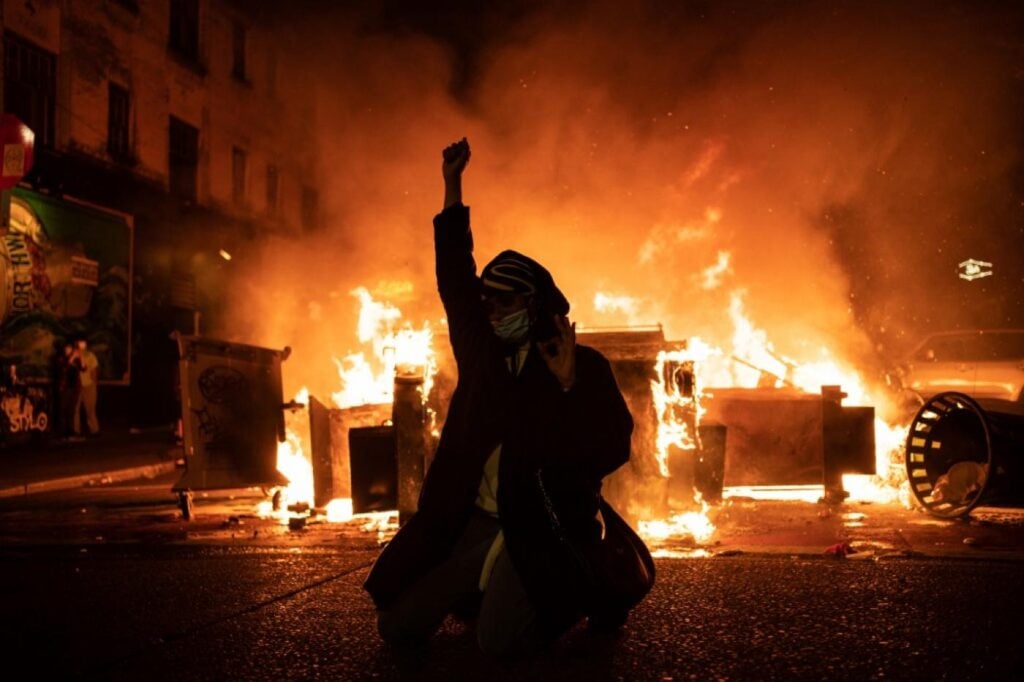
A demonstrator raises a fist after clashes with police in the US city of Seattle on 8 June (AFP)

As calls for racial justice reverberate across the country, the field of American Studies requires a radical rethink – namely, the active engagement of people around the globe at the receiving end of US militarism. 

By Hamid Dabashi

September 15, 2020

“The majority lives in the perpetual practice of self-applause, and there are certain truths which the Americans can only learn from strangers or from experience.” 

– Alexis de Tocqueville, Democracy in America

“Americans are the unhappiest they’ve been in 50 years,” according to recent polls. “It’s been a rough year for the American psyche.”   

The deeply troubling presidency of Donald Trump has led to severe consequences of the coronavirus pandemic in the US, where the per-capita mortality rate is among the highest in the world, exacerbated by claustrophobic despair over lockdowns and social distancing, alongside a massive uprising against racism and police brutality.

Americans are at a loss.   

Originally published at middleeasteye.net

Dysfunctional empire

Calls for racial justice reverberate from one end of the US to the other. Police brutality against African Americans has been caught on tape; statues of racist Confederate generals, and even US presidents, are coming down. The massive uprising in the aftermath of George Floyd’s murder in May announced Black Lives Matter as a new and unprecedented phase in contemporary US history.  

It is too early to tell where, if anywhere, this uprising will lead, and whether it will result in any enduring changes. “Police reform” and electoral politics are the two immediate lullabies that seek to lull and derail this uprising.

Barack and Michelle Obama are leading the way to compromise and stall the momentum of the Black Lives Matter uprising, by repeating the centrist mantra of “protest peacefully and vote in all elections”, thus implying the protests are not peaceful, and there are not far more radical prospects of change than just voting for the Democratic party’s presidential candidate Joe Biden. 

On their own, many Americans are unable to fathom the depth of the calamity that they face – and which, in turn, they have imposed upon the larger world. As the fragile republican centre of a dysfunctional empire, what happens in the US happens to the rest of the world.

Critical lenses from around the world are therefore essential in understanding what is happening in the US. That necessity creates its own epistemological challenges and opportunities. 

Orientalism and post-Orientalism

For more than two centuries of modern history, the world has been at the receiving end of the “Western gaze” – being looked at, examined, ethnicised, anthropologised, the circumference of their skulls measured, put into zoos and museums to be studied by the white masters who roamed the globe and conquered and colonised the earth.    

In his seminal book, Orientalism, Edward Said laser-beamed in on a particular episode in the history of this mode of colonial knowledge production that called itself “Orientalism” – a mode of knowledge at the service of colonial domination. Said’s text inaugurated an entire field of postcolonial studies to reverse that colonial gaze. 

In my Post-Orientalism, I took Said’s insights and moved beyond the structural limitations of one particular episode of colonial knowledge production, examining the relationship between knowledge and power into the later periods of area studies and think tanks.

I examined their mode of “disposable knowledge”, as in the preparatory stages of the invasion and occupation of Afghanistan in 2001 and Iraq in 2003.        

By and large, Eurocentric modes of knowledge production have remained operative even after Said’s seminal text, and disciplines such as anthropology have continued to extend their deeply racist epistemologies to the farthest corners of the earth.   

Vantage point of white Americans

The field of American Studies is one such area, which has been by and large the domain of Americans themselves, though mostly from the vantage point of white people – until more recently, when Native Americans, African Americans, Latinx Americans and other immigrant communities began to reverse that internalised gaze, altering the way we read America.  

But today, the field requires an even more radical reversal – namely, the active engagement of non-Americans, or more precisely those people around the globe at the receiving end of US militarism.  
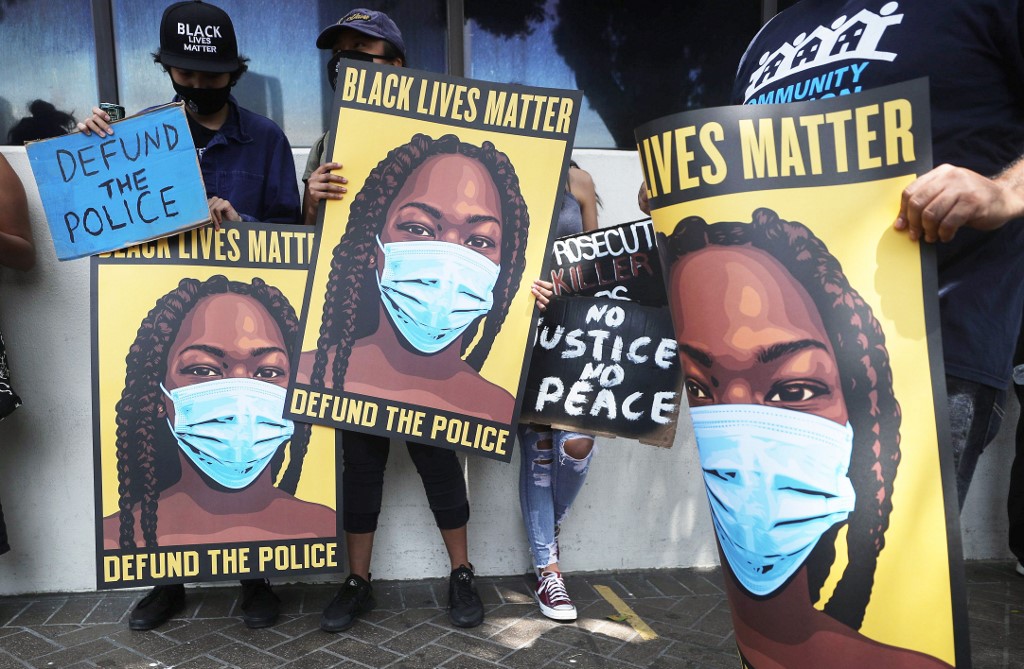
Black Lives Matter supporters protest in Los Angeles on 23 June (AFP)

In his Representations of the Intellectual, Said theorised that the empowering position of exile, the refugee, the expatriate – all whether factual or figurative – were definitive to the critical stance of intellectuals, whether native or foreign to a land.  

The theoretical basis of this crucial text should be the cornerstone of a new generation of American Studies that links the progressive forces among Native, Black and Hispanic American Studies to the larger non-American community of scholars, critical thinkers, artists, filmmakers, etc.  

Predicated on a critical reappraisal of Said’s insights, the field of American Studies must go global, liberated from a country where Betsy DeVos, the sister of the mercenary merchant of death, Erik Prince, is the secretary of education.

‘A human problem’

The globalisation of American empire has put the world at the receiving end of American violence. But the world does not have a say in whom US citizens choose as their president. Black and other racialised communities in the US are as much at the mercy of the militarised and racist police as the world is at the mercy of the US military.  

The roots of racism against African Americans in the US extends to the ruling white supremacist attitude towards Africa – “the shithole countries”, as Trump calls them – and by extension to Asia and Latin America. 

Recently, lawyers representing the Floyd family made an appeal to the United Nations Human Rights Council, as they should. The origin of this goes back to when Malcolm X argued that the case of the ruling racism against Black Americans must be taken to the UN. 

The problem of the Black person in the US, he argued, “is beyond America’s ability to solve. It is a human problem, not an American problem, or a Negro problem, and as a human problem or a world problem, we feel that it should be taken out of the jurisdiction of the United States government and the United States courts and taken into the United Nations.”   

Echoing Malcolm X’s thoughts, today, African nations correctly seek a UN investigation into the manner in which the ruling racism in the US is the principal source of racist violence against its own citizens.  

Electoral seesaw

This is not to ignore that the UN is a morally compromised space, a toothless tiger that could investigate the Jamal Khashoggi murder to identify the main culprit, but had no way of bringing him to justice.  

But still, one crucial consequence of this move is to put the entire structure of vicious racism, definitive of the US historical experience, on trial beyond its own compromised jurisdiction for the whole world to see.  

Bringing the endemic and enduring structure of US racism to the world’s attention is a crucial framework towards creating both a forum and an entire field of American Studies liberated from the compromising institutions of US-based scholarship and critical thinking by people trapped inside the useless seesaw electoral politics of Republicans versus Democrats – the Pepsi and Coke choices that Americans are free to make, both equally dangerous to their health, every two to four years. 

Originally published at middleeasteye.net

About the Author

Hamid Dabashi is Hagop Kevorkian Professor of Iranian Studies and Comparative Literature at Columbia University in the City of New York. His latest books include Reversing the Colonial Gaze: Persian Travelers Abroad (Cambridge University Press, 2020), and The Emperor is Naked: On the Inevitable Demise of the Nation-State (Zed, 2020).
His forthcoming book, On Edward Said: Remembrance of Things Past, is scheduled to be released by Haymarket Books later this year.
Here is his virtual home.

If you appreciate this article, please show it here. Thanks!

Related Posts

The MIMAC – Military-Industrial-Media-Academic Complex – drives the world’s rampant militarism and wars without end. Here is a short reflection of how it works against all interests of humanity. #5 deals with why there is no real enemy or threat images/analysis. It’s all ex-post constructions. And, btw, theTFF Peace Pulse is now on Rumble.
Jan Oberg, TFF director April 9, 2026 I was recently invited to have a good, long talk about the world – and, of course, about peace too – with Boris Malagurski on his Weight of Chains Channel on YouTube. It was a real joy and seems to have been greatly appreciated by the viewers too. Mr Malagurski and I shall of course be grateful if you share this conversation in your circles – of course, only if you like what you see and hear 😉☮️ And remember that this one – like hundreds of others with TFF Associates – can be enjoyed at our TFF Video Collection.
A friendly quarrel while we agree that the US sanctions are a weapon of mass destruction and kill more people than wars do. And that we must talk much more about sanctions than we have so far. Jan Oberg, TFF director March 16, 2026 John Mearsheimer recently stated that U.S. sanctions murdered around 38 million people between 1971 and 2021 – see the video below. It is a dramatic figure, and it has spread quickly because it captures, in one sentence, the enormous human cost of modern sanctions. I share his concern about the destructive effects of economic coercion. But the specific number he cites — and the way he attributes it — deserves a friendly academic clarification. The figure comes from a 2023 Lancet Global Health article estimating the mortality effects of unilateral U.S. and EU sanctions over the past half‑century. This is the first point where Mearsheimer’s shorthand diverges from the text: the study...

Recent Articles

Tony Robinson October 4, 2026 Violence is easy to recognise when someone is being beaten, shot or killed. It becomes more difficult when nobody is holding a weapon. Poverty, discrimination, exploitation and repression can restrict a human life just as effectively, although they do so in very different ways and with very different consequences. Simply adding more categories to an ever-growing list of forms of violence does not really solve the problem. The more interesting question is what all these different situations have in common and why it makes sense to describe them using the same word. Human beings do not simply react to what happens around them. They remember the past, imagine things that do not yet exist, make plans and undertake projects. Workers organise because they imagine different working conditions; people migrate because they imagine another life somewhere else; social movements emerge because people refuse to accept the...
It’s a matter of principles, courage, vision and pulling together – while the militarist world is falling apart… Peter Langille October 3, 2026 “Here, then, is the problem which we present to you, stark and dreadful and inescapable: Shall we put an end to the human race; or shall mankind renounce war?”The Bertrand Russell—Albert Einstein Manifesto, July 9, 1955 ⁕ The forecast for what’s ahead is worrisome. The sharp rise in armed conflicts over the past three years is adding to what was already the highest level in over seventy years. Genocides, which should be prevented are supported. A shared climate emergency that jeopardises survival is ignored. Diverse polls now suggest that people are war-weary, worried and interested in a more effective United Nations. And, there are viable policy options for a more secure world! Yet governments are doubling-down, betting on more war and investing heavily. If current trends persist,...
Johan Galtung 1930-2024October 2015 Published here on October 3, 2026 Let us focus on Civilization for conflict analysis and remedies. Major forms of disorder use violence; war is state organized violence. The most belligerent states are the United States of America and Israel, both with civilization roots. National Evangelism, the US Protestant Christian civilization– more national than evangelical–justifies US warfare as exceptionalism of a people chosen by God, with a manifest destiny to run the world. Orthodox Judaism justifies Israeli warfare to conquer and expand from Nile to Euphrates as a religious right and duty to the Eternal One. The third most belligerent country, the UK, no longer believes it is God-chosen but chosen by the USA; not quite the same but something. But the root cause of global disorder lies in the Occident–with Islam–seeing itself as the single, universal civilization valid for all at all times, all others being...

TFF on Substack

Discover and subscribe to more peace materials on TFF Substack

Most Popular

Tony Robinson October 4, 2026 Violence is easy to recognise when someone is being beaten, shot or killed. It becomes more difficult when nobody is holding a weapon. Poverty, discrimination, exploitation and repression can restrict a human life just as effectively, although they do so in very different ways and with very different consequences. Simply adding more categories to an ever-growing list of forms of violence does not really solve the problem. The more interesting question is what all these different situations have in common and why it makes sense to describe them using the same word. Human beings do not simply react to what happens around them. They remember the past, imagine things that do not yet exist, make plans and undertake projects. Workers organise because they imagine different working conditions; people migrate because they imagine another life somewhere else; social movements emerge because people refuse to accept the...
It’s a matter of principles, courage, vision and pulling together – while the militarist world is falling apart… Peter Langille October 3, 2026 “Here, then, is the problem which we present to you, stark and dreadful and inescapable: Shall we put an end to the human race; or shall mankind renounce war?”The Bertrand Russell—Albert Einstein Manifesto, July 9, 1955 ⁕ The forecast for what’s ahead is worrisome. The sharp rise in armed conflicts over the past three years is adding to what was already the highest level in over seventy years. Genocides, which should be prevented are supported. A shared climate emergency that jeopardises survival is ignored. Diverse polls now suggest that people are war-weary, worried and interested in a more effective United Nations. And, there are viable policy options for a more secure world! Yet governments are doubling-down, betting on more war and investing heavily. If current trends persist,...
Johan Galtung 1930-2024October 2015 Published here on October 3, 2026 Let us focus on Civilization for conflict analysis and remedies. Major forms of disorder use violence; war is state organized violence. The most belligerent states are the United States of America and Israel, both with civilization roots. National Evangelism, the US Protestant Christian civilization– more national than evangelical–justifies US warfare as exceptionalism of a people chosen by God, with a manifest destiny to run the world. Orthodox Judaism justifies Israeli warfare to conquer and expand from Nile to Euphrates as a religious right and duty to the Eternal One. The third most belligerent country, the UK, no longer believes it is God-chosen but chosen by the USA; not quite the same but something. But the root cause of global disorder lies in the Occident–with Islam–seeing itself as the single, universal civilization valid for all at all times, all others being...
Read More
Living-Peace-Sign-Budapest-copy
Tony Robinson October 4, 2026 Violence is easy to recognise when someone is being beaten, shot or killed. It becomes more difficult when nobody is holding a weapon. Poverty, discrimination, exploitation and repression can restrict a human life just as effectively, although they do so in very different ways and with very different consequences. Simply adding more categories to an ever-growing list of forms of violence does not really solve the problem. The more interesting question is what all these different situations have in common and why it makes sense to describe them using the same word. Human beings do not simply react to what happens around them. They remember the past, imagine things that do not yet exist, make plans and undertake projects. Workers organise because they imagine different working conditions; people migrate because they imagine another life somewhere else; social movements emerge because people refuse to accept the...
b54a1f10-8c65-4f0b-9dd5-4abc0a7d04cc_2659x2659
It’s a matter of principles, courage, vision and pulling together – while the militarist world is falling apart… Peter Langille October 3, 2026 “Here, then, is the problem which we present to you, stark and dreadful and inescapable: Shall we put an end to the human race; or shall mankind renounce war?”The Bertrand Russell—Albert Einstein Manifesto, July 9, 1955 ⁕ The forecast for what’s ahead is worrisome. The sharp rise in armed conflicts over the past three years is adding to what was already the highest level in over seventy years. Genocides, which should be prevented are supported. A shared climate emergency that jeopardises survival is ignored. Diverse polls now suggest that people are war-weary, worried and interested in a more effective United Nations. And, there are viable policy options for a more secure world! Yet governments are doubling-down, betting on more war and investing heavily. If current trends persist,...
010
Johan Galtung 1930-2024October 2015 Published here on October 3, 2026 Let us focus on Civilization for conflict analysis and remedies. Major forms of disorder use violence; war is state organized violence. The most belligerent states are the United States of America and Israel, both with civilization roots. National Evangelism, the US Protestant Christian civilization– more national than evangelical–justifies US warfare as exceptionalism of a people chosen by God, with a manifest destiny to run the world. Orthodox Judaism justifies Israeli warfare to conquer and expand from Nile to Euphrates as a religious right and duty to the Eternal One. The third most belligerent country, the UK, no longer believes it is God-chosen but chosen by the USA; not quite the same but something. But the root cause of global disorder lies in the Occident–with Islam–seeing itself as the single, universal civilization valid for all at all times, all others being...
Screenshot 2026-10-02 011738
Jan ObergPhD, director, The Transnational Foundation for Peace and Future Research, TFFLund, Sweden October 2, 2026 This is my full original manuscript. The Chinese Academy of Social Science, CASS, makes two publications out if it. 1. China’s Five-year plan emphasized the capabilities of basic research and original innovation. It is regarded as the goal of the future social development, which, as required, should be significantly enhanced. Can you comment on the importance of original innovation in research and academic study? I believe it is easier to define “original innovation” in the natural sciences than in social sciences. The breaking points of what constitutes something new, or innovative, are not quite as sharp in the latter. But in both fields it is about opening up something that was closed, unseen, unexplored before – making manifest what was earlier latent. Innovations come in many forms and shapes – naming something that was not...
arctic-circle-map
The agreement is catastrophic both because of what it says and what it doesn’t mention. It reduces further the major asset of security policies: Freedom of action. Jan Oberg TFF director September 25, 2026 A couple of hours before the agreement was signed on September 22, 2026, I published the following 13 hypotheses about what it would most likely contain on TFF Substack (in English). I was wrong on only the first point. Contrary to what Trump had written on his Truth Social platform, it does not appear to come into force immediately. In fact, it turned out to be worse than even I had anticipated. After these hypotheses now come a number of reflections in light of what the agreement actually contains, and does not contain, as well as the way in which it has generally been presented by major media outlets and by the public-service broadcaster DR. My...
girl-5894831_1280
Below are TFF-related media mentions, comments, videos and social media posts published elsewhere but not on this homepage. We happen to catch and list only a fraction. Regarding video comments and debates, we recommend that you go to the TFF Video Channel on Substack where many of them are reproduced. Jan Oberg is a contributor to China Daily – 52 million daily clicks – and Global Times, CGTN and CCTV (the national television), China Investment, Xinhua News Agency and several others. Articles and videos on these media very often multiply into countless Chinese (and Western media) that re-post them from these main media. Thanks to The China Academy, his analyses, interviews and comments are frequently posted on YouTube channels such as Thinkers Forum and Wave Media. These videos are often re-posted on Bilibili (China’s YouTube), the China Content Center on TikTok, and on the Chinese edition of TikTok, Douyin.com. This means reaching hundreds of millions of viewers worldwide over a year. While there are too many to catch on all these...




