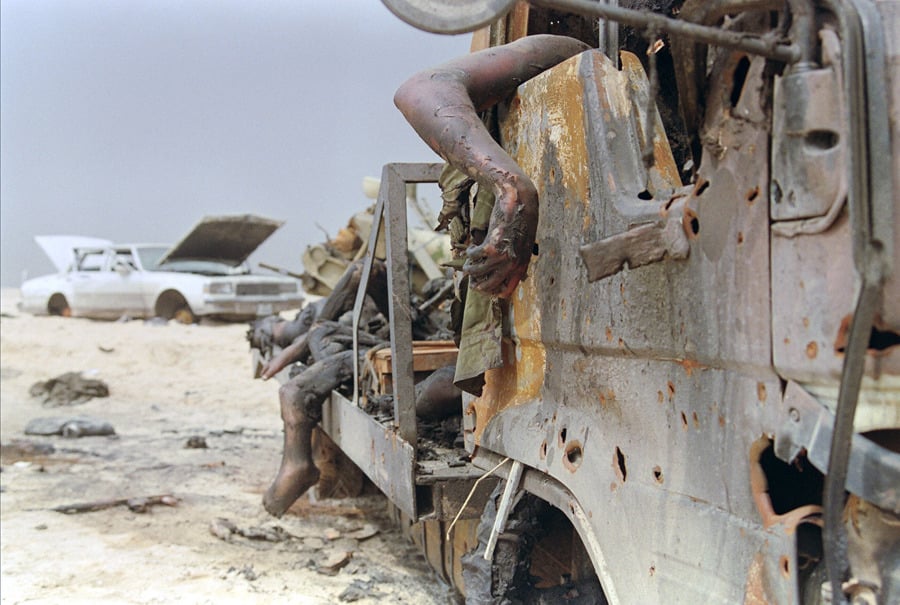
KUWAIT. March 11, 1991. The bodies of dead Iraqi soldiers hang from a truck abandoned by the fleeing Iraqi army by a road leading to Iraq.
The Gulf War which was marked by the introduction of live news broadcasts from the front lines of the battle, principally by the U.S. network CNN. The war has also earned the nickname Video Game War after the daily broadcast of images from cameras on board U.S. bombers during Operation Desert Storm.
Photograph: Pascal Guyot/AFP/Getty
August 2nd, 2020, marks the 30th anniversary of one of the most consequential and perhaps the most underestimated wars in recent history. On 2nd August 1990, between 100,000 (according to Iraqi claims) and 300,000 (according to US claims) Iraqi troops invaded and occupied Kuwait, which Saddam Hussein immediately named Iraq’s nineteenth province.
In response, President George H. W. Bush and the British Prime Minister Margaret Thatcher formed a coalition of 39 countries, including many Arab and Islamic countries, 28 of which provided troops for the war. In all, some 956,600 troops from 28 countries, including 700,000 US and 53,000 British troops, were deployed. More than 2,250 combat aircraft, 1,800 of which were American, took part in the fighting.
The Good War
What came to be known as “The First Gulf War” is often described as the “good war” as opposed to the 2003 illegal invasion of Iraq by President George W. Bush. First of all, it was a legal war in the sense that the UN Security Council Resolution 678, issued on 29 November 1990, authorized the use of force to expel Iraqi forces from Kuwait.
The war certainly resulted in a clear victory and permanently kicked Saddam’s forces out of Kuwait. It saved Saudi Arabia, which could have been Saddam’s next target had the invasion of Kuwait ended successfully.
It also stabilized the price of oil and US control of it, which would have been endangered if Saddam Hussein had managed to gain control of Kuwaiti and Saudi and perhaps UAE oil, as well as Iraq’s substantial oil deposits.
However, many dark aspects were also associated with the war, which are often forgotten. The First Gulf War will be remembered for a number of events that took place for the first time in world history.
It was the first war to introduce live news broadcasts from the front lines of the battle, principally by the newly established global US network CNN. The images of invasion, human hostages, anti-aircraft flak, Scuds and Cruise missiles, wailing sirens, and burning oil fields were broadcast live on our TV screens.
Cruise missiles fired from US warships in the Persian Gulf were used for the first time in warfare. Altogether, 297 Tomahawk Cruise missiles and 35 CALCMs were fired at Iraqi targets, and 1,332 GPS units were fielded. There were also more than 100,000 coalition sorties.
The war earned the nickname “Video Game War” after the first daily broadcast of images from cameras on board US bombers.
The war brought together the largest coalition of forces from 39 countries since the Second World War. It cost the United States practically nothing, because out of the estimated $61 billion dollars cost of the war, Saudi Arabia and Kuwait covered $36 billion, in addition to providing free oil to the coalition forces, and Germany and Japan covered $16 billion of the cost, and other countries contributed smaller amounts.

False propaganda to justify the war was used extensively. The daughter of Kuwait’s ambassador in Washington was filmed acting as a hospital nurse, claiming that Iraqi forces had thrown away babies from the incubators in the hospital where she allegedly worked.
Such lies provided a model for much-more extensive lies about Saddam’s weapons of mass destruction which could be fired at the West in a few minutes and all other lies concocted by the Office for Special Plans set up by Paul Wolfowitz and Douglas Feith in the Pentagon to manufacture false intelligence, and the Dodgy Dossier produced for the British Prime Minister Tony Blair.
The Kuwait war again revealed the extent of US military power and put an end to war-weariness and hesitations that had been created in the minds of the American public following the defeat in the Vietnam War, the so-called Vietnam Syndrome. It made wars again acceptable and even popular to a certain section of US population.
US and Arab Assistance to Saddam during the Iran-Iraq War
However, the most important factor about the Kuwait War that has often been overlooked was that it was the first war since the collapse of the Soviet Union and the end of the Cold War that ushered in a unipolar world led by the United States, a factor that led to more unilateral US wars, mainly in the Middle East.
It should be noted that when Saddam Hussein tore up the Algiers Agreement that he had reached with the late Mohammad Reza Shah of Iran delineating the border between the two countries, and launched a massive invasion of Iran along 1,000 kilometers of the border on 22 September 1980, he was whole-heartedly supported by the rest of the Persian Gulf states, and ironically Kuwait had been his closest ally.
The Arab rulers provided him with logistical assistance and free oil during the war and lent him billions of dollars. The bulk of the financial help came from Saudi Arabia, but Kuwait also initially “lent” the Iraqi dictator $14 billion to help finance his war with Iran.
The deadly Iran-Iraq war that resulted in over a million casualties from the two sides eventually came to an end on 20 August 1988, with Security Council Resolution 598.
After the war, Saddam believed that his debts had to be written off because he claimed that without his war against Iran all Persian Gulf Arab states would have been vulnerable to the Islamic revolution. He maintained that he had saved the Arab sheikhdoms from extinction and was worthy of greater respect.
However, Kuwait refused his pleas and demanded prompt payment. Saddam regarded these demands as the height of ingratitude.
Also, the price of oil had been falling, partly because Kuwait had raised its oil production from the OPEC quota of 1.5 million barrels a day to 1.9 million just weeks before the invasion. This had lowered the oil price from $18 to $14 a barrel, which reduced Iraqi revenue from oil by $4 billion.
Saddam also accused Kuwait of stealing Iraqi oil by drilling at a slant northwards along their frontier, and extracting more than its quota from their jointly-owned Rumaila Oilfield, a claim that Kuwait haughtily dismissed.
Above all, Saddam was in a desperate economic situation and having emerged undefeated out of the Iran-Iraq War mainly due to US support, he wanted to steal the mantle of the late Mohammad Reza Shah of Iran granted to him by the United States as the “Persian Gulf’s policeman”.
So, he invaded Kuwait in the hope of a quick victory, but this was his second major miscalculation after his invasion of Iran.
The Strange Glaspie Conversation
There has been some controversy about whether the United States deliberately lured Saddam Hussein to Kuwait to find an excuse to destroy the Iraqi army now that Iran’s capabilities had been greatly diminished or whether Saddam misread US intentions.
We must remember that during the Iran-Iraq war, Henry Kissinger said that it was such a pity that both sides could not lose.
After helping Saddam to avoid defeat in the war with Iran and in the process to greatly weaken Iran, it is argued that some in the US government decided that it was now time to destroy Iraq’s capabilities so that it did not pose a threat to Israel, as many Israeli leaders alleged that he did. They base their reasoning on the strange conversation that took place between Saddam Hussein and the US ambassador in Baghdad April Glaspie during the run-up to the war.
On 25th of July, or just about a week before invading Kuwait, Saddam met with Glaspie and said that he placed America not among Iraq’s enemies but among its friends. He criticized US response to his imminent invasion of Kuwait, about which he had already informed the Americans.
He protested to Glaspie: “So what can it mean when America says it will now protect its friends? It can only mean prejudice against Iraq. This stance plus manoeuvres and statements which have been made has encouraged the UAE and Kuwait to disregard Iraqi rights…”
Glaspie replied: “I know you need funds. We understand that and our opinion is that you should have the opportunity to rebuild your country. But we have no opinion on the Arab-Arab conflicts, like your border disagreement with Kuwait … Frankly, we can only see that you have deployed massive troops in the south. Normally that would not be any of our business. But when this happens in the context of what you said on your national day, then when we read the details in the two letters of the Foreign Minister, then when we see the Iraqi point of view that the measures taken by the UAE and Kuwait is, in the final analysis, parallel to military aggression against Iraq, then it would be reasonable for me to be concerned.” (1)
Glaspie further said that she had served in Kuwait 20 years earlier; but, “then, as now, we took no position on these Arab affairs.” Any reasonable person would conclude from Glaspie’s remarks that the United States had no opinion on “the Arab-Arab conflicts” and would not “adopt a position on Arab affairs” that she was giving Saddam a green light for the invasion.
Whether the impression given by Glaspie was due to naivety or was a deliberate attempt to mislead Saddam, the fact is that Saddam took the bait and concluded that the United States would not intervene in the war on the side of Kuwait, a very costly mistake as it proved later.
Iraqi Losses and Casualties
As the result of the Kuwait war, 3,300 Iraqi tanks, 2,100 APCs, 2,200 Artillery Pieces and 110 aircraft were destroyed, 19 ships were sunk and a further six were damaged. In one noted incident, two USAF stealth planes bombed a bunker in Amiriya in Baghdad, mistaking it for a military target, causing the death of 408 Iraqi civilians, including 130 children, who had taken refuge in the shelter.
Some 80,000 Iraqi forces were captured, and after the war no-fly zones and crippling sanctions were imposed on Iraq which killed perhaps half a million Iraqi children, and those restrictions and occasional attacks on Iraqi positions continued right up to the 2003 invasion of Iraq.
The number of casualties of the First Gulf War has always been a matter of contention. Although U.S. General Tommy Franks who led the invasion of Iraq famously declared, “We don’t do body counts”, there were some estimates of the casualties of the war. There were 147 combat-related and 145 non-combat related coalition casualties. But for obvious reasons, the number of Iraqi casualties has been often underestimated.
As US General Stanley A. McCrystal said in his inaugural speech as ISAF Commander in June 2009: “I believe the perception caused by civilian casualties is one of the most dangerous enemies we face.” However, in order to become aware of the true horror of war, it is important to get a fair estimate of the true casualties.
A joint study by Physicians for Social Responsibility (PSR), International Physicians for the Prevention of Nuclear War (IPPNW), and Physicians for Global Survival, with a preface by Dr Hans C. von Sponeck, former UN Assistant Secretary-General & UN Humanitarian Coordinator for Iraq (1998-2000) and TFF Associate, provided the most accurate body counts based on the scientific examination of the figures. (2)
Those figures are completely different from the insultingly low figures provided by Western governments.
According to this study, the number of Iraqi soldiers killed range from 60,000 to 200,000, an estimated 25,000 to 30,000 in the ground war alone.
The estimates for civilian deaths as a direct result of the war range from 100,000 to 200,000. Heaps of Iraqi corpses were buried in mass graves in the desert when bunkers filled with conscripts who were still alive were bulldozed.
The Death Highway
One of the most gruesome examples of the killings occurred in the so-called “Death Highway”. As a large number of Iraqi soldiers and some civilians began fleeing from Kuwait toward Iraq, they were attacked by A-6 intruder attack jets of the United States Marine Corps’ 3rd Marine Aircraft Wing.
They blocked the head and tail of a massive vehicle column of the Iraqi Regular Army on Highway 80, bombarding them with MK-20 Rockeye II cluster bombs. Over the next 10 hours, scores of US Marine and US Air Force aircraft and US Navy pilots from USS Ranger attacked the convoy. Vehicles surviving the air attacks were later engaged by arriving coalition ground units, producing a long uninterrupted line of more than 300 stationary vehicles with the charred bodies of fleeing Iraqis smoldering in them.
Russian Attemps at Mediation are Ignored
As pointed out earlier on, perhaps the greatest legacy of the First Gulf War was to demonstrate the end of the Cold War and the start of US supremacy in a unipolar world, with all its positive and negative consequences that continue right to the present time.
The Russian leader Mikhail Gorbachev was trying to mediate between Saddam Hussein and the West to allow for a face-saving formula for Iraqi withdrawal from Kuwait.
In his long interview with Frontline Oral History, the former Iraqi Foreign Minister Tariq Aziz spoke about Gorbachev’s mediation and his trip to Moscow with Saddam’s message accepting the Russian terms.
Aziz said: “I reached an agreement with Gorbachev in the middle of the war. The agreement was based on full withdrawal from Kuwait, etc., and Gorbachev declared that agreement and he told me that he is going to summon the Security Council of the United Nations and turn that agreement between us into a UN resolution. George Bush didn’t listen to him. He moved in the ground attack without listening to Gorbachev.”
Aziz said that he was very surprised when war broke out.
On his way from Moscow to Baghdad, he stopped in Amman to brief King Hussein of Jordan about the agreement. The king and queen had been waiting for him and they had been very happy and hopeful that this would end the war and that there would be a ceasefire.
He was heading for Baghdad to give Saddam Hussein the good news, but he continued: “I went to Baghdad after that, when I woke up to head towards Baghdad I saw Cheney on the CNN in the Royal Guest House [announcing] that the ground attack had already started, so it was a great disappointment.” (3)
The unipolar world had already begun and the US president did not need anyone’s permission or agreement to wage war. It was now the case of Prometheus Unbound, free to operate on world stages without any restraints or regard for international law.
Note
1) Quoted in “Confrontation in the Gulf; Excerpts from Iraqi Document on Meeting with U.S. Envoy”, New York Times, 23 September 1990.
2) Body Count: Casualty Figures after Ten Years (First International Edition, March 2015).
3) Frontline, Oral History: Tariq Aziz.
The author
If you think this was a relevant and trustworthy article, please show it here: