Shouldn’t we be Panglossian when it comes to the progress now being made to defeat the Coronavirus? Pangloss in his youth was unreasonably optimistic. He was in Voltaire’s novel “Candide” Candide’s mentor, and coined the phrase, “All this is for the best in this best of all possible worlds.”

But how can one be Panglossian, you might say, when Russia still seems to be bogged down with the pandemic and Britain now has the developed world’s highest number of deaths per capita, and the US recently reached a total of 100,000 deaths?

Partly because there are Panglossian islands, some very large like Germany, Vietnam and South Korea, which started early as soon as the warnings from China came in and chose to have less severe lockdowns or none at all.

Germany has shown the way in Europe with its policy of intensive testing and tracing and, as a result, never had the high death rate of most other European countries. South Korea which started with high numbers, by testing and tracing and no lockdown, got its cases down to a handful. Likewise, Vietnam and Mongolia.

But there are other good reasons to be Panglossian.

The skies over heavily polluted Beijing and Los Angeles have become blue again. Smog has disappeared so children are healthier. So has the clarity of the water in the Venice canals. The number of car and bicycle accidents the world over has fallen dramatically.

Crime is quite sharply down. The amount of rubbish produced has also fallen. There are fewer plastic bags blowing down the street or into the rivers and seas.

A good number of people have taken to reading serious books after decades of declining readership and learning to entertain themselves without the supplements of modern-day life.

People have taken to indoor push-ups and skipping. Serious media has found its readers and viewers shooting up, at the expense of tabloid-type reporting and Facebook-type dependency on badly and inaccurately reported news and comment. (No press is perfect as the uncorrected misreporting last Friday on Sweden’s experiment on how to balance virus-fighting against economic, social and mental regression has shown.)

As countries face up to what comes next, more and more are committing themselves to future policies that will have greener elements. I particularly like the French government’s decision to aid ailing Air France on the condition it ends all its domestic flights, pushing people to take the train. 

In Britain, where an incompetent government is flailing in its mishandled effort to keep the outbreak under control, more bike lanes are fast being developed. When Mayor of London, Boris Johnson used his bike all the time and developed “Boris bikes” as the papers named it – bikes at street corners one could borrow. Today we need Vladimir bikes and Angela bikes, even Donald bikes.

None of this is enough to meet the UN’s climate-warming targets but the virus undoubtedly has helped many governments and their voters to understand that the objective of holding rises in CO2 to 1.5C by the end of the century is not Panglossian. It’s absolutely necessary.

We cannot return to “normal”. We have to continue to take advantage of the benign benefits the virus has bestowed on us – and then more.

As the virus situation improves what can we as individuals do? Governments have their responsibilities. We have ours. Everybody can make their own lists. The suggestion at the top of my list is to walk more.

That will cut carbon emissions quite rapidly, make us more healthy and lead to less illnesses that demand ever-larger expensive health services.

A book on “The lost art of walking” by Geoff Nicholson, says that walking can be likened to sex, “Basic, simple, repetitive” but “capable of great sophistication and elaboration. It can be completely banal and meaningless, and yet it can also involve great passions and adventures. Both can lead you into strange and unknown territories: a walk on the side.”

Apparently, during the First World War, British troops on long forced marches were given cocaine tablets to keep going. For many people, bottoms erect in their cars for decades, it might be necessary to repeat the treatment to get them going à pied!

But it need not be – if a president, prime minister or political leader sets them an example. I’m thinking of Vladimir Putin, Emmanuel Macron, Xi Jinping, Joe Biden and New Zealand’s path-breaker, Jacinda Ardern, who seems game for anything as she sets an example to the world on how to get cases of the virus down to zero, which was achieved on Monday.

The best thing about walking, as a writer in The Economist wrote, is that “You are your own boss. Start and halt, look at everything or nothing. Think about a lot or a little.”

Walking is totally different from other forms of locomotion. You see things you have never seen when you go faster – the elegant cornices on an old building, the carvings on a church door, the small bookshop tucked away, the movement of leaves on a tree, the direction of the clouds, the blossom hatching on the bushes, cats teaching us how to be happy sitting in the sun, the strange antics of the birds… The other weekend, out walking, I watched a father swan struggling to insist that his family – one wife and four youngsters – follow him on a long Sunday afternoon walk up a hill, away from their home on the water.

The kids just didn’t want to follow. In the end, the mother took them on a quick flight, while a rueful dad waddled back to the lake to wait for them. When they returned to dad I laughed and laughed.

In the days when my long-time paper, the Paris-based International Herald Tribune, was on the Rue de Berri, off the Champs Elysees, I would often walk there from my pension in the Marais, three or four miles down the Seine.

It’s quite remarkable that one can conveniently traverse the length of one of the world’s larger inner cities without having to leave a towpath or a back alley, except for the last 500 meters dash up from the river.

The same is true in London. Setting off from a hotel on the edge of Kensington Gardens where the Patriotic Front stayed during the constitutional conference on Rhodesia, now Zimbabwe, it was possible to walk, without touching a main road, through three of London’s great parks, one after another, until I reached the Foreign Office.

Whenever or wherever I travel to a new city I walk as far and as often as I can. Then I start to get the feel of the place in a way the metro, the bus or the taxi can’t give me. 

Nothing will stop me, wherever I am in the globe, trying to find the walking ways. As the great philosopher, Bertrand Russell, once wrote, “Unhappy men would increase their happiness more by walking 6 miles every day than by any conceivable change in philosophy.”

And that was said long before the coronavirus or global-warming manifest themselves.

If you think this article was useful, reward TFF with a dollar or two
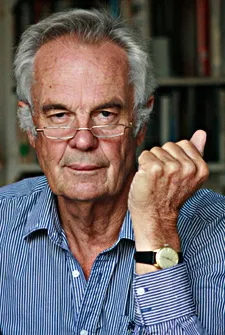
Foreign affairs columnist, film-maker and author

Related Posts

Johan Galtung 1930-2024October 2015 Published here on October 3, 2026 Let us focus on Civilization for conflict analysis and remedies. Major forms of disorder use violence; war is state organized violence. The most belligerent states are the United States of America and Israel, both with civilization roots. National Evangelism, the US Protestant Christian civilization– more national than evangelical–justifies US warfare as exceptionalism of a people chosen by God, with a manifest destiny to run the world. Orthodox Judaism justifies Israeli warfare to conquer and expand from Nile to Euphrates as a religious right and duty to the Eternal One. The third most belligerent country, the UK, no longer believes it is God-chosen but chosen by the USA; not quite the same but something. But the root cause of global disorder lies in the Occident–with Islam–seeing itself as the single, universal civilization valid for all at all times, all others being...
Jan ObergPhD, director, The Transnational Foundation for Peace and Future Research, TFFLund, Sweden October 2, 2026 This is my full original manuscript. The Chinese Academy of Social Science, CASS, makes two publications out if it. 1. China’s Five-year plan emphasized the capabilities of basic research and original innovation. It is regarded as the goal of the future social development, which, as required, should be significantly enhanced. Can you comment on the importance of original innovation in research and academic study? I believe it is easier to define “original innovation” in the natural sciences than in social sciences. The breaking points of what constitutes something new, or innovative, are not quite as sharp in the latter. But in both fields it is about opening up something that was closed, unseen, unexplored before – making manifest what was earlier latent. Innovations come in many forms and shapes – naming something that was not...
The agreement is catastrophic both because of what it says and what it doesn’t mention. It reduces further the major asset of security policies: Freedom of action. Jan Oberg TFF director September 25, 2026 A couple of hours before the agreement was signed on September 22, 2026, I published the following 13 hypotheses about what it would most likely contain on TFF Substack (in English). I was wrong on only the first point. Contrary to what Trump had written on his Truth Social platform, it does not appear to come into force immediately. In fact, it turned out to be worse than even I had anticipated. After these hypotheses now come a number of reflections in light of what the agreement actually contains, and does not contain, as well as the way in which it has generally been presented by major media outlets and by the public-service broadcaster DR. My...

Recent Articles

Tony Robinson October 4, 2026 Violence is easy to recognise when someone is being beaten, shot or killed. It becomes more difficult when nobody is holding a weapon. Poverty, discrimination, exploitation and repression can restrict a human life just as effectively, although they do so in very different ways and with very different consequences. Simply adding more categories to an ever-growing list of forms of violence does not really solve the problem. The more interesting question is what all these different situations have in common and why it makes sense to describe them using the same word. Human beings do not simply react to what happens around them. They remember the past, imagine things that do not yet exist, make plans and undertake projects. Workers organise because they imagine different working conditions; people migrate because they imagine another life somewhere else; social movements emerge because people refuse to accept the...
It’s a matter of principles, courage, vision and pulling together – while the militarist world is falling apart… Peter Langille October 3, 2026 “Here, then, is the problem which we present to you, stark and dreadful and inescapable: Shall we put an end to the human race; or shall mankind renounce war?”The Bertrand Russell—Albert Einstein Manifesto, July 9, 1955 ⁕ The forecast for what’s ahead is worrisome. The sharp rise in armed conflicts over the past three years is adding to what was already the highest level in over seventy years. Genocides, which should be prevented are supported. A shared climate emergency that jeopardises survival is ignored. Diverse polls now suggest that people are war-weary, worried and interested in a more effective United Nations. And, there are viable policy options for a more secure world! Yet governments are doubling-down, betting on more war and investing heavily. If current trends persist,...
Johan Galtung 1930-2024October 2015 Published here on October 3, 2026 Let us focus on Civilization for conflict analysis and remedies. Major forms of disorder use violence; war is state organized violence. The most belligerent states are the United States of America and Israel, both with civilization roots. National Evangelism, the US Protestant Christian civilization– more national than evangelical–justifies US warfare as exceptionalism of a people chosen by God, with a manifest destiny to run the world. Orthodox Judaism justifies Israeli warfare to conquer and expand from Nile to Euphrates as a religious right and duty to the Eternal One. The third most belligerent country, the UK, no longer believes it is God-chosen but chosen by the USA; not quite the same but something. But the root cause of global disorder lies in the Occident–with Islam–seeing itself as the single, universal civilization valid for all at all times, all others being...

TFF on Substack

Discover and subscribe to more peace materials on TFF Substack

Most Popular

Tony Robinson October 4, 2026 Violence is easy to recognise when someone is being beaten, shot or killed. It becomes more difficult when nobody is holding a weapon. Poverty, discrimination, exploitation and repression can restrict a human life just as effectively, although they do so in very different ways and with very different consequences. Simply adding more categories to an ever-growing list of forms of violence does not really solve the problem. The more interesting question is what all these different situations have in common and why it makes sense to describe them using the same word. Human beings do not simply react to what happens around them. They remember the past, imagine things that do not yet exist, make plans and undertake projects. Workers organise because they imagine different working conditions; people migrate because they imagine another life somewhere else; social movements emerge because people refuse to accept the...
It’s a matter of principles, courage, vision and pulling together – while the militarist world is falling apart… Peter Langille October 3, 2026 “Here, then, is the problem which we present to you, stark and dreadful and inescapable: Shall we put an end to the human race; or shall mankind renounce war?”The Bertrand Russell—Albert Einstein Manifesto, July 9, 1955 ⁕ The forecast for what’s ahead is worrisome. The sharp rise in armed conflicts over the past three years is adding to what was already the highest level in over seventy years. Genocides, which should be prevented are supported. A shared climate emergency that jeopardises survival is ignored. Diverse polls now suggest that people are war-weary, worried and interested in a more effective United Nations. And, there are viable policy options for a more secure world! Yet governments are doubling-down, betting on more war and investing heavily. If current trends persist,...
Johan Galtung 1930-2024October 2015 Published here on October 3, 2026 Let us focus on Civilization for conflict analysis and remedies. Major forms of disorder use violence; war is state organized violence. The most belligerent states are the United States of America and Israel, both with civilization roots. National Evangelism, the US Protestant Christian civilization– more national than evangelical–justifies US warfare as exceptionalism of a people chosen by God, with a manifest destiny to run the world. Orthodox Judaism justifies Israeli warfare to conquer and expand from Nile to Euphrates as a religious right and duty to the Eternal One. The third most belligerent country, the UK, no longer believes it is God-chosen but chosen by the USA; not quite the same but something. But the root cause of global disorder lies in the Occident–with Islam–seeing itself as the single, universal civilization valid for all at all times, all others being...
Read More
Living-Peace-Sign-Budapest-copy
Tony Robinson October 4, 2026 Violence is easy to recognise when someone is being beaten, shot or killed. It becomes more difficult when nobody is holding a weapon. Poverty, discrimination, exploitation and repression can restrict a human life just as effectively, although they do so in very different ways and with very different consequences. Simply adding more categories to an ever-growing list of forms of violence does not really solve the problem. The more interesting question is what all these different situations have in common and why it makes sense to describe them using the same word. Human beings do not simply react to what happens around them. They remember the past, imagine things that do not yet exist, make plans and undertake projects. Workers organise because they imagine different working conditions; people migrate because they imagine another life somewhere else; social movements emerge because people refuse to accept the...
b54a1f10-8c65-4f0b-9dd5-4abc0a7d04cc_2659x2659
It’s a matter of principles, courage, vision and pulling together – while the militarist world is falling apart… Peter Langille October 3, 2026 “Here, then, is the problem which we present to you, stark and dreadful and inescapable: Shall we put an end to the human race; or shall mankind renounce war?”The Bertrand Russell—Albert Einstein Manifesto, July 9, 1955 ⁕ The forecast for what’s ahead is worrisome. The sharp rise in armed conflicts over the past three years is adding to what was already the highest level in over seventy years. Genocides, which should be prevented are supported. A shared climate emergency that jeopardises survival is ignored. Diverse polls now suggest that people are war-weary, worried and interested in a more effective United Nations. And, there are viable policy options for a more secure world! Yet governments are doubling-down, betting on more war and investing heavily. If current trends persist,...
010
Johan Galtung 1930-2024October 2015 Published here on October 3, 2026 Let us focus on Civilization for conflict analysis and remedies. Major forms of disorder use violence; war is state organized violence. The most belligerent states are the United States of America and Israel, both with civilization roots. National Evangelism, the US Protestant Christian civilization– more national than evangelical–justifies US warfare as exceptionalism of a people chosen by God, with a manifest destiny to run the world. Orthodox Judaism justifies Israeli warfare to conquer and expand from Nile to Euphrates as a religious right and duty to the Eternal One. The third most belligerent country, the UK, no longer believes it is God-chosen but chosen by the USA; not quite the same but something. But the root cause of global disorder lies in the Occident–with Islam–seeing itself as the single, universal civilization valid for all at all times, all others being...
Screenshot 2026-10-02 011738
Jan ObergPhD, director, The Transnational Foundation for Peace and Future Research, TFFLund, Sweden October 2, 2026 This is my full original manuscript. The Chinese Academy of Social Science, CASS, makes two publications out if it. 1. China’s Five-year plan emphasized the capabilities of basic research and original innovation. It is regarded as the goal of the future social development, which, as required, should be significantly enhanced. Can you comment on the importance of original innovation in research and academic study? I believe it is easier to define “original innovation” in the natural sciences than in social sciences. The breaking points of what constitutes something new, or innovative, are not quite as sharp in the latter. But in both fields it is about opening up something that was closed, unseen, unexplored before – making manifest what was earlier latent. Innovations come in many forms and shapes – naming something that was not...
arctic-circle-map
The agreement is catastrophic both because of what it says and what it doesn’t mention. It reduces further the major asset of security policies: Freedom of action. Jan Oberg TFF director September 25, 2026 A couple of hours before the agreement was signed on September 22, 2026, I published the following 13 hypotheses about what it would most likely contain on TFF Substack (in English). I was wrong on only the first point. Contrary to what Trump had written on his Truth Social platform, it does not appear to come into force immediately. In fact, it turned out to be worse than even I had anticipated. After these hypotheses now come a number of reflections in light of what the agreement actually contains, and does not contain, as well as the way in which it has generally been presented by major media outlets and by the public-service broadcaster DR. My...
girl-5894831_1280
Below are TFF-related media mentions, comments, videos and social media posts published elsewhere but not on this homepage. We happen to catch and list only a fraction. Regarding video comments and debates, we recommend that you go to the TFF Video Channel on Substack where many of them are reproduced. Jan Oberg is a contributor to China Daily – 52 million daily clicks – and Global Times, CGTN and CCTV (the national television), China Investment, Xinhua News Agency and several others. Articles and videos on these media very often multiply into countless Chinese (and Western media) that re-post them from these main media. Thanks to The China Academy, his analyses, interviews and comments are frequently posted on YouTube channels such as Thinkers Forum and Wave Media. These videos are often re-posted on Bilibili (China’s YouTube), the China Content Center on TikTok, and on the Chinese edition of TikTok, Douyin.com. This means reaching hundreds of millions of viewers worldwide over a year. While there are too many to catch on all these...