
By Hussein Askary
April 22, 2020
When China was fighting alone against the Corona virus in January and February, Western media mocked China and its leadership for mismanaging the health affairs of the nation. A Danish newspapers gleefully published a cynical cartoon of the Chinese flag with a cluster of Corona viruses instead of the stars. Others called the COVID-19, a “Chinese virus” and “Wuhan virus”. China was described as “Asia’s sick man” in the Wall Street Journal. Chinese and Asian nationals suffered racist attacks in Europe and the United States.
Orginally posted on Brix’s official website on March 21, 2020
The Chinese people and their leadership were busy fighting ferociously, making huge sacrifices in lives and wealth to control the epidemic. Their fight was praised by the World Health Organization (WHO), which called on the other nations of the world to learn from China in dealing with the outbreak in their countries.
Now that China has successfully stopped the advance of the virus, with zero cases reported on March 19 in mainland China, what do you think the Chinese people and their government are doing? Are they mocking the EU nations and the U.S., who have become the center of the global pandemic? Is the Chinese media making cartoons about the “European virus”?
No, China has instead unleashed the full force of the “Health Silk Road” to help not only one nation, but a dozen, now that it is regaining its production capacity and its medical staff are not under much distress.
In a phone conversation with Italian Prime Minister Giuseppe Conte on March 16, China’s President Xi Jinping called for increased cooperation with Italy, and all nations, “to contribute to international cooperation in combatting the epidemic and to the construction of a Health Silk Road,” according to a detailed report in Xinhua.
Now that it has its own COVID-19 epidemic more under control, China has been providing help—both equipment and personnel – to a number of countries, including Italy, Spain, Iran, Iraq, Panama and others. In their phone conversation, Xi promised Italy additional help in its battle against COVID-19. According to Xinhua, Xi said that “China will act prudently from beginning to end and strive for an early and complete victory over the epidemic, so as to provide other countries with confidence in their prevention and control efforts. Noting that the Italian government has taken a series of resolute prevention and control measures in response to the epidemic, Xi said that China firmly supports Italy and has full confidence in Italy’s victory over the epidemic. China identifies with Italy’s urgent concerns, and will send more medical experts to Italy and do its best to provide medical supplies and other assistance, Xi said. China is willing to work with Italy to contribute to international cooperation in combating the epidemic and to the construction of a Health Silk Road, Xi said.”
China sent to Italy a team of experts, including medical doctors and pediatricians, who were first in Rome, at the Spallanzani Hospital, and commented that the work done by Italian doctors is excellent but “there are still too many people around”, and then to Milan. At a press conference with governor Fontana in Milan the head of the Red Cross in China Sun Shuopeng emphasized that also in Milan and Lombardy, the epicenter of the contagion, too many people are still running around and violating the government decree “this is not good, it is a matter of life or death” he said.
The Italian people have expressed their gratitude to China in many ways, including by singing the Chinese national anthem from balconies.
Working overtime to produce equipment for the world
China has also ramped up production of medical equipment to meet the growing needs of countries faced with fighting the coronavirus. Shenzhen Mindray Bio-Medical Electronics Co., Ltd. said the Italian government had procured nearly 10,000 devices for fighting the disease, most of which are for patient monitoring, from the Guangdong-based medical equipment giant, whose products were part of the Chinese medical aid that arrived in Italy on March 12.
Shenzhen-listed Guangdong Biolight Meditech Co., Ltd. on Tuesday disclosed that it had since March 2 received orders for nearly 2,000 pieces of medical equipment from eight countries including Italy, France and Germany. Zhejiang Dali Technology Co., Ltd, another manufacturer of infrared thermometers, said production is running at full tilt to meet growing orders at home and from Asia, Europe, and America. Oriental Energy Co., Ltd, a major alkane resources operator, said it had exported over 3,000 tons of Y381H, an essential fiber for making the melt-blown non-woven fabric used for making face masks and protective suits, to countries including India and Vietnam since February.
Mask-maker Great Star Industrial Co., Ltd has received the EC declaration of conformity document approving the quality of its products for sale in the EU. At least 10 Chinese producers of detection kits for nucleic acid and antibody testing have also won approvals to enter the EU market. Meanwhile, 14 novel coronavirus testing kits developed by five Chinese universities, including Tsinghua University, have obtained the CE marking, which allows them to be marketed across the European Union, according to the Ministry of Education.
In addition, the following items have also been dispatched by China to virus-stricken nations: – An aircraft carrying 500,000 medical masks from China arrived at Zaragoza airport in northern Spain on Tuesday, as confirmed COVID-19 cases in the country rose to 11,178; – A team of 12 medical experts from east China’s Zhejiang Province was sent to Italy Tuesday by the Chinese government to aid the anti-coronavirus fight on the Apennine Peninsula; – 300,000 face masks donated by Chinese charities arrived in Belgium on Monday; – China donated 2,000 fast test kits for COVID-19 to the Philippines on Monday; – Beijing will donate protective supplies including medical isolation gowns and gloves to the cities of Seoul, Tehran, Tokyo and Yokohama to help with their novel coronavirus control.
Some 200,000 medical isolation gowns, 100,000 pairs of gloves, 200,000 pairs of shoe covers and 200,000 disposable medical caps will be delivered to these cities; — South China’s Guangdong Province has donated more than 80,000 testing kits to countries including Iran, Japan, Iraq and Peru; — Central China’s Hunan Province has donated supplies to aid the novel coronavirus fight in Laos and the Republic of Korea.
Spain finds a true friend!
Spain’s fierce attachment to the European Union, and insistence on dealing with China only through the EU, is cracking, as due note has been taken in Spain that the EU refused to aid Italy, but China stepped in. In the past few days, the Chinese community in Spain brought aid. El Confidencial’s report sums up the result:
“From Madrid to Cordoba, from Zaragoza to Jerez, the images of Chinese citizens in Spain arriving with vans full of boxes of masks, gloves and hand sanitizer to donate to hospitals, police and fire stations, have generated applause and expressions of gratitude all over Spain. In full European paralysis, they are the ones who have mobilized massively in the face of the dramatic situation of health professionals, who have been asking urgently for weeks for masks and respirators for the front-lines of the battle against COVID-19.”
In its article, “Welcome Mr. Xi: Chinese Marshall Plan against Coronavirus Lands in Spain,” the paper reported that the Spanish government had initially turned down the Chinese government’s offer of medical material and advice, on grounds that “we prefer to do that through the EU.”
But on March 15, Foreign Affairs Minister Arancha Gonzalez Laya spoke with Chinese Foreign Minister Wang Yi about Spain purchasing medical material to build up its stockpiles from China, and China facilitating imports from thousands of Spanish small and medium companies. “Cooperation to protect health and the economy,” she tweeted.
“It is inevitable that we accept the Chinese offer, as Italy has done. At this moment, we need help urgently and we could care less about the China propaganda,” a Foreign Ministry source told El Confidencial.
What is the Health Silk Road?
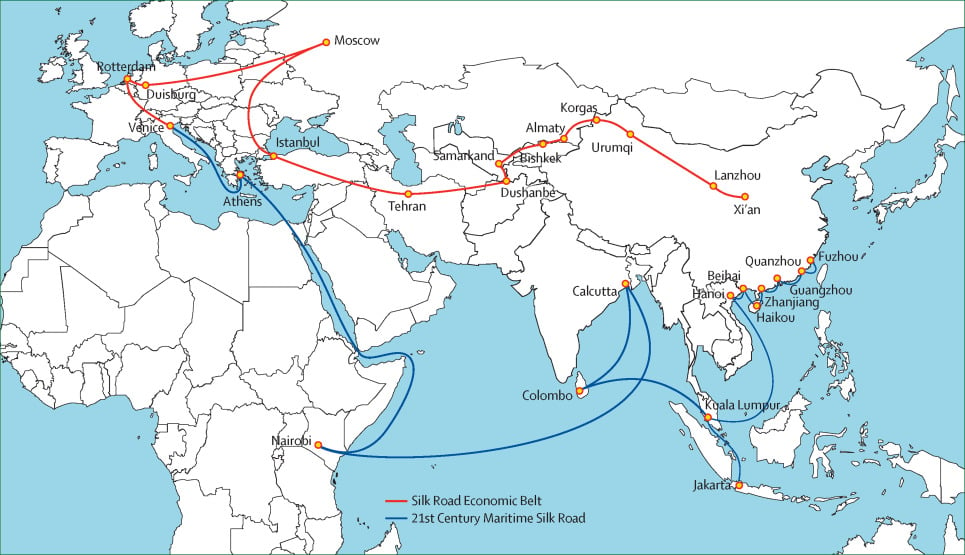
President Xi Jinping announced the Belt and Road Initiative in 2013 to connect the nations of Asia, Europe and Africa along the routes of the ancient Silk Road with modern transport corridors. However, the BRI has soft infrastructure aspects too, like health. In the most detailed description of the Belt and Road Initiative (BRI) by the Chinese National Development and Reform Commission “Vision and actions on jointly building Belt and Road”, published in march 2015, one can read the following: “We should strengthen cooperation with neighboring countries on epidemic information sharing, the exchange of prevention and treatment technologies and the training of medical professionals, and improve our capability to jointly address public health emergencies. We will provide medical assistance and emergency medical aid to relevant countries.”
In his speech delivered at the Legislative Chamber of the Uzbek Supreme Assembly on June 22, 2016, President Xi said: “We should step up efforts in deepening medical and health cooperation, and enhancing mutually beneficial cooperation in the alert of infectious diseases, disease control and prevention, medical assistance, traditional medicines and other areas, so as to jointly build a healthy Silk Road.”
In the scientific paper ”Combating infectious disease epidemics through China’s Belt and Road Initiative”, researchers Jin Chen and Robert Bergquist wrote that “The Healthy China 2030 plan, promulgated in 2016, considers health as one of the national policy priorities, and the Memorandum of Understanding with the World Health Organization (WHO), signed in 2017, which promotes global health security and development along the terms of the initiative.”
They argue that “Based on these agreements, the building of a Health Silk Road has become a core task leading to an extensive engagement in global health development”. Chen and Bergqvist refer to the “Belt and Road High-Level Meeting for Health Cooperation: Towards a Health Silk Road”, held on August 18, 2017, in Beijing, at the end of which the participating 64 countries signed the “Health Silk Road communiqué”.
In his address to this 2017 conference, Director-General of WHO, Dr Tedros Adhanom Ghebreyesus, said: “As you know, the world faces increasing and more complex epidemics, pandemics and disasters. Not only are these events more likely to occur, they’re also likely to have a bigger impact on human health, the social fabric, security and the economy…President Xi’s proposal for a Health Silk Road, which strengthens and renews ancient links between cultures and people, with health at its core, is indeed visionary.”
Tedros emphasized that “if we are to secure the health of the billions of people represented here, we must seize the opportunities the Belt and Road Initiative provides”, adding that the “WHO has proposed a strategic partnership with China to target vulnerable countries along the Belt and Road and in Africa.”
Pointing the connection between the BRI and the UN Sustainable Development Goal number 3, the WHO Director said: “The Belt and Road Initiative contains the fundamentals to achieve universal health coverage: infrastructure, access to medicines, human resources, and a platform to share experience and promote best practices. China has much to teach us about these issues. It is a world leader in disease surveillance and outbreak control, and was one of the first countries to step in during the Ebola outbreak.”
Here, Tedros is referring to the unprecedented operation launched by China in 2014 against the Ebola outbreak in west Africa, dispatching 1200 workers, including Chinese military personnel.
Tedros added that “China has built a nationwide health insurance scheme that covers more than 95% of its population. The country also has a great capacity for research and development, and was one of the first countries to meet the Millennium Development Goal for maternal health.”
In conclusion, Tedros said: “We should build upon these experiences. Let us, the health leaders of 60 countries gathered here, and public health partners, build a healthy Silk Road, together.”
East-West cooperation needed now!
On March 19, The Russian and Chinese Foreign Ministers discussed the proposed UN Permanent-5 Security Council summit (proposed by President Putin), the Foreign Ministry reported on March 18. Lavrov and Wang spoke by phone on international coronavirus situation and their bilateral cooperation in confronting it the spirit of their strategic partnership. They also “touched on” UNSC matters (China is the chair this month), “preparations for the summit of permanent members of the Security Council, and the development of cooperation in the Russia-India-China format.”
Already on February 26, Mrs. Helga Zepp-LaRouche, the Chairwoman of the International Schiller Institute issued a call for an emergency summit among those leaders, as the most important step to cope with the Corona pandemic, because it is imperative to coordinate and mobilize all the resources and technologies of all nations towards one direction and in a unified manner. Otherwise, the COVID-19 virus would find its way to penetrate through the cracks created by the schism between East and West based on completely unfounded geopolitical grounds.
A very important element in this international effort is to help poor countries build modern hospitals and healthcare centers as soon as possible, to prevent the contagion from bouncing back once again.
What the Corona virus should have already taught the leaders of the world is, that it does not care if the victims are Asian, European, American or African. It attacks them because they are human. Their response should be likewise, as humans! Every nation is called upon now to join the Health Silk Road to save lives and build a secure and healthy future for all mankind.
If you enjoyed this article, please consider donating a dollar, or five…

Hussein Askari is a scholar of economic development in the Middle East and in Islam and the founder of Islamicity Indices, a benchmark to build effective institutions for political, social and economic reform and progress.
Editor’s suggested further reading
Another good background to China and health can be found in The Lancet, China’s Silk Road and Global Health (2017).
WHO, Towards a Health Silk Road (2017).
Wade Shepard, Forbes, China’s ‘Health Silk Road’ gets a boost from COVID-19 (2020).
Pepe Escobar, China rolls out the Health Silk Road, Asia Times.





