
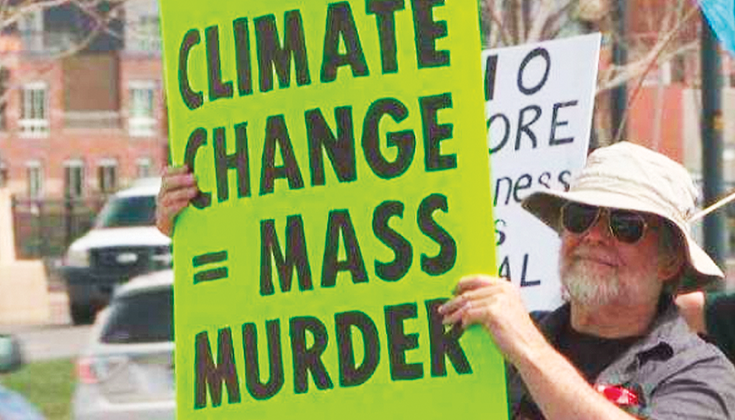
Photo: David Loy at an Extinction Rebellion protest in Denver. Photo by denver.cbslocal.com

How do bodhisattvas respond to the greatest crisis of our time?
Appropriately, says Buddhist teacher, activist and TFF Associate, David Loy.

By David Loy

One of my favorite Zen stories is short and simple. A student asks the master, “What is the constant activity of all the buddhas and bodhisattvas?” In other words, what’s special about the day-to-day lives of awakened people?

The master replies: “Responding appropriately.”

That’s all. No special powers, except being fully attentive to what’s actually happening and acting accordingly.


“We don’t know what is possible, we don’t know what will work, but we do our best.”

That’s an easy thing to do in a monastery. When the bell rings, you put on your robe and go to the Buddha Hall for meditation. But what about when one leaves the monastery gates and steps out into a world with many problems, most ominously an ecological crisis that is severely degrading the biosphere.

How do we respond appropriately to a climate emergency that threatens even the survival of our own species?

Some might say that this is not a Buddhist problem, that Buddhism is only about individual awakening and personal transformation. But is the goal to transcend—escape—this world, or to realize our nonduality with it?

If the latter, then the Buddhist path involves not only focusing on our own meditative practice, but integrating what we realize into how we actually live in the world.

Wisdom founders without compassion, and today that involves responding to the greatest challenge that humanity has ever faced.

Originally published at lionsroar.com

It seems to me that public consciousness has shifted over the last year. More people are aware that our ecological situation has become very precarious, and continues to deteriorate rapidly.

“Business as usual,” along with “politics as usual,” is leading to disaster. In light of this, what should we do? How should we respond appropriately? Today that is our collective koan.

Buddhism originated and developed in a very different social and environmental context than today, so unsurprisingly it has little to tell us about what to do.

But its teachings say a great deal to say about how to do it. That’s called the bodhisattva path. In fact, I wonder if the bodhisattva (or ecosattva) path is the most important contribution that Buddhism can offer today.

Acknowledging the importance of social engagement is a big step for many Buddhists since we have usually been taught to focus on what is happening in our own minds.

On the other side, those committed to social action tend to suffer from frustration, anger, and burnout. The engaged bodhisattva path provides what each needs because it involves a double practice, inner and outer, each reinforcing the other.

Combining meditation and activism enables deep engagement without burnout. Activism also helps meditators avoid self-stultifying preoccupation with their own mental condition and spiritual progress.

Insofar as a sense of separate self is the basic problem, compassionate commitment to the well-being of others is an important part of the solution. Engagement with the ecological crisis is therefore not a distraction from our personal contemplative practice but essential to it.

Although there are many aspects to the bodhisattva path, the equanimity and insight it cultivates supports what is most distinctive and powerful about spiritual activism: acting without attachment to the results of action.

The Buddha said that enlightened people are nirasa: “wishless, desireless, without expectation.” This doesn’t mean inaction or disengagement but what the Bhagavad-Gita calls “karma yoga”: “Your right is to the work, never to the fruits. Be neither motivated by the fruits of action nor inclined to give up action.” Do what is needed, but without attachment to the outcome.

Nonattachment to results is easily misunderstood, however.

It doesn’t mean our approach to our task or nonchalance. In response to the ongoing devastation of the earth, we are called upon to do the very best we can, not knowing what the consequences will be, not knowing if our efforts will make any difference whatsoever.

This is an important aspect of the “don’t-know mind” that Zen practice explicitly cultivates. One of my teachers, Robert Aitken Roshi, liked to say that our task is not to clear up the mystery. It’s to make the mystery clear.

The spiritual path isn’t about coming to understand everything but opening up to a sacred and mysterious world that we access not by grasping it but in being taken by it.

Bodhisattvas always manifest something greater than their own egos. “You are not Atlas carrying the world on your shoulder,” Vandana Shiva said. “It is good to remember that the planet is carrying you.”

We don’t know what is possible, we don’t know what will work, but we do our best. We don’t know if what we do is important, but we know that it’s important for us to do it.

Have we already passed ecological tipping points and civilization as we know it is doomed? We don’t know—and that’s okay.

Of course, we would like our efforts to bear fruit, yet ultimately they are our gift to the earth, gratis, and gifts should be made without any expectation of return.

On April 20, I was part of a group of six Extinction Rebellion protestors, inspired by the ongoing XR actions in London, who briefly blocked a busy street in downtown Denver. Police detained us and issued a summons; our court cases are pending.

Was that the best thing for us to do, inconveniencing many drivers that Saturday afternoon?

I don’t know, but it has become clear that, without some radical changes, we face much more than an inconvenience in the next few years.

I don’t know if what Extinction Rebellion is doing is the most appropriate response, but right now I don’t have a better one, and our backs are against the wall.

We need to hold politicians’ feet to the fire, for the time for humanity to get its act together is short, and getting shorter every day.

A few days after our action, some of the Denver protestors asked if I would offer a workshop meditation retreat for XR activists up at our new Rocky Mountain Ecodharma Retreat Center near Boulder.

We’re holding it in mid-September, just before another week of XR activities worldwide. Doing the inner and outer practice of ecosattvas, we’ll train to respond appropriately.

Originally published at lionsroar.com

If you think this was an interesting approach…

About the author
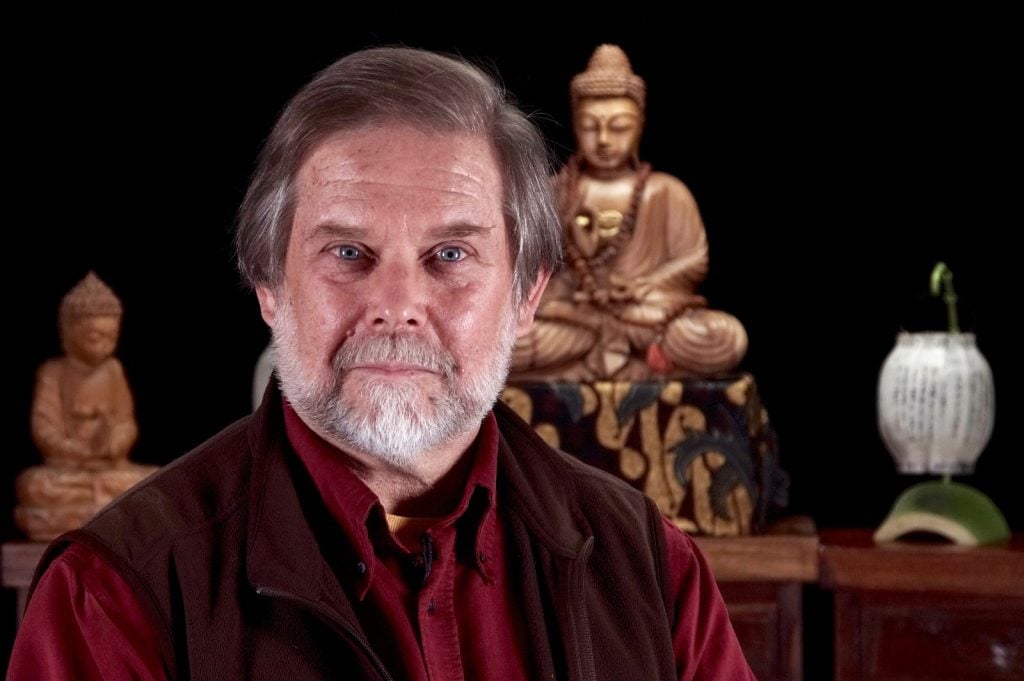
David Loy

David Loy is a scholar and a Zen teacher in the Sanbo Zen tradition. His latest book is A New Buddhist Path: Enlightenment, Evolution, and Ethics in the Modern World; he is also co-editor of A Buddhist Response to the Climate Emergency.

Related Posts

Tony Robinson October 4, 2026 Violence is easy to recognise when someone is being beaten, shot or killed. It becomes more difficult when nobody is holding a weapon. Poverty, discrimination, exploitation and repression can restrict a human life just as effectively, although they do so in very different ways and with very different consequences. Simply adding more categories to an ever-growing list of forms of violence does not really solve the problem. The more interesting question is what all these different situations have in common and why it makes sense to describe them using the same word. Human beings do not simply react to what happens around them. They remember the past, imagine things that do not yet exist, make plans and undertake projects. Workers organise because they imagine different working conditions; people migrate because they imagine another life somewhere else; social movements emerge because people refuse to accept the...
It’s a matter of principles, courage, vision and pulling together – while the militarist world is falling apart… Peter Langille October 3, 2026 “Here, then, is the problem which we present to you, stark and dreadful and inescapable: Shall we put an end to the human race; or shall mankind renounce war?”The Bertrand Russell—Albert Einstein Manifesto, July 9, 1955 ⁕ The forecast for what’s ahead is worrisome. The sharp rise in armed conflicts over the past three years is adding to what was already the highest level in over seventy years. Genocides, which should be prevented are supported. A shared climate emergency that jeopardises survival is ignored. Diverse polls now suggest that people are war-weary, worried and interested in a more effective United Nations. And, there are viable policy options for a more secure world! Yet governments are doubling-down, betting on more war and investing heavily. If current trends persist,...
Johan Galtung 1930-2024October 2015 Published here on October 3, 2026 Let us focus on Civilization for conflict analysis and remedies. Major forms of disorder use violence; war is state organized violence. The most belligerent states are the United States of America and Israel, both with civilization roots. National Evangelism, the US Protestant Christian civilization– more national than evangelical–justifies US warfare as exceptionalism of a people chosen by God, with a manifest destiny to run the world. Orthodox Judaism justifies Israeli warfare to conquer and expand from Nile to Euphrates as a religious right and duty to the Eternal One. The third most belligerent country, the UK, no longer believes it is God-chosen but chosen by the USA; not quite the same but something. But the root cause of global disorder lies in the Occident–with Islam–seeing itself as the single, universal civilization valid for all at all times, all others being...

Recent Articles

Tony Robinson October 4, 2026 Violence is easy to recognise when someone is being beaten, shot or killed. It becomes more difficult when nobody is holding a weapon. Poverty, discrimination, exploitation and repression can restrict a human life just as effectively, although they do so in very different ways and with very different consequences. Simply adding more categories to an ever-growing list of forms of violence does not really solve the problem. The more interesting question is what all these different situations have in common and why it makes sense to describe them using the same word. Human beings do not simply react to what happens around them. They remember the past, imagine things that do not yet exist, make plans and undertake projects. Workers organise because they imagine different working conditions; people migrate because they imagine another life somewhere else; social movements emerge because people refuse to accept the...
It’s a matter of principles, courage, vision and pulling together – while the militarist world is falling apart… Peter Langille October 3, 2026 “Here, then, is the problem which we present to you, stark and dreadful and inescapable: Shall we put an end to the human race; or shall mankind renounce war?”The Bertrand Russell—Albert Einstein Manifesto, July 9, 1955 ⁕ The forecast for what’s ahead is worrisome. The sharp rise in armed conflicts over the past three years is adding to what was already the highest level in over seventy years. Genocides, which should be prevented are supported. A shared climate emergency that jeopardises survival is ignored. Diverse polls now suggest that people are war-weary, worried and interested in a more effective United Nations. And, there are viable policy options for a more secure world! Yet governments are doubling-down, betting on more war and investing heavily. If current trends persist,...
Johan Galtung 1930-2024October 2015 Published here on October 3, 2026 Let us focus on Civilization for conflict analysis and remedies. Major forms of disorder use violence; war is state organized violence. The most belligerent states are the United States of America and Israel, both with civilization roots. National Evangelism, the US Protestant Christian civilization– more national than evangelical–justifies US warfare as exceptionalism of a people chosen by God, with a manifest destiny to run the world. Orthodox Judaism justifies Israeli warfare to conquer and expand from Nile to Euphrates as a religious right and duty to the Eternal One. The third most belligerent country, the UK, no longer believes it is God-chosen but chosen by the USA; not quite the same but something. But the root cause of global disorder lies in the Occident–with Islam–seeing itself as the single, universal civilization valid for all at all times, all others being...

TFF on Substack

Discover and subscribe to more peace materials on TFF Substack

Most Popular

Tony Robinson October 4, 2026 Violence is easy to recognise when someone is being beaten, shot or killed. It becomes more difficult when nobody is holding a weapon. Poverty, discrimination, exploitation and repression can restrict a human life just as effectively, although they do so in very different ways and with very different consequences. Simply adding more categories to an ever-growing list of forms of violence does not really solve the problem. The more interesting question is what all these different situations have in common and why it makes sense to describe them using the same word. Human beings do not simply react to what happens around them. They remember the past, imagine things that do not yet exist, make plans and undertake projects. Workers organise because they imagine different working conditions; people migrate because they imagine another life somewhere else; social movements emerge because people refuse to accept the...
It’s a matter of principles, courage, vision and pulling together – while the militarist world is falling apart… Peter Langille October 3, 2026 “Here, then, is the problem which we present to you, stark and dreadful and inescapable: Shall we put an end to the human race; or shall mankind renounce war?”The Bertrand Russell—Albert Einstein Manifesto, July 9, 1955 ⁕ The forecast for what’s ahead is worrisome. The sharp rise in armed conflicts over the past three years is adding to what was already the highest level in over seventy years. Genocides, which should be prevented are supported. A shared climate emergency that jeopardises survival is ignored. Diverse polls now suggest that people are war-weary, worried and interested in a more effective United Nations. And, there are viable policy options for a more secure world! Yet governments are doubling-down, betting on more war and investing heavily. If current trends persist,...
Johan Galtung 1930-2024October 2015 Published here on October 3, 2026 Let us focus on Civilization for conflict analysis and remedies. Major forms of disorder use violence; war is state organized violence. The most belligerent states are the United States of America and Israel, both with civilization roots. National Evangelism, the US Protestant Christian civilization– more national than evangelical–justifies US warfare as exceptionalism of a people chosen by God, with a manifest destiny to run the world. Orthodox Judaism justifies Israeli warfare to conquer and expand from Nile to Euphrates as a religious right and duty to the Eternal One. The third most belligerent country, the UK, no longer believes it is God-chosen but chosen by the USA; not quite the same but something. But the root cause of global disorder lies in the Occident–with Islam–seeing itself as the single, universal civilization valid for all at all times, all others being...
Read More
Living-Peace-Sign-Budapest-copy
Tony Robinson October 4, 2026 Violence is easy to recognise when someone is being beaten, shot or killed. It becomes more difficult when nobody is holding a weapon. Poverty, discrimination, exploitation and repression can restrict a human life just as effectively, although they do so in very different ways and with very different consequences. Simply adding more categories to an ever-growing list of forms of violence does not really solve the problem. The more interesting question is what all these different situations have in common and why it makes sense to describe them using the same word. Human beings do not simply react to what happens around them. They remember the past, imagine things that do not yet exist, make plans and undertake projects. Workers organise because they imagine different working conditions; people migrate because they imagine another life somewhere else; social movements emerge because people refuse to accept the...
b54a1f10-8c65-4f0b-9dd5-4abc0a7d04cc_2659x2659
It’s a matter of principles, courage, vision and pulling together – while the militarist world is falling apart… Peter Langille October 3, 2026 “Here, then, is the problem which we present to you, stark and dreadful and inescapable: Shall we put an end to the human race; or shall mankind renounce war?”The Bertrand Russell—Albert Einstein Manifesto, July 9, 1955 ⁕ The forecast for what’s ahead is worrisome. The sharp rise in armed conflicts over the past three years is adding to what was already the highest level in over seventy years. Genocides, which should be prevented are supported. A shared climate emergency that jeopardises survival is ignored. Diverse polls now suggest that people are war-weary, worried and interested in a more effective United Nations. And, there are viable policy options for a more secure world! Yet governments are doubling-down, betting on more war and investing heavily. If current trends persist,...
010
Johan Galtung 1930-2024October 2015 Published here on October 3, 2026 Let us focus on Civilization for conflict analysis and remedies. Major forms of disorder use violence; war is state organized violence. The most belligerent states are the United States of America and Israel, both with civilization roots. National Evangelism, the US Protestant Christian civilization– more national than evangelical–justifies US warfare as exceptionalism of a people chosen by God, with a manifest destiny to run the world. Orthodox Judaism justifies Israeli warfare to conquer and expand from Nile to Euphrates as a religious right and duty to the Eternal One. The third most belligerent country, the UK, no longer believes it is God-chosen but chosen by the USA; not quite the same but something. But the root cause of global disorder lies in the Occident–with Islam–seeing itself as the single, universal civilization valid for all at all times, all others being...
Screenshot 2026-10-02 011738
Jan ObergPhD, director, The Transnational Foundation for Peace and Future Research, TFFLund, Sweden October 2, 2026 This is my full original manuscript. The Chinese Academy of Social Science, CASS, makes two publications out if it. 1. China’s Five-year plan emphasized the capabilities of basic research and original innovation. It is regarded as the goal of the future social development, which, as required, should be significantly enhanced. Can you comment on the importance of original innovation in research and academic study? I believe it is easier to define “original innovation” in the natural sciences than in social sciences. The breaking points of what constitutes something new, or innovative, are not quite as sharp in the latter. But in both fields it is about opening up something that was closed, unseen, unexplored before – making manifest what was earlier latent. Innovations come in many forms and shapes – naming something that was not...
arctic-circle-map
The agreement is catastrophic both because of what it says and what it doesn’t mention. It reduces further the major asset of security policies: Freedom of action. Jan Oberg TFF director September 25, 2026 A couple of hours before the agreement was signed on September 22, 2026, I published the following 13 hypotheses about what it would most likely contain on TFF Substack (in English). I was wrong on only the first point. Contrary to what Trump had written on his Truth Social platform, it does not appear to come into force immediately. In fact, it turned out to be worse than even I had anticipated. After these hypotheses now come a number of reflections in light of what the agreement actually contains, and does not contain, as well as the way in which it has generally been presented by major media outlets and by the public-service broadcaster DR. My...
girl-5894831_1280
Below are TFF-related media mentions, comments, videos and social media posts published elsewhere but not on this homepage. We happen to catch and list only a fraction. Regarding video comments and debates, we recommend that you go to the TFF Video Channel on Substack where many of them are reproduced. Jan Oberg is a contributor to China Daily – 52 million daily clicks – and Global Times, CGTN and CCTV (the national television), China Investment, Xinhua News Agency and several others. Articles and videos on these media very often multiply into countless Chinese (and Western media) that re-post them from these main media. Thanks to The China Academy, his analyses, interviews and comments are frequently posted on YouTube channels such as Thinkers Forum and Wave Media. These videos are often re-posted on Bilibili (China’s YouTube), the China Content Center on TikTok, and on the Chinese edition of TikTok, Douyin.com. This means reaching hundreds of millions of viewers worldwide over a year. While there are too many to catch on all these...




