
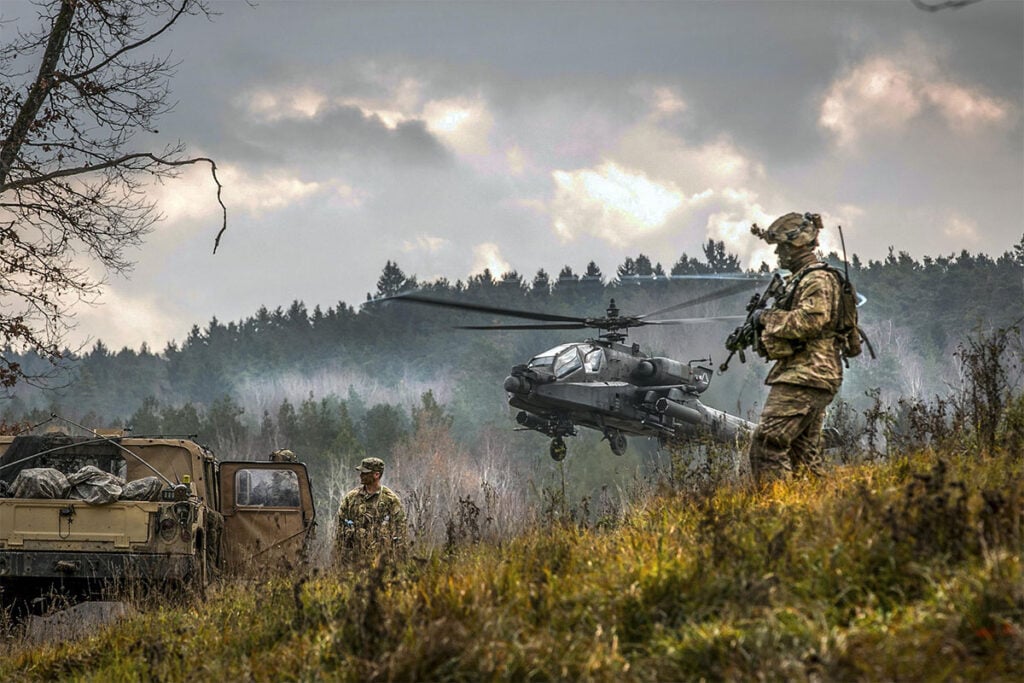
Welcome to Bootprint – TFF’s online magazine on militarism and environment

Today TFF launches “Bootprint – Militarism and Environment” – a curated, free-of-charge online magazine that brings you quality knowledge about the connections between the two most urgent problems that humanity faces.

These two main clusters of problems which, if not solved, threaten to destroy humanity, our Earth and all future potentials are:

Environment – with catchwords such as climate change, global warming, CO2 footprint, non-sustainability, pollution, resource depletion, species extinction, variety and diversity reduction, rain forest destruction, overconsumption, fossil fuels economy, limitless material growth, etc. etc. – and

Militarism – with catchwords such as warfare, nuclear weapons, arms production and trade, militarization of land, air, space and oceans, tension creating, interventionism, base networks, terrorism, cyber and propaganda warfare, other weapons of mass destruction, special forces operations, intelligence agency crimes, imperialism, etc.

The two clusters a fundamentally connected – militarism is enormously destructive of the environment; climate change and other processes in the global environment cause increasing risks to our security. Wars produce refugees, refugee migrations cause social upheaval and xenophobia and immense environmental degradation, etc.

And there are the opportunity cost relations: whenever resources and budgets are spent on militarism, we are reducing the chance to solve the environmental problems because of the perverse proportions between the comparatively tiny budgets for peace and sustainability and welfare, on the one hand, and the seemingly unlimited budgets for everything related to violence, on the other.

You can’t have the cake and blow it up too.

The two clusters are also connected at deeper cultural levels and ways of thinking. They are both fundamentally expressive of the human acceptance of violence as legitimate and effective – violence against Mother Nature in a broad sense and violence against other people, cultures, political systems, religions, or whatever. Violence for a mission civilisatrice.

They both flow from a deep-seated contempt for weakness on the one hand and an – absurd, naive – belief in anthropocentrism, on the other. That is, that Man is the centre of everything and that some men are more central than others.

Wars are fought against those considered lower, (morally) weaker, less powerful, lower in a civilisational ranking system than “we” are. Mother Nature shall be the object of scientific research, exploration and experimentation – in order to be controlled, shaped, manipulated – in order to serve Man.

It was during the process of this male scientific penetration and control of female Nature aiming at finding her secrets in the smallest building block that we stumbled upon the atom which was then, immediately and tragically, put to destructive use on July 16, 1945, and used – unnecessarily – on Hiroshima and Nagasaki less than a month later.

The deep thought patterns embedded in these two global problems are one and the same, carry the same message: Dominate, control, exploit as much as you can! Use your superiority against the weaker and serve yourselves, the egoistic, not the common good – and use violence ad libitum! Might makes right!

Doris Lessing called it Shikasta – a fundamental flaw in our civilisation’s ‘code’ of human and societal thinking that will lead to destruction unless… unless we stop and begin to think of how it is we think. And then change fundamentally the way we act, do politics and define the meaning of the term society.

•

It goes without saying – but should, therefore, be emphasized: It borders on the bizarre that, today, there is intense world attention only to the environment themes and hardly any to the peace. And that there are very few connectors between the two – in science, politics, activism and media.

But we must ask: What’s the use of fighting to stop climate change – the Whimper – if even one small nuclear weapon goes off or a major war breaks out – the Bang – somewhere tomorrow?

And how can anyone believe that we can save the environment and create a global, sustainable future while the warfare and militarism system is maintained unchanged – perhaps with measures to make it “green” – and the global military continues to consume resources and funds nobody understands anymore?

How can anyone with his head overground believe that MIMAC – Military-Industrial-Media-Academic Complex – can continue to invent enemies and require more and more resources as the perpetuum mobile it is and serving only itself – while we are trying to make the rest of the civil and civilised world sustainable?

If so, then we are doomed.

The Bulletin Of The Atomic Scientists recently put its famous world warning Doomsday Clock at 100 seconds to midnight, the closest to predictable world catastrophe ever. Mind you, it is intended to reflect basic changes in the level of continuous danger in which mankind lives in the nuclear age.

Is it really to ask too much holistic thinking that we address both issues – before each of them – and their combined effects – bring us beyond the point of no return?

Integral thinking and action will come. It is so self-evident that it must come. The slogan for both areas: Reduce all kinds of violence in thinking, speaking and action. And devise a constructive program for both areas – integral positive future thinking and scenario-development. What you can visualize, people may work for – what you cannot visualize, nobody will work for.

And the world could be such a beautiful, peaceful, sustainable place. We don’t need Utopias. We don’t need Dystopia. We need Eutopia – visions or the future world that is better and really possible and for which it is meaningful to work.

In times of fake and omission, of denial and escapism and of political systems that have proven incapable of turning the ship in time – we have known about these two problems and the necessity to find solutions to them – for a good 70 years and done far too little – we need knowledge (not only information) and holistic thinking more than ever.

•

Today, TFF launches a curated online magazine on Flipboard to help you find your own way through these issues and how they are interconnected – “Bootprint – Militarism and Environment”. It’s on Flipboard and works particularly well on your phone, just download its app.

It’s just an embryo, a small guide to begin with (about 50 posts). It’s by no means complete – but there is enough to browse for the seriously concerned citizen – in line with TFF’s wish to contribute to public education and constructive action.

More will be added as time goes by.

Bootprint holds more diagnosis and prognosis than treatment and constructive policy proposals in it. At this point. It’s a reflection of the research and debate as it is. But we shall need, ASAP, to integrate constructive solution-thinking and policies for both problem cluster as one.

It contains materials from many perspectives and written by a diversity of people and institution, civil and also military. TFF takes no responsibility for views brought forward in these articles and videos, some of them may be based on values we do not share. But they are part of the knowledge base and the debate.

We hope you will benefit from Bootprint.

We hope you will alert us too quality materials to be included – send them to tff@transnational.live.

We hope you will press “Follow” and spread whatever message you find important in some of these articles and videos and share them with everyone you know and decision-makers you think must learn.

TFF and its Associates are painfully aware that we can do only very little about these huge problems. But the ocean consists of drops. But we are happy to add our drop to the ocean of knowledge and thinking – and thereby help bring about both peace and sustainability through the only means that will have a real, lasting effect: Knowledge and education on how to reduce all kinds of violence and on how to channel resources to civilian development of both the inner and outer human beings and all human beings.

And now listen…

If you think “Bootprint” is yet another good initiative from TFF for a better world…

TFF’s first online magazine on Flipboard is “Transnational Peace Affairs” and can be browsed and followed here.

Peace & future researcher + ‌Art Photographer

Related Posts

Tony Robinson October 4, 2026 Violence is easy to recognise when someone is being beaten, shot or killed. It becomes more difficult when nobody is holding a weapon. Poverty, discrimination, exploitation and repression can restrict a human life just as effectively, although they do so in very different ways and with very different consequences. Simply adding more categories to an ever-growing list of forms of violence does not really solve the problem. The more interesting question is what all these different situations have in common and why it makes sense to describe them using the same word. Human beings do not simply react to what happens around them. They remember the past, imagine things that do not yet exist, make plans and undertake projects. Workers organise because they imagine different working conditions; people migrate because they imagine another life somewhere else; social movements emerge because people refuse to accept the...
It’s a matter of principles, courage, vision and pulling together – while the militarist world is falling apart… Peter Langille October 3, 2026 “Here, then, is the problem which we present to you, stark and dreadful and inescapable: Shall we put an end to the human race; or shall mankind renounce war?”The Bertrand Russell—Albert Einstein Manifesto, July 9, 1955 ⁕ The forecast for what’s ahead is worrisome. The sharp rise in armed conflicts over the past three years is adding to what was already the highest level in over seventy years. Genocides, which should be prevented are supported. A shared climate emergency that jeopardises survival is ignored. Diverse polls now suggest that people are war-weary, worried and interested in a more effective United Nations. And, there are viable policy options for a more secure world! Yet governments are doubling-down, betting on more war and investing heavily. If current trends persist,...
Johan Galtung 1930-2024October 2015 Published here on October 3, 2026 Let us focus on Civilization for conflict analysis and remedies. Major forms of disorder use violence; war is state organized violence. The most belligerent states are the United States of America and Israel, both with civilization roots. National Evangelism, the US Protestant Christian civilization– more national than evangelical–justifies US warfare as exceptionalism of a people chosen by God, with a manifest destiny to run the world. Orthodox Judaism justifies Israeli warfare to conquer and expand from Nile to Euphrates as a religious right and duty to the Eternal One. The third most belligerent country, the UK, no longer believes it is God-chosen but chosen by the USA; not quite the same but something. But the root cause of global disorder lies in the Occident–with Islam–seeing itself as the single, universal civilization valid for all at all times, all others being...

Recent Articles

Tony Robinson October 4, 2026 Violence is easy to recognise when someone is being beaten, shot or killed. It becomes more difficult when nobody is holding a weapon. Poverty, discrimination, exploitation and repression can restrict a human life just as effectively, although they do so in very different ways and with very different consequences. Simply adding more categories to an ever-growing list of forms of violence does not really solve the problem. The more interesting question is what all these different situations have in common and why it makes sense to describe them using the same word. Human beings do not simply react to what happens around them. They remember the past, imagine things that do not yet exist, make plans and undertake projects. Workers organise because they imagine different working conditions; people migrate because they imagine another life somewhere else; social movements emerge because people refuse to accept the...
It’s a matter of principles, courage, vision and pulling together – while the militarist world is falling apart… Peter Langille October 3, 2026 “Here, then, is the problem which we present to you, stark and dreadful and inescapable: Shall we put an end to the human race; or shall mankind renounce war?”The Bertrand Russell—Albert Einstein Manifesto, July 9, 1955 ⁕ The forecast for what’s ahead is worrisome. The sharp rise in armed conflicts over the past three years is adding to what was already the highest level in over seventy years. Genocides, which should be prevented are supported. A shared climate emergency that jeopardises survival is ignored. Diverse polls now suggest that people are war-weary, worried and interested in a more effective United Nations. And, there are viable policy options for a more secure world! Yet governments are doubling-down, betting on more war and investing heavily. If current trends persist,...
Johan Galtung 1930-2024October 2015 Published here on October 3, 2026 Let us focus on Civilization for conflict analysis and remedies. Major forms of disorder use violence; war is state organized violence. The most belligerent states are the United States of America and Israel, both with civilization roots. National Evangelism, the US Protestant Christian civilization– more national than evangelical–justifies US warfare as exceptionalism of a people chosen by God, with a manifest destiny to run the world. Orthodox Judaism justifies Israeli warfare to conquer and expand from Nile to Euphrates as a religious right and duty to the Eternal One. The third most belligerent country, the UK, no longer believes it is God-chosen but chosen by the USA; not quite the same but something. But the root cause of global disorder lies in the Occident–with Islam–seeing itself as the single, universal civilization valid for all at all times, all others being...

TFF on Substack

Discover and subscribe to more peace materials on TFF Substack

Most Popular

Tony Robinson October 4, 2026 Violence is easy to recognise when someone is being beaten, shot or killed. It becomes more difficult when nobody is holding a weapon. Poverty, discrimination, exploitation and repression can restrict a human life just as effectively, although they do so in very different ways and with very different consequences. Simply adding more categories to an ever-growing list of forms of violence does not really solve the problem. The more interesting question is what all these different situations have in common and why it makes sense to describe them using the same word. Human beings do not simply react to what happens around them. They remember the past, imagine things that do not yet exist, make plans and undertake projects. Workers organise because they imagine different working conditions; people migrate because they imagine another life somewhere else; social movements emerge because people refuse to accept the...
It’s a matter of principles, courage, vision and pulling together – while the militarist world is falling apart… Peter Langille October 3, 2026 “Here, then, is the problem which we present to you, stark and dreadful and inescapable: Shall we put an end to the human race; or shall mankind renounce war?”The Bertrand Russell—Albert Einstein Manifesto, July 9, 1955 ⁕ The forecast for what’s ahead is worrisome. The sharp rise in armed conflicts over the past three years is adding to what was already the highest level in over seventy years. Genocides, which should be prevented are supported. A shared climate emergency that jeopardises survival is ignored. Diverse polls now suggest that people are war-weary, worried and interested in a more effective United Nations. And, there are viable policy options for a more secure world! Yet governments are doubling-down, betting on more war and investing heavily. If current trends persist,...
Johan Galtung 1930-2024October 2015 Published here on October 3, 2026 Let us focus on Civilization for conflict analysis and remedies. Major forms of disorder use violence; war is state organized violence. The most belligerent states are the United States of America and Israel, both with civilization roots. National Evangelism, the US Protestant Christian civilization– more national than evangelical–justifies US warfare as exceptionalism of a people chosen by God, with a manifest destiny to run the world. Orthodox Judaism justifies Israeli warfare to conquer and expand from Nile to Euphrates as a religious right and duty to the Eternal One. The third most belligerent country, the UK, no longer believes it is God-chosen but chosen by the USA; not quite the same but something. But the root cause of global disorder lies in the Occident–with Islam–seeing itself as the single, universal civilization valid for all at all times, all others being...
Read More
Living-Peace-Sign-Budapest-copy
Tony Robinson October 4, 2026 Violence is easy to recognise when someone is being beaten, shot or killed. It becomes more difficult when nobody is holding a weapon. Poverty, discrimination, exploitation and repression can restrict a human life just as effectively, although they do so in very different ways and with very different consequences. Simply adding more categories to an ever-growing list of forms of violence does not really solve the problem. The more interesting question is what all these different situations have in common and why it makes sense to describe them using the same word. Human beings do not simply react to what happens around them. They remember the past, imagine things that do not yet exist, make plans and undertake projects. Workers organise because they imagine different working conditions; people migrate because they imagine another life somewhere else; social movements emerge because people refuse to accept the...
b54a1f10-8c65-4f0b-9dd5-4abc0a7d04cc_2659x2659
It’s a matter of principles, courage, vision and pulling together – while the militarist world is falling apart… Peter Langille October 3, 2026 “Here, then, is the problem which we present to you, stark and dreadful and inescapable: Shall we put an end to the human race; or shall mankind renounce war?”The Bertrand Russell—Albert Einstein Manifesto, July 9, 1955 ⁕ The forecast for what’s ahead is worrisome. The sharp rise in armed conflicts over the past three years is adding to what was already the highest level in over seventy years. Genocides, which should be prevented are supported. A shared climate emergency that jeopardises survival is ignored. Diverse polls now suggest that people are war-weary, worried and interested in a more effective United Nations. And, there are viable policy options for a more secure world! Yet governments are doubling-down, betting on more war and investing heavily. If current trends persist,...
010
Johan Galtung 1930-2024October 2015 Published here on October 3, 2026 Let us focus on Civilization for conflict analysis and remedies. Major forms of disorder use violence; war is state organized violence. The most belligerent states are the United States of America and Israel, both with civilization roots. National Evangelism, the US Protestant Christian civilization– more national than evangelical–justifies US warfare as exceptionalism of a people chosen by God, with a manifest destiny to run the world. Orthodox Judaism justifies Israeli warfare to conquer and expand from Nile to Euphrates as a religious right and duty to the Eternal One. The third most belligerent country, the UK, no longer believes it is God-chosen but chosen by the USA; not quite the same but something. But the root cause of global disorder lies in the Occident–with Islam–seeing itself as the single, universal civilization valid for all at all times, all others being...
Screenshot 2026-10-02 011738
Jan ObergPhD, director, The Transnational Foundation for Peace and Future Research, TFFLund, Sweden October 2, 2026 This is my full original manuscript. The Chinese Academy of Social Science, CASS, makes two publications out if it. 1. China’s Five-year plan emphasized the capabilities of basic research and original innovation. It is regarded as the goal of the future social development, which, as required, should be significantly enhanced. Can you comment on the importance of original innovation in research and academic study? I believe it is easier to define “original innovation” in the natural sciences than in social sciences. The breaking points of what constitutes something new, or innovative, are not quite as sharp in the latter. But in both fields it is about opening up something that was closed, unseen, unexplored before – making manifest what was earlier latent. Innovations come in many forms and shapes – naming something that was not...
arctic-circle-map
The agreement is catastrophic both because of what it says and what it doesn’t mention. It reduces further the major asset of security policies: Freedom of action. Jan Oberg TFF director September 25, 2026 A couple of hours before the agreement was signed on September 22, 2026, I published the following 13 hypotheses about what it would most likely contain on TFF Substack (in English). I was wrong on only the first point. Contrary to what Trump had written on his Truth Social platform, it does not appear to come into force immediately. In fact, it turned out to be worse than even I had anticipated. After these hypotheses now come a number of reflections in light of what the agreement actually contains, and does not contain, as well as the way in which it has generally been presented by major media outlets and by the public-service broadcaster DR. My...
girl-5894831_1280
Below are TFF-related media mentions, comments, videos and social media posts published elsewhere but not on this homepage. We happen to catch and list only a fraction. Regarding video comments and debates, we recommend that you go to the TFF Video Channel on Substack where many of them are reproduced. Jan Oberg is a contributor to China Daily – 52 million daily clicks – and Global Times, CGTN and CCTV (the national television), China Investment, Xinhua News Agency and several others. Articles and videos on these media very often multiply into countless Chinese (and Western media) that re-post them from these main media. Thanks to The China Academy, his analyses, interviews and comments are frequently posted on YouTube channels such as Thinkers Forum and Wave Media. These videos are often re-posted on Bilibili (China’s YouTube), the China Content Center on TikTok, and on the Chinese edition of TikTok, Douyin.com. This means reaching hundreds of millions of viewers worldwide over a year. While there are too many to catch on all these...





