
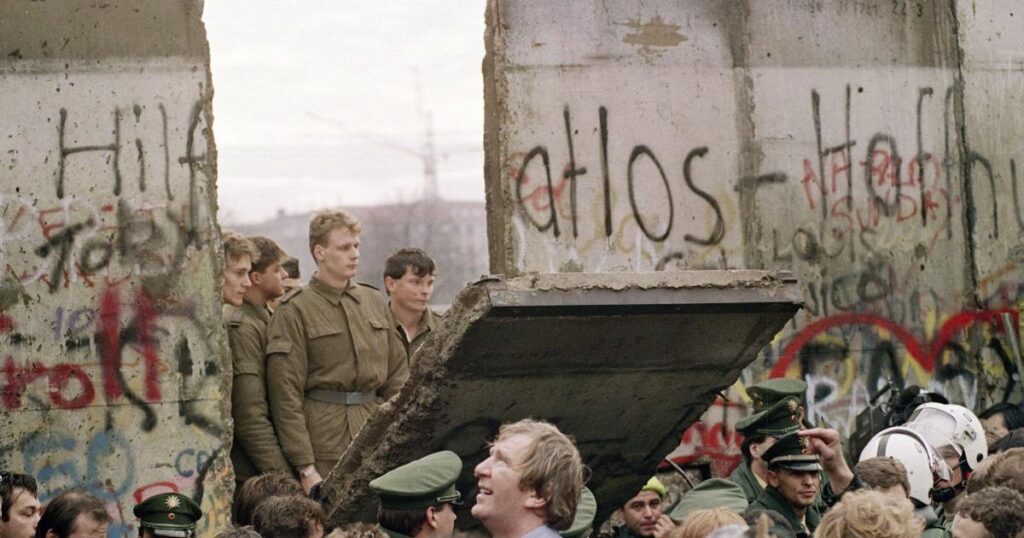
Photo: Gerard Malie/AFP/Ritzau Scanpix
Posing the Question
Such a question seems little more than a provocation until the effects of the interval between the fall of the Berlin Wall and the present are critically examined in relation to their principal effects. On closer inspection, I am not quite prepared, although almost so, to say that the peoples of the world lost ground as a result of the collapse of the Soviet Union and emergence of the United States as the so-called ‘sole surviving superpower.’
Generally, it was rather automatically assumed almost never challenged, that the outcome of the Cold War was a victory for liberal values, including human rights, political democracy, economic growth, and certainly world peace. There was the added popular view that since democracies supposedly do not go to war against each other, and if Communism was discredited on both ideological and materialist grounds, then democracy would spread naturally and quickly, and the world would become in the process more peaceful and its people better off.
It was also assumed with the end of strategic conflict among the most powerful states that substantial resources would be freed and devoted more generously to improving the social and economic wellbeing, end extreme poverty, protect the environment, and invest in the renewal of ageing infrastructures of countries in the West long stressed by the security rigours of the Cold War.
This positive sense of the end of the Cold War was powerfully reinforced by the ideological self-confidence that produced such triumphalist expressions as ‘the end of history’ or ‘the second American century.’ The outcome was seen as a moral victory for capitalist democracies and a defeat for socialist authoritarian states. Even China seemed to throw in its red towel, zestfully embracing its new role as a rising star in the capitalist world market, and many countries, especially in Asia did grow at unprecedented rates, raising living standards beyond all expectations and attaining a higher status as international actors.
The legitimacy of capitalism and constitutionalism were not seriously challenged as the legitimate foundations of world order for the first time in 150 years, underscoring the demoralization of the political left, and its disappearance of the left and fascist right as political forces almost everywhere.
Without doubt, the United States could have taken advantage of this global setting to champion a post-Cold War global reform movement in ways that would in all likelihood have been benevolent, but it chose not to do so.
Instead, it gave its energies to taking short-term materialist advantage of the geopolitical vacuum created by the abrupt Soviet withdrawal from the global scene. One can only wonder how the world might have evolved if a Gorbachev-like leader who espoused a global vision was running the show in Washington while Russia produced someone with the mentality of Reagan or the elder Bush, neither of whom embraced ideas any more enlightened than making the world safe for American economic, political, and cultural hegemony.
American Geopolitical Myopia
In more concrete terms this meant giving priority in American foreign policy to such retrograde global goals as ‘full-spectrum dominance’ with respect to military superiority and in solidifying its global sphere of influence, what was sometimes given historical specificity as ‘the globalization of the Monroe Doctrine.’
George H. W. Bush did use the occasion of the First Gulf War in 1991 to proclaim ‘a new world order’ by which he meant that the UN could become the geopolitical instrument of the West that it was intended to be in 1945 – a peacekeeping mechanism to promote Western interests, which in that instance meant restoring Kuwaiti sovereignty after Iraq’s aggression and annexation.
Washington – soon worried by seemingly vesting authority, responsibility, and expectations in the UN, even as a geopolitical legitimating tool – put the idea ‘back on the shelf’ as a prominent American diplomat at the time put it.
Bush’s Secretary of State told a private gathering shortly after the First Gulf War that his boss made a mistake by connecting the new world order with UN peacekeeping rather than with spread of neoliberal globalization to the four corners of the planet.
American global idealism, always hedged by a realist calculus, was definitely undergoing a normative eclipse.
If the elder Bush had seen the collapse of the Soviet Union as something more than a geopolitical checkmate, we might be living in a different, more hopeful and responsible world. He had the visionary opportunity to strengthen the UN in a variety of ways, including weakening the right of veto, increasing popular participation by establishing a world parliament, proposing a global tax to achieve more independent financing, and calling for a serious world nuclear disarmament conference that might also have directed attention toward the broader horizons of global demilitarization, but it was not to be.
Militarism was too entrenched in government and the private sector. More generally, capitalism was seen as having proven itself the most robust and creative means of fostering wealth and growth and creating decent societies that the world had ever known. Unlike World Wars I & II, the Cold War – despite the language and periodic crises and dangerous confrontations – didn’t end with such widespread elite or public anxieties that it was necessary to adopt important measures to avoid any repetition, which could be construed either as Cold War II or World War II.
The triumphalist mood engendered an unchallenged mood geopolitical complacency toward the future, which had the ironic effect of creating a materialist obsessiveness, a kind of market-driven Marxism (that is, neoliberal globalization) that celebrated and depended upon a consumerist ethos that disregarded the damage being done to the physical, cultural, and psycho-political environments of humanity.
Why the West Lost the Cold War
Why, then, even if account is taken of these emergent patterns, should we take seriously my provocation that more critically considered, the West actually lost the Cold War? I will give my responses in abbreviated form.
• The end of the Cold War created an open road for predatory capitalism: the collapse of socialism as an alternative approach to economic development and state/society relations cleared the ideological path, leading Western leaders to be comfortable about regarding capitalism as ‘the only game in town.’ Without the ideological challenge of socialism, backed by the geopolitical leverage of the Soviet Union, capitalism felt a declining need to show a human face, becoming a victim of its own success.
In practice, this meant rolling back social protection, weakening regulation, and privileging the efficiency of capital over the wellbeing of people. (See my Predatory Globalization: A Critique, Polity Press, 1999). In other words, capitalism needed the challenges posed by socialism and a vibrant labor movement to realize its own humanist potentials. In its post-Cold War enactment, preoccupations with economic growth were useful political distractions from the rising inequality and the adoption of a precautionary approach to increasing ecological concerns.
• The end of the Cold War induced after twenty years a process that led to the legitimation of democratically elected autocratic leadership that manipulated public outrage over failures to raise lower and middle-class living standards, while catering to the ultra-rich. In this respect, due to the disappearance of ideological cleavages, the phenomenon of ‘choiceless democracies’ discouraged political participation, making political parties unsatisfactory vehicles for divergent political views and as sources of creative solutions for societal challenges. The Democratic Party seemed pragmatically as tied to Wall Street and Goldman Sachs as were the ideologically aligned Republicans.
• The end of the Cold War led the United States to lose a sense of direction, seemingly adrift when it lost the Soviet Union as its ‘indispensable enemy,’ seeming essential for achieving social cohesion and a wider sense of purpose. This loss was most controversially, yet effectively, articulated by Samuel Huntington in his 1993 Foreign Affairs article, “The Clash of Civilizations.” His postulate of ‘the West against the rest,’ with particular attention to political Islam exerting pressures along the fault lines of Western Civilization, was given a decisive, although misleading credibility by the 9/11 attacks on the World Trade Center and the Pentagon, the two symbolic embodiments of American power—trade and war-making.
In some respects, the anarchic character of global terrorism was a more disruptive threat to the security of the established order than was the Cold War. Insecurity became pervasive, verging on hysteria, complicating lives and underscoring that after the Cold War the world had become a global battlefield with no place, however well protected by military means, to escape the torments of vulnerability and the inconveniences of ‘watch lists,’ intrusive surveillance, security checks at airports, public buildings, and even hotels and stores.
In this context, Iran has become the statist embodiment of the indispensable enemy, with China and Russia as default options. When the indispensable enemy lacks deterrent capabilities, dangers of military confrontation heighten especially as the enemy is pronounced ‘evil,’ and such a tag is reciprocated by the weaker adversary.
• The end of the Cold War strengthened the political will in Washington to make the world order more congenial in light of the foregoing considerations, with particular attention to the Middle East due to a sense of dependence on access to the oil reserves of the region. What was championed as ‘democracy promotion’ was tried in the Iraq War of 2003 – generating a series of disastrous results such as a costly intervention and occupation that achieved none of its strategic goals in terms of democracy, containment of Iranian influence, permanent military bases, reduced oil prices, and a victory over counterterrorism.
In fact, the American occupation of Iraq was administered in a highly dysfunctional manner that not only generated national resistance, but gave rise to the most extremist non-state political formation the modern world has ever known, ISIS or Daesh, as well as to the disruptive intensification of sectarian tensions within Iraq and regionally.

In effect, the end of the Cold War leading to Soviet collapse and disengagement, allowed the United States to pursue in a less restrained manner more ambitious goals, yet still leading to disastrous results. Regime-changing interventions in Afghanistan, Iraq, Libya resulted in quagmires or in political outcomes that undercut the initial goals, spread turmoil and distrust of American global leadership.
Only late in 2019 does there seem to be some hope for restored regional stability due to the frustration of U.S. goals, Russian reinvolvement during the terminal stages of the Syrian ‘international civil war,’ and Saudi Arabia moving toward a possible accommodation with Iran.
The unappreciated irony is that the last best hope for stability in the region is to restore a geopolitical discipline that encourages all actors to behave more cautiously.
• The end of the Cold War has serious diminished the quality of world order in several crucial dimensions, including even the likelihood of war fought with nuclear weapons. With less incentive to ensure war-prevention and maintain alliance cohesion and in light of greater political independence by many states, international cooperation has declined at the very time when it is most needed in relation to ecological protection (climate change, biodiversity, acidification and rising sea levels).
Warfare and climate change have induced large-scale migratory movements that have pushed many more affluent countries in ultra-nationalist directions with adverse consequences for human rights, democratic forms of governance, international law, and the authority of and support for the UN System (as expressed by withheld dues and budgetary stresses).
When the Cold War raged, the West used internationalism and humanitarian diplomacy not only as venues for propaganda, but to gain the higher moral, ideological, and political terrain in relations to the Soviet Union and socialist management of the economy.
With the Soviet collapse, Western countries pursued economic gains in imprudent ways that produced the current crises of inequality and corruption in many societies and a general situation of ecological malaise.
A Concluding Note
This contrarian argument does not contend that the Soviet Union (or Russia) won the Cold War, although after a period of decline and austerity, the return of Russia to the ranks of geopolitical leaders with less ideological and imperial baggage (considering the independence of countries in East Europe and Central Asia), such a case could and perhaps should be made.
The main claim in this essay is that the end of the Cold War was not, as triumphalists claimed, so much of a victory for world capitalism in its neoliberal modes and of constitutional democracy as it was assumed to be in the early 1990s.
It became an occasion for less regulated economic globalization and for new violent political encounters that has made the world into a global battlefield in an unresolvable struggle between non-state extremist multinational networks and various established sovereign states. In the process, due to internal and international moves away from global responsibility by the United States, a global leadership vacuum has emerged while a variety of unchecked dangerous trends imperil the human future.
The initial, and perhaps decisive, failure to assert global leadership after the end of the Cold War involved a failure at a moment of global fluidity to seek reforms that could facilitate various forms of environmental protection, denuclearization and demilitarization, and the enhancement of the normative order via a stronger UN and a greater acceptance of international law as serving the national interests of geopolitical actors.
The United States enjoyed the historic opportunity to lead such an effort, but other countries were remiss in not putting forward proposals and creating pressures that might have induced more constructive American behavior at such a potentially opportune time.
It seems especially a lost opportunity from the perspective of the present in which cosmopolitan sentiments have been so pervasively pushed aside by nativist forms of ultra-nationalism.







One Response
Actually, nationalism is not the enemy or villain. it is globalist corporatism (and that includes the mega corporate banks), which is slowly making us all serfs on a global plantation, that is the enemy of peace and stability in much of the world.