Prefatory Note: The following essay will appear as a chapter in Peter Burden & Klaus Bosselmann, eds., The Future of Global Ethics (Edward Elgar, 2018), with the title:
Revisiting the Earth Charter 20 Years Later: A Response to Ron Engel
Ron Engel has articulated an insider review of the Earth Charter so thoughtfully, urbanely, and persuasively that my initial temptation was to restrict my response to a single word: ‘Amen!’
Yet I am familiar enough with the academic ways of gathering diverse voices to explore a topic or to evaluate the scholarship of a distinguished author, as to discard my one-word option. At the same time, it would be misleading if I didn’t praise Ron Engel for putting so many elusive issues before us in such a lucid and compelling manner as to make my efforts at dialogue feel a bit forced, given the high level of agreement.
Originally posted on Richard Falk’s blog on August 27, 2019 here
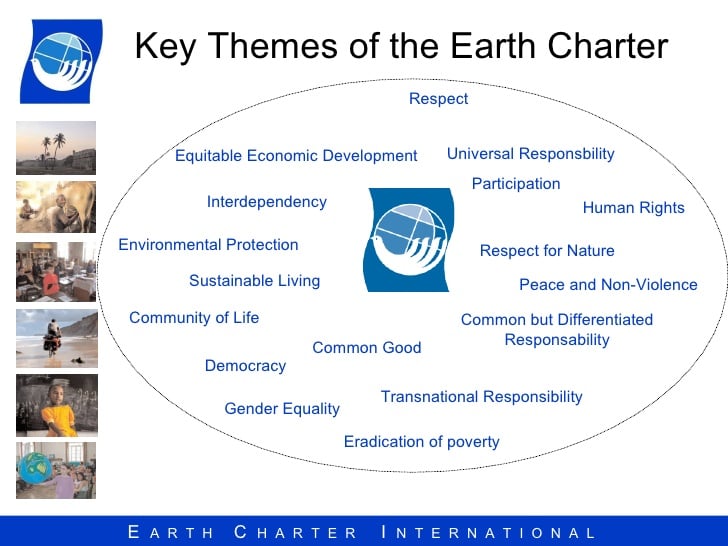
This endorsement of Engel’s call to action for the realization of the ambitious goals of the Earth Charter does not strike me as particularly dialogic, but rather as expressive of the importance of transnational consensus-building at this stage among the like-minded constituency of ecological worried on the crucial transformative challenges that lie at the heart of the making the Earth Charter into a Plan of Action, or at the very least, a manifesto.
In effect, if the Earth Charter presents the vision, a manifesto could implore implementation by identifying what needs to be done, and by whom.
Can we, amid the complexities and contradictions of the historical present, identify agents of change or social forces comparable to the manner in which Marx and Engels interpreted the role of the working classes in mid-19thcentury Europe?
Without differing from Ron Engel except in choice of words, I am wondering how to achieve political traction for a transformative political movement that agrees with him that the most formidable obstacles lying on the path leading toward planetary peace and justice are ideologies and practices associated with neoliberal capitalism and its strong linkages of mutual dependence with militarized governmental bureaucracies.
In recent years, this toxic set of institutional/ideological linkages has been able to divert the peoples of the world and most governing elites from the challenge of restoring pre-industrial ecological integrity to such issues as the threats to civilizational coherence posed either by trans-civilizational migratory flows that expose the fragility of democratic values and practices, climate change, various forms of globalization that reinforce inequalities and enrage those feeling themselves left behind.
In reaction, many populated and affluent societies of the world have perversely placed their trust, and their future, in demagogic leaders and ultra-nationalist political parties who proclaim anti-ecological agendas in spirit and substance.
In light of this, it does seem rather utopian to situate current hopes on the ecological radicalization of democracy in ways that insist on the implementation of equality across the spectrum of human concerns and even extend the boundaries of ethical sensitivity to encompass non-human species.
Can we, in other words, really rely on the peoples of the world to form a movement powerful enough to bring the Second Axial Age into being, especially at a time when the transcendent values of the First Axial Age are being so widely betrayed?
At least, we need some exploration of why such a belief in the reinvigoration of democracy is not a mere exercise in wishful thinking and needs to be put aside if we are to contemplate the future with an open mind.
I admit that if a skeptical eye is turned toward the present potentialities of democracy, we need to ask, ‘what then?’ to escape from falling into a dark pit of despair. Certainly, none of the now competing secular ideologies, or their religious analogues, seem capable of taking on such a mission.
It could be that we are experiencing nothing more than a democratic pause, and that there will be a dialectical renewal of democracy in reaction to the dominant autocratic/populist political trajectories that now seem to be moving the world toward ecological crisis, if not catastrophe.
We need to remember that the best Athenian minds, including Plato, Aristotle, Thucydides, all lost faith in democracy due to the capacity of demagogues to turn the citizenry of their city into a frenzied warmongering mob that made Athens succumb to its own hubris. This surrender has often been misunderstood and misapplied by the power-mad realists shaping global governance in its present hybrid mixture of statism and geopolitics, the chaos of interacting sovereign states ‘disciplined’ by the grand strategies of the dominant states.
The Melian Dialogue in Thucydides, The History of the Peloponnesian War, is often cited by writers on international relations to show that in the foreign encounters of states, power counts, and that’s it, with reliance
A more careful reading of Thucydides’ whole history shows that this first great historian of warfare was using this apparent whitewash of cruelty and opportunism in war as indicative of Athenian decline, and not as a comment on the way the world works.
It was suggesting to attentive readers that those who do not respect universal morality in dealing with their weaker adversaries will themselves perish before long.
This is a message our militarist political elites refuse to heed or even receive and they are aided in doing so by think-tank realists and
Perhaps, the most startling claim in Engel’s essay is that the Earth Charter is actually illuminating the ontological essence of human reality. Such a bold assertion sets the agenda of the Second Axial Age as above all tasked with converting this sense of humanity as ecological beings into a living historical reality. By invoking ontology Engel is claiming that Earth Charter perspectives depict “the essential structure of reality” that definitively establishes the moral boundaries of human endeavor and grounds hope for a relevant global movement for self-government as necessarily responsive to this understanding.
I share the view of Engel that we must keep focused on what is necessary and desirable, and not let our views of the future get hijacked by the self-interested entrepreneurs of what is feasible and reasonable who continue to exert near
Among the most insidious of these entrepreneurs are the corporatized media giants that feed our minds with a false confidence in the normalcy of our times, thereby distracting us from an appreciation of the urgent priorities that stem from its unprecedented systemic abnormality.

This media spin on the contemporary world obstructs most efforts to achieve a relevant critical awareness. Without such an awareness, the needed emergent consensus on who we are and how we should behave is situated on a terrain that is out of human reach. Instead of an ecologically driven focus, the mainstream media is leading the worthy fight in so many places to protect freedom of expression from statist and corporate encroachments, thereby offering a better understanding of the abuses attributable to autocratic forms of governance operating at the level of the state.
While this struggle is truly significant, and must be waged, it is not as central as is the struggle to recover an ecological sense of our beingness-in-the-world, a sense that came naturally to many native peoples around the world whose existence was not only suppressed and exploited, but their wisdom discarded by reductionist and hegemonic versions of how human society interacts with its natural surroundings.
At the very time when we need to be conditioned by the ecological imperatives of a new global ethics, most societies are in the grips of these earlier struggles to avoid slipping into 21stcentury versions of the dark ages or at best making themselves content with being ‘entertained’ while the fires of ecological disarray move ever closer.
In this sense, the political struggles being waged are tinkering with the modalities of how human society manipulates nature for its benefit instead of recovering modalities of mutuality and reciprocity that can produce structural changes as well as fight policy battles within anachronistic ontological frameworks.
What is possible and necessary, and follows from the coherence of the Earth Charter, and our recognition of the truthfulness of its presentation of reality, is altering the sense of citizenship and political participation, at least for those of us that endorse the vision. I find that the call for global citizenship, which Engel affirms, to be somewhat misleading. Citizenship presupposes community, and what is lacking at present is any meaningful sense of global political community.
For the overwhelming multitude of people the boundaries of territorial sovereign states exhaust the content of political community. Moving toward an ecological civilization will require the emergence and construction of a genuine and robust global community, but that is a project for the future rather than presenting an existing alternative. It is a task for the future, and needs to be identified as such to avoid a purely nominal claim of global citizenship in a global setting shaped by nationalist ideologies that inhibit in the name of traditional patriotism, any real engagement with either species or ecological wellbeing, especially when these normative strivings are seen to place burdens on the pursuit of nationalist priorities.
For this reason, I prefer the language of ‘citizen pilgrim’ as self-identifying those of us seeking to construct a global community that is organized around global ethics of the sort that flows from an acceptance of the worldview embedded in the Earth Charter.
In my imaginary, the citizen pilgrim is embarked on such a journey equipped with maps that locate no fixed
In the background of such musing, is a problematic sense that the United Nations, as the institutional center of the international legal order, was supposed to prefigure such a global community. From a reading of the Preamble to the UN Charter it was clear that the new organization was expected to promote human interests rather than provide an additional vehicle for realization of national interests.
Such an idealistic perception of the UN was always doubtful, and at most expressed a vague expectation to be fulfilled at some distant time in the future. The constitutional makeup of the UN reflected the anarchic workings of existing world order, giving priority to the equality of sovereign states as against the claims of either people or nature and allowing the dominant states to use their right of veto so as to
In light of this background, it should have been anticipated that the UN would become over time primarily an instrument combining statecraft and geopolitics, and only rarely a crucial venue for global policy
Such a generalization is not meant to withhold credit from the UN, especially from its specialized organs dealing with health, children, culture, human rights, and environment in ways that improve lives and the habitat, but within frames of thought and action that are almost totally pre-ecological.
At the very outset of his
This undertaking is quite revolutionary in its call for reordering the values and practices that have prevailed throughout modern human history, it is further extended, by a fundamental ecological pedagogy insisting that we as a species can only expect to live in a sustainable manner if we also enlarge our moral and political imagination to take into account the wellbeing of non-human species.
The realization of the Earth Charter vision would seem to depend upon the existence of institutions having as their primary mandate a mission to serve peace and justice for all peoples of the world, not by implementing the outlook of a growth-oriented developmental economy, but by reference to an ecologically infused global ethics.
Richard Falk
What that means concretely needs to be worked out in ways that acknowledge the contradictions that exist when it comes to mediating inter-species relations on the basis of some measure of mutuality. Does it, for instance, require the adoption of a dramatic dietary embrace of vegetarianism by the entire human species, or is it sufficient to treat animals decently and killing only for subsistence as native peoples clearly did?
Who is there to identify the demographic limits that meet the standards set by an ecologically grounded global ethics, and how will such limits be set and implemented? Engel regards non-violence as integral to the dynamics of the transformation expected to result from the Second Axial Age, but does that mean that security for communities can dispense with weapons and count on the disappearance of violent crime?
Such questions are illustrative only.
I was struck by a recent report that a year ago in a penguin colony in Antarctica only two penguins survived from a birth cohort of 18,000 due to the diminished ecological conditions prevailing in their customary habitat.[2] Among the causes of such a doleful incident is industrial fishing that has greatly diminished the supply of krill on which not only penguins, but giant squid, the blue whale, and seals depend upon for sustenance.
From the perspective of humane ecology, there arise a series of questions about balancing the needs and desires of the human species against the wellbeing of other species, including whether certain
Given the gross disparities that exist in material circumstances and resource endowments in the world as we know it, is it plausible utopianism to insist on equality as the measure of a just society, or is it more credible to settle for equity, fairness, and material needs (as already posited as human rights in Articles 25 and 28 of the Universal Declaration of Human Rights).
There are many more relevant issues if the design of ecologically oriented global governance is to become, whether by stages or through a revolutionary surge, the signature achievement of the Second Axial Age.
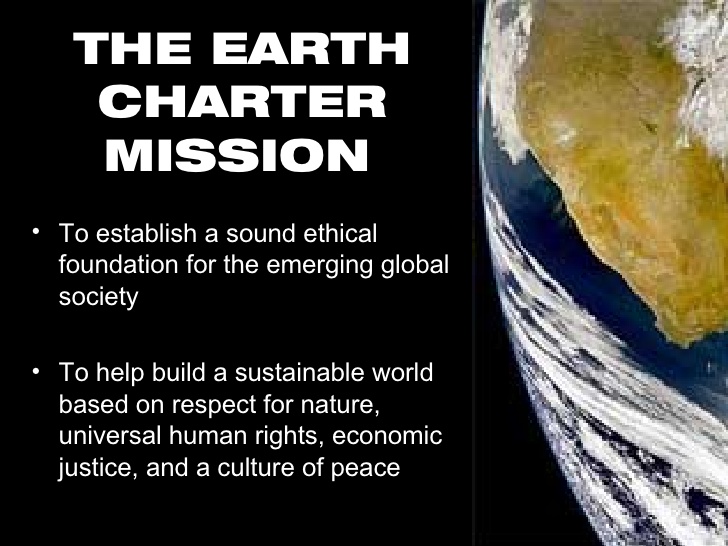
One such overarching issue is whether a kind of minimalism could fashion early effort to make the Earth Charter assume the status of being a political project, and more maximalist views being held in abeyance.
There is also the question of time, and the related urgency of meeting challenges that cannot await for the usual rhythms of historical change to work their way into human experience. The pace of technological innovation shortens time horizons in ways that societies seem unable to absorb, and so deny to varying extents. This seems true whether it is the advent of nuclear weaponry or digital life styles.
It would seem that we are living with unrealistic calmness in the midst of a consuming global emergency.
We cannot hope to achieve the vision of the Earth Charter by waiting for it to happen, and the value of Ron Engel’s essay is to impart such feelings of urgency with respect to moving from vision to action. In my terms, can a band of citizen pilgrims be the Paul Revere’s of this age, sounding alarm bells that awaken the slumbering masses before it is too late?
I know that some respected commentators on the global situation insist that we are already too late, have crossed vital ecological and biodiversity thresholds of no return. I resist such pessimism, or its twin, optimism, for the simple reason that the future is unknowable. If unknowable, then we share the responsibility and opportunity to work toward a preferred future.
We are living in a period when the only politics that meets our needs as a species and our planet as an ecological entity is ‘a politics of impossibility,’ which is another way of saying that mastering the art of the possible has no chance of embodying the vision and values of the Earth Charter, along with Engel’s gloss, in the realities of the human future.
[1] Thucydides, The Landmark Thucydides: A Comprehensive Guide to the Peloponnesian War (Free Press, translated by Richard Crawley, 1998) 588.
[2] See article by John Sauven, director of Greenpeace, in The Guardian, Oct. 13, 2017 under the title “Penguins starving to death is a sign that something’s very wrong in the Antarctic.”
About the Earth Charter