
By Kevin Cashman and Cavin Kharrazian
Iranian foreign minister Mohammad Javad Zarif recently visited the Group of Seven (G7) at the invitation of French
Back in 2018, after months of increasingly hostile rhetoric, the US government withdrew from the Joint Comprehensive Plan of Action (JCPOA), or “Iran Deal,” and imposed a “maximum pressure” campaign that included
Originally posted on September 1, 2019, on the
Center for Economic and Policy Research (CEPR) here
When President Trump reimposed sanctions in November 2018, it cut off Iran’s oil exports and access to the international financial system. At the time, he announced that Iran could comply with new US demands or face “economic isolation.” Additional US sanctions issued since then have specifically targeted a thousand individuals and entities with the goal of reducing Iran’s oil revenues to “zero.” More recently, Trump said that although “[Iran’s] economy is crashing…it’s very easy to straighten [it] out or it’s very easy for us to make it a lot worse.”
And so, according to Trump himself, the United States has the power to solve – or exacerbate – Iran’s current economic problems. What is left unsaid, including by much of the media, is that sanctions that “crash” the economy
In Venezuela, which is under a similar US sanctions regime, there have been similar effects, with more than 40,000 people estimated to have died from 2017 to 2018 due to the “collective punishment” inflicted on them.
Yet other statements from US administration officials often contend that sanctions have negligible economic or social effects on the general population of Iran.
For example, the US State Department’s special representative for Iran, Brian Hook, recently denied that US sanctions on Iran affect the availability of medicine and agricultural products. In this argument, Hook divorces the connection between the economic damage caused by sanctions in Iran and the lack of basic necessities like medicine and food, preferring to instead lay blame on the Iranian government, not what the Trump administration calls “targeted” sanctions.
Are the sanctions causing Iran’s economic problems, or simply a way to punish individual actors? Answering this question requires an examination of the impact sanctions have on Iran’s economy and the mechanisms by which sanctions work – two important areas of inquiry that seldom receive attention in the US press.
Sanctions are severely impacting Iran’s oil production
Looking at Iran’s oil sector, which has been directly targeted by the sanctions regime, is a good way to get a sense of how the sanctions have affected the country’s economy, which remains dependent on the production and export of oil, according to a number of indicators. For example, around 70 percent of Iran’s merchandise exports consists of fuel.
Although this dependence on oil production has decreased over the last decade, in large part due to government efforts to diversify the economy, the International Monetary Fund (IMF) reported in March 2018 (before the announcement of the resumption of US sanctions) that oil revenues accounted for nearly 40 percent of government revenues in fiscal year 2016–17, and projected a similar number for fiscal year 2017–18 (assuming, then, that there would be no new sanctions).
Clearly, a large reduction in Iran’s oil production would pose significant challenges to its ability to provide services to its people, as well as maintain essential imports including some foreign-produced medicines and other healthcare and life-saving goods.
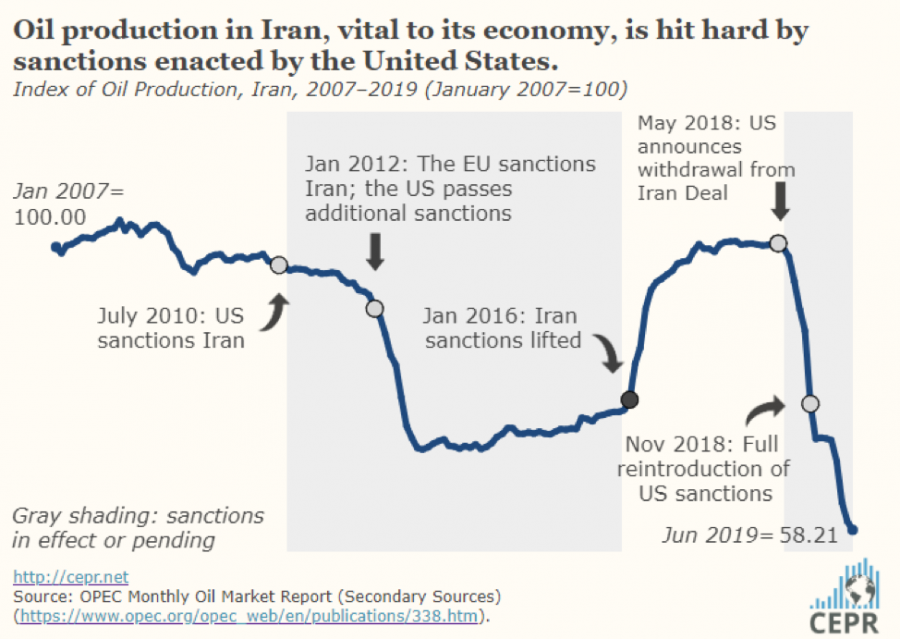
Unsurprisingly, Iran’s oil production moves very much in tandem with the enactment and repeal of broad sanctions over time (see the figure below). US sanctions in 2010 affected investment in Iran’s oil infrastructure and prohibited some international transactions.
Then, in early 2012, the United States and the European Union banned oil imports from Iran and froze its central bank assets. Shortly thereafter, oil production plummeted and reached its nadir in late 2012. After the Iran Nuclear Deal (JCPOA) was enacted in early 2016 and US and EU sanctions were repealed, Iran’s oil production rapidly recovered to 2007 levels.
This level of production was maintained until the announcement by the Trump administration in May 2018 that the United States was withdrawing from the JCPOA.
Since May 2018, Iran’s oil production has fallen precipitously; it is down by over 40 per
To get a sense of the size of these impacts, it’s useful to compare what they would look like in the US economy. If applied to the United States, they would be comparable to a budget reduction of $521 billion or 16 per cent in 2018. However, this would also represent about 85 per
While the United States would be able to borrow or create money to fill this deficit, Iran has much less capacity to do either without triggering more economic difficulties.
Broader economic impacts are also visible:
The IMF lowered growth projections for Iran due to the “crippling effect of tighter US sanctions” in its July update. Based on this projection, it is estimated that the economy will contract by 9.3 per cent in 2019. This is a downward revision from a previous projection in April of a decline of 6.0 per cent. Before the sanctions, the economy was projected to grow by 4.0 per cent.
Other indicators also worsened after the reimposition of sanctions: the unemployment rate is estimated to be 25 per cent; inflation has risen to 80 per cent, and the currency has lost over half its value.
Sanctions are exacerbating social problems
The main mechanism by which oil production has fallen is the same mechanism that prevents Iran from importing food and medicine: Iran cannot find buyers for its oil on the open market, just like it cannot buy food or medicine on the open market. In effect, it is cut off from the US-dominated international financial system.
Uniquely, the United States exerts broad control over international banking transactions. One way is via the SWIFT and CHIPS systems, which handle the vast majority of those transactions. The SWIFT system, which provides a common communication system for banks, is controlled by US banks, which own the majority of the system and have officials on its board.
On top of that, despite not being located in the United States, SWIFT makes all of the system’s data available to the US government, even if those transactions do not involve the United States.
The CHIPS system, which provides communication as well as settlement functions, is governed by US law, has many US banks as owners, and is directly overseen by US authorities. These systems rely on a network of correspondent banks -which link banks that might not have relationships with one another – to complete transactions. The apex of the correspondent system is the New York Federal Reserve Bank, under the control of US banking authorities, which also serves as a lender of last resort to other central banks.
A system designed in this way ensures that banks with no relationship with each other still can transact in a common currency (dollars) via a common bank (the New York Fed) in an agreed-upon framework (SWIFT and CHIPS).
However, it also means that the United States has disproportionate power over transactions. Formally, the United States government, via the Office of Foreign Assets Control, can prohibit transactions involving Iran to pass through systems and banks in which it has jurisdiction.
More informally, the US government can pressure SWIFT, other central banks, correspondent banks, and even specific firms to adopt policies of refusing to do business with Iran.
Since these players fear retribution from US authorities (e.g., being sanctioned themselves), they are usually unwilling to take the risk of doing business with Iran unless they have no other business that might involve the United States or financial entities that can be pressured by the United States.
Because the international banking system is designed in this way, US sanctions on the Iranian economy effectively mean that not only can Iran not easily sell oil on the open market, it cannot easily buy food or medicine either, even if the latter are nominally exempt, as Hook says. This is because sanctioned Iranian banks and officials are ultimately involved in these transactions in the same way that they are with oil, often by virtue of the position they hold in the Iranian banking system.
It is telling
Unsurprisingly, efforts at importing food and medicine via the technical exemptions that do exist often fail. It appears that the technical exemptions are used more to deflect criticism of sanctions overall than to actually permit the importation of food and medicine.
But on top of these issues, even if food and medicine were, in reality, exempt from the sanctions regime, the “crippling effect” on Iran’s economy would impact the Iranians’ financial ability to acquire food and medicine anyway. Iran would have fewer resources to devote to domestic food and medicine production, and many fewer resources to import the same products.
Adapting to US sanctions
It is surprisingly difficult to bypass this financial system because it is so entrenched, although it is not impossible. For example, countries might set up a bilateral or multilateral system to carry out transactions in their own currencies and settle accounts in a currency other than the dollar. Iran could negotiate bilateral trades with India: in exchange for oil, Iran would accept rupees, and then use those rupees to purchase Indian products.
The downsides are that mechanisms would be needed to support these transactions (i.e., establishing parallel payment and banking functions). In addition, Iran would need to find a use for the rupees it received in exchange for oil, usually by buying Indian goods (this is because it would be difficult to exchange rupees for other currencies on the open market due to the sanctions).
One promising new multilateral mechanism, dubbed INSTEX, would allow trade between EU countries and Iran without relying on direct transfer of funds or the use of the US-dominated financial system. While in its beginning stage it will only deal with humanitarian trade, INSTEX’s model could potentially create a new path to buy Iranian oil. It is telling, however, that EU countries set up an entirely different financial mechanism to use for humanitarian trade, rather than risk drawing the ire of the United States by using established channels.
Yet these alternative mechanisms are not immune from US influence either. In recent cases where countries have announced intentions to develop alternative trade arrangements, the United States has applied political pressure to nipthem in the bud. This involves overt economic threats as well as rhetoric urging countries like India to refrain from using a “narrow bilateral lens” in economic trade.
In the meantime, Iran is able to sell some oil to countries such as China, Russia, and India; either to pay back debt or because some banks in these countries do not have a significant business that can be impacted by US retaliation. It also has had some success in covertly transferring oil to buyers, but this does not always escape US control. Similarly, Iran is able to maintain imports of some items, like bananas, outside of the established financial system primarily due to the experience and ingenuity of importers, although usually at lower volumes.
It should be clear that the US is uniquely positioned to choke off imports and exports from a targeted country using sanctions, with deep, negative consequences for that country’s economy as well as severe constraints on its government’s ability to address economic problems.
In Iran’s case, US sanctions mean that production of oil – a vital export – is in free fall, unemployment is on the rise, and record inflation due to scarce imports has made it harder for everyday Iranians to buy basic goods and access life-saving medicine.
Recent reports have detailed harrowing stories of hospitals running out of crucial cancer medicines and patients struggling to afford or even find their prescriptions.
As in Venezuela and other targeted countries, US sanctions undoubtedly have a human toll associated with them, which will only grow as time goes on. This human impact is one of the main reasons that experts in international law argue unilateral sanctions are illegal under the United Nations Charter and international human rights law.
While Iran has been exploring alternative ways of exporting and importing goods, it’s unclear what more it could do absent relief from sanctions. Even so, US officials will typically place responsibility for the social and economic problems resulting from the sanctions on the Iranian government, as Hook does. But Trump’s comments are more revealing. Sanctions only work because they cause suffering in the first place.
In effect, the United States is risking – and sometimes ending – the lives of thousands of Iranians with the hope that the Iranian government acquiesces to its demands or is replaced by a more compliant government.
That the United States could carry out such a strategy in the first place should raise serious questions among concerned US citizens and within the international community, especially among those who respect international law.

Kevin Cashman, Senior Associate at the Center for Economic and Policy Research in Washington, DC., has a B.A. in Biological Chemistry and Political Science from Grinnell College. His experience includes time working in environmental protection, organizing, and progressive political advocacy, specifically supporting the expansion of social insurance and healthcare programs. He is interested in analyzing our society from a perspective that includes economic and social justice, class, race, and gender.
Cavan Kharrazian is a researcher at the Center for Economic and Policy Research in Washington, DC. He holds an MA in Development Studies from the International Institute of Social Studies in The Hague, where he explored debates around alternative development models and specifically focused on agrarian, food, and environmental issues. He has engaged in participant research with social movements in Mexico that are fighting against water grabbing, and hopes to continue scholar-activism in solidarity with movements around the Americas.
The original article was published by Jacobin.
Note
Please see this important statement by the UN Human Rights Office of the High Commissioner (OHCHR).






One Response
This excellent article leads one to conclude that: 1- The Trump administration is engaged in economic terrorism against Iran. It is also clear that US actions amount to an almost total blockade imposed on Iran, which is an act of war and contrary to the UN Charter. 2- The function of the dollar as a universal currency means that the United States can exert enormous pressure on other countries and economies, and in effect deprives other countries of their economic independence. 3- By imposing illegal, extraterritorial sanctions on Iran, US government is pursuing a policy of collective punishment of the entire population, as it did in Iraq, Venezuela, North Korea and other countries where the sanctions were responsible for the death of hundreds of thousands of people, especially children, which is a form of genocide. 4. If the international community wishes to put an end to this disastrous situation it has no option but to find alternatives to the US dollar, thus ending US’s undue dominance over international economy. This requires collective action by all the leading economies. The alternative is total subjugation of other countries to US Empire. 5- The current unipolar world, dominated by the US military-industrial complex, will inexorably lead to a global conflagration that will spell the end of human civilisation. Therefore, it is incumbent upon all other members of the United Nations to revive the ideal of that organisation about the equal rights of all member states and to establish a multipolar system before it is too late.