
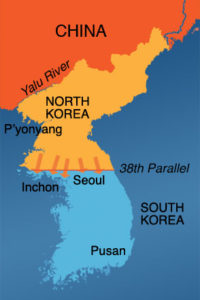
A map of the Korean Peninsula showing the 38th Parallel where the DMZ was established in 1953. (Wikipedia)

“Do not demonise North Korea. Demons do not negotiate. If there are no negotiations, there will be war.”
The words of Chung-in Moon to journalists who gathered for the Korea Press Foundation journalism conference in Seoul, last October, as diplomatic efforts were being stepped up for a second summit meeting between Kim Jong Un and President Donald Trump.

Moon is a sage old hand of arms control talks. A current member of the South Korean government’s advisory committee on diplomatic strategy, he previously served as Ambassador for International Security, combining these posts with his career in universities.

His advice was timely, given the findings of new research on Australian media and how they refer to the Democratic People’s Republic [i]. In coverage from two major newspapers and the public broadcaster, the ABC, North Korea was usually described as rogue, secretive, totalitarian or evil, with its leader “often referred to as a ruthless psychopath.”

Dominant metaphors tended to be conflictual, framing the country as “a military threat [and] unpredictable, irrational and ruthless.” As the researchers comment, the pattern is typical, and not just in Australia.

What would it take, to change the tenor of international coverage? Restraint, for one: CNN’s Seoul correspondent Paula Hancocks, who also spoke at the conference, recalled how she successfully argued against the network running a story on claims that Kim had removed one of his relatives, fallen from government favour, by feeding him to a pack of dogs. Editors in Atlanta had been keen on the story, which was being widely aired elsewhere, but Hancocks advised caution, given that no firm evidence was available to support it.

What can the Peace Journalism playbook contribute?

How can readers and audiences be prompted and equipped to consider and value nonviolent responses to the still-unresolved conflict on the Korean peninsula, with all its potential dangers? Look past slogans from both ‘sides’ to focus on the goals of the conflict parties, for one.

The Korean war of 1950-53 has never been declared officially over. The Koreas are separated by a so-called Demilitarised Zone (DMZ) which marks the ceasefire line. Given this, Moon said, it was vital to realise that the North saw no reason to consider itself “a defeated nation. [So, they would think] don’t treat us as if we have to surrender to the United States.”

Reporters should therefore regard with scepticism calls by hawkish voices on the American side for “complete and verifiable disarmament” before concessions such as the lifting of sanctions (which, indeed, collapsed the second Trump summit, when made under the apparent influence of National Security Adviser John Bolton). Approaches that provide for such steps to proceed in parallel should be seen as more realistic.

Another distinction in the Peace Journalism model originally proposed by Johan Galtung is to focus on “people as peacemakers”, not just leaders. A couple of months before leaving for Seoul, I listened to a talk, at Sydney’s Exodus Foundation, by the veteran nuclear disarmament campaigner, Joseph Gerson, who was visiting Australia from the US. Because the North Korea talks were an initiative of the Trump White House, he explained, Democrats were instinctively sceptical, if not downright hostile. A typical line was: “this is all a sham, Trump gave up too much, we should still be exerting maximum pressure.”

Instead, he called on the official agenda for the process to be “attacked from the Left: demand the formation of negotiating teams” to hammer out a sequence of real progress towards denuclearisation, and the “easing of the trade and medicine embargo.” This would also meet one of Galtung’s key recommendations for reporting peace plans, which I presented at the Seoul conference: ask “is the peace plan a process, or only an outcome?”

Beyond the day’s headline, what happens next?

If non-elite voices deserve greater prominence on the American side, the same is true on the Korean peninsula. Korea Peace Now: Women Mobilizing to End War, was an intervention by the Nobel Women’s Initiative and Women Cross the DMZ. Taking the form of a letter to Presidents Trump and Kim, they called for normalization of relations by “establishing reciprocal liaison offices, lifting sanctions that harm vulnerable individuals, and facilitating people-to-people engagement.”

One of the chief gains from the first Trump-Kim summit in 2018 was a “freeze for a freeze”: no further nuclear weapons testing by Pyongyang, in exchange for a halt to joint military exercises between the US and South Korea. Peace campaigners are calling for the latter to be made permanent.

Over recent years, the pristine environment of Jeju Island has been violated by the establishment of a new naval base, which hosted an “international fleet review” last October. The local Association of Gangjeong villagers, who opposed the development, called on third countries not to send warships to take part. If more media were prepared to listen seriously to such voices, then a more nuanced picture, exposing more of the realistic prospects for peacemaking, could emerge.

As Annabel McGoldrick and I argue in Peace Journalism, our book [ii] distilling many of the discussions we conducted with editors and reporters around the world, presenting inputs to news from unconventional sources requires journalism to construct a “framework of understanding” to establish their relevance to the story.

Today’s journalists must do this anyway, it could be argued, to justify their existence as professional communicators.

Another contributor to the Seoul conference was Thomas Rosenstiel, Executive Director of the American Press Institute. Publics now require “news fluency”, he said, to enable them to differentiate journalism they can rely on. Editors and reporters can help by explaining “how and why this was a story.” If the message from journalism to readers and audiences in the 20th Century was “trust me”, its equivalent for the 21st, in a world of unprecedented media plenitude, was inverted.

Now, the message was coming from readers and audiences, demanding greater transparency as a corollary of that trust: “show me.”

Part of the remedy, for the demonising coverage exposed by the findings on Australian media, would, the researchers say, be to feature “more stories illustrating individual and community life. This would give North Koreans a human face.” Getting the requisite access for such stories is difficult, they concede. However, a notable example screened this year on Australian television, which points the way.

The Foreign Correspondent strand on ABC Television took us into the heart of a unique US-North Korean cooperative venture, between clinics in the country for patients with multidrug-resistant tuberculosis – a deadly disease that strikes half a million people a year worldwide – and volunteers from the Eugene Bell Foundation, who work with them.

Titled ‘Out of Breath’, it’s a moving and memorable film, deserving to be more widely viewed – which it can be, on the program’s website [iii]. “I will never forget the first tuberculosis centre I visited,” the film-maker, Hein S Seok, has written[iv]. “As soon as we stopped, the North Korean medical team rushed over with huge smiles. I realised I was witnessing a reunion of old friends who had been working towards the same goal for decades… I discarded any assumptions I might have had about the North Korean people.”

As long-form journalism (the film runs at 28 minutes), it’s in a genre that lends itself most readily to the PJ approach. But there are clear opportunities now for editors and reporters engaged in all forms of journalism to peer beyond the clichés, engage with the goals and agendas of the parties to an unresolved and potentially dangerous conflict, and make room for peace to enter the debate. [v]

Notes

[i] Bronwen Dalton (2019) ‘Hermit kingdom, nuclear nation: if the media keep calling North Korea names, it will only prolong conflict’, The Conversation, February 28.

[iii] https://www.abc.net.au/foreign/out-of-breath/10825830

[iv] Hein S. Seok (2019) ‘Amid international tensions, the battle to treat “contagious cancer” in North Korea’. ABC News, February 19.

Associate Professor Jake Lynch chairs the Department of Peace and Conflict Studies at the University of Sydney. And a TFF Associate.
His debut novel, Blood on the Stone: An Oxford Detective Story of the 17th Century, is published by Unbound Books. Jake has spent 20 years developing and researching Peace Journalism, in theory and practice. He is the author of seven books and over 50 refereed articles and book chapters. His work in this field was recognised with the award of the 2017 Luxembourg Peace Prize, by the Schengen Peace Foundation. He served for two years as Secretary General of the International Peace Research Association, having organised its biennial global conference in Sydney, in 2010.
Before taking up an academic post, Jake enjoyed a 17-year career in journalism, with spells as a Political Correspondent in Westminster, for Sky News, and the Sydney Correspondent for the Independent newspaper, culminating in a role as an on-screen presenter for BBC World Television News. Lynch is a member of the TRANSCEND Network for Peace Development Environment and advisor for TRANSCEND Media Service.
He is the co-author, with Annabel McGoldrick, of the book Peace Journalism (Hawthorn Press, 2005), and Debates in Peace Journalism, Sydney University Press and TRANSCEND University Press. He also co-authored with Johan Galtung and Annabel McGoldrick ‘Reporting Conflict: An Introduction to Peace Journalism,’ which TMS editor Antonio C. S. Rosa translated to Portuguese.
His most recent book of scholarly research is, A Global Standard for Reporting Conflict (Taylor & Francis, 2014).
Related Posts

Tony Robinson October 4, 2026 Violence is easy to recognise when someone is being beaten, shot or killed. It becomes more difficult when nobody is holding a weapon. Poverty, discrimination, exploitation and repression can restrict a human life just as effectively, although they do so in very different ways and with very different consequences. Simply adding more categories to an ever-growing list of forms of violence does not really solve the problem. The more interesting question is what all these different situations have in common and why it makes sense to describe them using the same word. Human beings do not simply react to what happens around them. They remember the past, imagine things that do not yet exist, make plans and undertake projects. Workers organise because they imagine different working conditions; people migrate because they imagine another life somewhere else; social movements emerge because people refuse to accept the...
It’s a matter of principles, courage, vision and pulling together – while the militarist world is falling apart… Peter Langille October 3, 2026 “Here, then, is the problem which we present to you, stark and dreadful and inescapable: Shall we put an end to the human race; or shall mankind renounce war?”The Bertrand Russell—Albert Einstein Manifesto, July 9, 1955 ⁕ The forecast for what’s ahead is worrisome. The sharp rise in armed conflicts over the past three years is adding to what was already the highest level in over seventy years. Genocides, which should be prevented are supported. A shared climate emergency that jeopardises survival is ignored. Diverse polls now suggest that people are war-weary, worried and interested in a more effective United Nations. And, there are viable policy options for a more secure world! Yet governments are doubling-down, betting on more war and investing heavily. If current trends persist,...
Johan Galtung 1930-2024October 2015 Published here on October 3, 2026 Let us focus on Civilization for conflict analysis and remedies. Major forms of disorder use violence; war is state organized violence. The most belligerent states are the United States of America and Israel, both with civilization roots. National Evangelism, the US Protestant Christian civilization– more national than evangelical–justifies US warfare as exceptionalism of a people chosen by God, with a manifest destiny to run the world. Orthodox Judaism justifies Israeli warfare to conquer and expand from Nile to Euphrates as a religious right and duty to the Eternal One. The third most belligerent country, the UK, no longer believes it is God-chosen but chosen by the USA; not quite the same but something. But the root cause of global disorder lies in the Occident–with Islam–seeing itself as the single, universal civilization valid for all at all times, all others being...

Recent Articles

Tony Robinson October 4, 2026 Violence is easy to recognise when someone is being beaten, shot or killed. It becomes more difficult when nobody is holding a weapon. Poverty, discrimination, exploitation and repression can restrict a human life just as effectively, although they do so in very different ways and with very different consequences. Simply adding more categories to an ever-growing list of forms of violence does not really solve the problem. The more interesting question is what all these different situations have in common and why it makes sense to describe them using the same word. Human beings do not simply react to what happens around them. They remember the past, imagine things that do not yet exist, make plans and undertake projects. Workers organise because they imagine different working conditions; people migrate because they imagine another life somewhere else; social movements emerge because people refuse to accept the...
It’s a matter of principles, courage, vision and pulling together – while the militarist world is falling apart… Peter Langille October 3, 2026 “Here, then, is the problem which we present to you, stark and dreadful and inescapable: Shall we put an end to the human race; or shall mankind renounce war?”The Bertrand Russell—Albert Einstein Manifesto, July 9, 1955 ⁕ The forecast for what’s ahead is worrisome. The sharp rise in armed conflicts over the past three years is adding to what was already the highest level in over seventy years. Genocides, which should be prevented are supported. A shared climate emergency that jeopardises survival is ignored. Diverse polls now suggest that people are war-weary, worried and interested in a more effective United Nations. And, there are viable policy options for a more secure world! Yet governments are doubling-down, betting on more war and investing heavily. If current trends persist,...
Johan Galtung 1930-2024October 2015 Published here on October 3, 2026 Let us focus on Civilization for conflict analysis and remedies. Major forms of disorder use violence; war is state organized violence. The most belligerent states are the United States of America and Israel, both with civilization roots. National Evangelism, the US Protestant Christian civilization– more national than evangelical–justifies US warfare as exceptionalism of a people chosen by God, with a manifest destiny to run the world. Orthodox Judaism justifies Israeli warfare to conquer and expand from Nile to Euphrates as a religious right and duty to the Eternal One. The third most belligerent country, the UK, no longer believes it is God-chosen but chosen by the USA; not quite the same but something. But the root cause of global disorder lies in the Occident–with Islam–seeing itself as the single, universal civilization valid for all at all times, all others being...

TFF on Substack

Discover and subscribe to more peace materials on TFF Substack

Most Popular

Tony Robinson October 4, 2026 Violence is easy to recognise when someone is being beaten, shot or killed. It becomes more difficult when nobody is holding a weapon. Poverty, discrimination, exploitation and repression can restrict a human life just as effectively, although they do so in very different ways and with very different consequences. Simply adding more categories to an ever-growing list of forms of violence does not really solve the problem. The more interesting question is what all these different situations have in common and why it makes sense to describe them using the same word. Human beings do not simply react to what happens around them. They remember the past, imagine things that do not yet exist, make plans and undertake projects. Workers organise because they imagine different working conditions; people migrate because they imagine another life somewhere else; social movements emerge because people refuse to accept the...
It’s a matter of principles, courage, vision and pulling together – while the militarist world is falling apart… Peter Langille October 3, 2026 “Here, then, is the problem which we present to you, stark and dreadful and inescapable: Shall we put an end to the human race; or shall mankind renounce war?”The Bertrand Russell—Albert Einstein Manifesto, July 9, 1955 ⁕ The forecast for what’s ahead is worrisome. The sharp rise in armed conflicts over the past three years is adding to what was already the highest level in over seventy years. Genocides, which should be prevented are supported. A shared climate emergency that jeopardises survival is ignored. Diverse polls now suggest that people are war-weary, worried and interested in a more effective United Nations. And, there are viable policy options for a more secure world! Yet governments are doubling-down, betting on more war and investing heavily. If current trends persist,...
Johan Galtung 1930-2024October 2015 Published here on October 3, 2026 Let us focus on Civilization for conflict analysis and remedies. Major forms of disorder use violence; war is state organized violence. The most belligerent states are the United States of America and Israel, both with civilization roots. National Evangelism, the US Protestant Christian civilization– more national than evangelical–justifies US warfare as exceptionalism of a people chosen by God, with a manifest destiny to run the world. Orthodox Judaism justifies Israeli warfare to conquer and expand from Nile to Euphrates as a religious right and duty to the Eternal One. The third most belligerent country, the UK, no longer believes it is God-chosen but chosen by the USA; not quite the same but something. But the root cause of global disorder lies in the Occident–with Islam–seeing itself as the single, universal civilization valid for all at all times, all others being...
Read More
Living-Peace-Sign-Budapest-copy
Tony Robinson October 4, 2026 Violence is easy to recognise when someone is being beaten, shot or killed. It becomes more difficult when nobody is holding a weapon. Poverty, discrimination, exploitation and repression can restrict a human life just as effectively, although they do so in very different ways and with very different consequences. Simply adding more categories to an ever-growing list of forms of violence does not really solve the problem. The more interesting question is what all these different situations have in common and why it makes sense to describe them using the same word. Human beings do not simply react to what happens around them. They remember the past, imagine things that do not yet exist, make plans and undertake projects. Workers organise because they imagine different working conditions; people migrate because they imagine another life somewhere else; social movements emerge because people refuse to accept the...
b54a1f10-8c65-4f0b-9dd5-4abc0a7d04cc_2659x2659
It’s a matter of principles, courage, vision and pulling together – while the militarist world is falling apart… Peter Langille October 3, 2026 “Here, then, is the problem which we present to you, stark and dreadful and inescapable: Shall we put an end to the human race; or shall mankind renounce war?”The Bertrand Russell—Albert Einstein Manifesto, July 9, 1955 ⁕ The forecast for what’s ahead is worrisome. The sharp rise in armed conflicts over the past three years is adding to what was already the highest level in over seventy years. Genocides, which should be prevented are supported. A shared climate emergency that jeopardises survival is ignored. Diverse polls now suggest that people are war-weary, worried and interested in a more effective United Nations. And, there are viable policy options for a more secure world! Yet governments are doubling-down, betting on more war and investing heavily. If current trends persist,...
010
Johan Galtung 1930-2024October 2015 Published here on October 3, 2026 Let us focus on Civilization for conflict analysis and remedies. Major forms of disorder use violence; war is state organized violence. The most belligerent states are the United States of America and Israel, both with civilization roots. National Evangelism, the US Protestant Christian civilization– more national than evangelical–justifies US warfare as exceptionalism of a people chosen by God, with a manifest destiny to run the world. Orthodox Judaism justifies Israeli warfare to conquer and expand from Nile to Euphrates as a religious right and duty to the Eternal One. The third most belligerent country, the UK, no longer believes it is God-chosen but chosen by the USA; not quite the same but something. But the root cause of global disorder lies in the Occident–with Islam–seeing itself as the single, universal civilization valid for all at all times, all others being...
Screenshot 2026-10-02 011738
Jan ObergPhD, director, The Transnational Foundation for Peace and Future Research, TFFLund, Sweden October 2, 2026 This is my full original manuscript. The Chinese Academy of Social Science, CASS, makes two publications out if it. 1. China’s Five-year plan emphasized the capabilities of basic research and original innovation. It is regarded as the goal of the future social development, which, as required, should be significantly enhanced. Can you comment on the importance of original innovation in research and academic study? I believe it is easier to define “original innovation” in the natural sciences than in social sciences. The breaking points of what constitutes something new, or innovative, are not quite as sharp in the latter. But in both fields it is about opening up something that was closed, unseen, unexplored before – making manifest what was earlier latent. Innovations come in many forms and shapes – naming something that was not...
arctic-circle-map
The agreement is catastrophic both because of what it says and what it doesn’t mention. It reduces further the major asset of security policies: Freedom of action. Jan Oberg TFF director September 25, 2026 A couple of hours before the agreement was signed on September 22, 2026, I published the following 13 hypotheses about what it would most likely contain on TFF Substack (in English). I was wrong on only the first point. Contrary to what Trump had written on his Truth Social platform, it does not appear to come into force immediately. In fact, it turned out to be worse than even I had anticipated. After these hypotheses now come a number of reflections in light of what the agreement actually contains, and does not contain, as well as the way in which it has generally been presented by major media outlets and by the public-service broadcaster DR. My...
girl-5894831_1280
Below are TFF-related media mentions, comments, videos and social media posts published elsewhere but not on this homepage. We happen to catch and list only a fraction. Regarding video comments and debates, we recommend that you go to the TFF Video Channel on Substack where many of them are reproduced. Jan Oberg is a contributor to China Daily – 52 million daily clicks – and Global Times, CGTN and CCTV (the national television), China Investment, Xinhua News Agency and several others. Articles and videos on these media very often multiply into countless Chinese (and Western media) that re-post them from these main media. Thanks to The China Academy, his analyses, interviews and comments are frequently posted on YouTube channels such as Thinkers Forum and Wave Media. These videos are often re-posted on Bilibili (China’s YouTube), the China Content Center on TikTok, and on the Chinese edition of TikTok, Douyin.com. This means reaching hundreds of millions of viewers worldwide over a year. While there are too many to catch on all these...





