
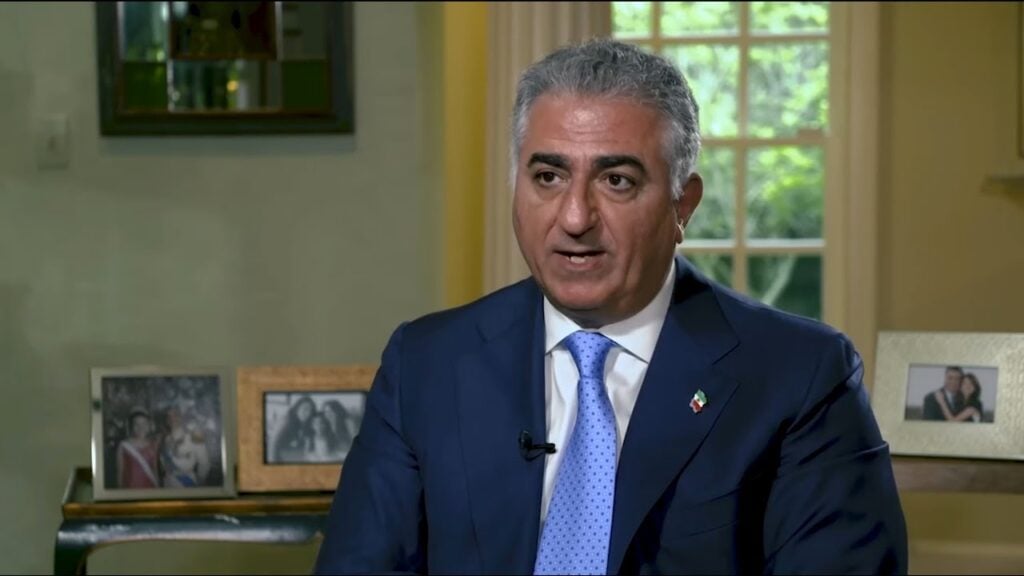
What the Shah’s son should do – instead of siding with Trump

After a long period of relative silence, Reza Pahlavi, the son of the deposed Iranian Shah who has lived in the United States for more than 40 years, recently made a rare public appearance, calling for a U.S.-backed regime change in Iran.

Speaking at the pro-Israel Washington Institute for Near East Policy on Friday, December 14, he called for “non-Military actions” in support of Iranians to replace the Islamic Republic with a secular democracy.

Since coming to office and even during the 2016 election campaign, President Donald Trump has adopted a very hostile attitude towards Iran and the landmark nuclear deal (the Joint Comprehensive Plan of Action or JCPOA) negotiated under President Barack Obama.

Some of the more hawkish members of his team have received huge fees speaking at the annual meetings of the Mojahedin-e Khalq (MEK) that are held outside Paris, and have openly called for regime change in Iran before the end of 2019.

Reza Pahlavi’s speech was in line with the Trump administration’s policies towards Iran, but he went even further and demanded action to bring about regime change. “You cannot come and say we support the Iranian people but we don’t want regime change,” he said. “How the hell do you want us to get to democracy while this regime is still in place?”

His appearance has created great excitement among some sections of the Iranian opposition abroad, who see him as a more viable alternative to the clerical regime than the MEK, which is seen as a terrorist organization and hated by most Iranians.

Could Reza Pahlavi play a role in ushering in regime change in Iran? What might that role be?

Whether we like it or not, the fall of Mohammad Reza Shah ’s government and the establishment of the Islamic Republic was not due to a military coup, as in Egypt, or a foreign coup, such as the 1953 coup against Mohammad Mosaddeq’s popular government.

As someone who lived in Iran and witnessed the early stages of the revolution, it was clear to me, as it will be to anyone who has studied the history of the revolution, that it was a mass movement.

Millions of people rose up against the government and demanded fundamental change, to such an extent that the Shah’s powerful military collapsed in the face of mainly bloodless nationwide demonstrations, strikes and, some terrorist and paramilitary activities mainly perpetrated by the members of the MEK.

The initial slogans of the Iranian revolution were “Freedom, Independence, Social Justice”. People wanted to put an end to arbitrary rule and lack of political freedom. They wanted to achieve independence from foreign domination and exploitation, which in their eyes had reduced Iran almost to the status of a US colony. They also wished to establish an economic system that distributed the enormous wealth of the country more equitably.

Sadly, none of those goals has been achieved and, instead, people even lost the degree of social freedom that they enjoyed under the Shah.

As a result, there is a certain amount of nostalgia for the old times. In several recent protests, people have chanted slogans in Iran and Reza Shah, presumably as a king who opposed and suppressed the clerics.

However, this does not mean that there is any likelihood of the return of the Pahlavis to power. As we say in Persian, “that jug has smashed and the wine has spilt.” Or in more poetic language, “that mighty torrent that has swept down the mountain, its return to the summit is most unlikely.”

Nearly 40 years since the fall of the Shah, it is time for U.S. politicians to understand and admit that fact. Any lasting change in Iran will and should come from within, even though U.S. neocons and their Israeli and Saudi backers wish otherwise.

Unlike most countries in the region, there has been a measure of public participation in politics in Iran, and elections have had an enormous effect on changing the Iranian government.

This is why, for better or worse, most people in Iran believe that they own the system, and it has also given them a measure of independence, completely unlike those regimes that, in the words or President Trump, cannot survive for ten days without U.S. support.

Many educated Iranians once had a very positive outlook towards the United States, but U.S. policies during the past few decades have completely alienated most Iranians. This feeling of hostility has been greatly strengthened as the result of the policies pursued by President Trump and the extremist members of his team.

President Trump cannot on the one hand bar Iranians from visiting the United States, prevent Iranian students from studying in US universities, deprive Iranian grandparents from attending the weddings of their grandchildren, impose unilateral sanctions on Iran, and even deprive Iranians from buying medicine abroad due to banking restrictions, and on the other hand still claim that he is on the side of the Iranian people.

Iranians also look at the outcome of U.S. policies in the Middle East and beyond. During the past few decades, rivers of blood have flowed in practically all Middle Eastern countries, particularly in Iran’s neighbours, while despite all this bloodshed and barbarity, the West has not been able to establish freedom and democracy in the Middle East.

On the contrary, it has destroyed what had formed the basis of some of the oldest civilizations in the world, leaving behind ruins in ancient Syria, Iraq, Yemen, and many other countries.

The US government also supported Saddam Hussein’s brutal invasion of Iran. In the process of militarisation, invasions and massacres, the West has also lost its soul, and its ideals and aspirations have also been diminished.

Both under President Khatami and President Rouhani, Iran extended a hand of friendship to the West. The Iranian government engaged in difficult negotiations andsigned a landmark agreement, not only with the United States, but with all the permanent members of the UN Security Council, plus Germany. The agreement also received the unanimous endorsement of the Security Council Resolution 2231 and the European Union. That agreement, unique in the history of nuclear negotiations, drastically curtailed Iran’s nuclear activities and blocked all the paths to the acquisition of nuclear weapons by Iran. In 12 reports, the International Atomic Energy Agency has repeatedly certified Iran’s full compliance with the terms of the agreement. Yet, against the almost unanimous international support for the JCPOA, President Trump unilaterally withdrew from that deal and imposed extraterritorial sanctions on Iran. Under these circumstances, any U.S. support for any person or opposition group, particularly the hated MEK, would be the kiss of death.

The best thing that Reza Pahlavi can do is to persuade the Trump administration to give up its insane and excessive hostility towards Iran, reverse its violation of the JCPOA, engage in serious multilateral negotiations on other matters of contention, and help the advancement of democracy, human rights and a strong middle class in Iran through greater engagement and economic development. Then, when the time is ripe, Reza Pahlavi can take part in elections in Iran and hopefully be elected to office on the basis of the goodwill that exists towards his father and grandfather.

Farhang Jahanpour is member of the TFF BOard and a former professor and dean of the Faculty of Languages at the University of Isfahan, and a former Senior Research Scholar at Harvard. For the past 30 years he has been teaching courses on the Middle East at the Department of Continuing Education and is a member of Kellogg College at the University of Oxford.

Photo on top: Reza Pahlavi from YouTube
Related Posts

Johan Galtung 1930-2024October 2015 Published here on October 3, 2026 Let us focus on Civilization for conflict analysis and remedies. Major forms of disorder use violence; war is state organized violence. The most belligerent states are the United States of America and Israel, both with civilization roots. National Evangelism, the US Protestant Christian civilization– more national than evangelical–justifies US warfare as exceptionalism of a people chosen by God, with a manifest destiny to run the world. Orthodox Judaism justifies Israeli warfare to conquer and expand from Nile to Euphrates as a religious right and duty to the Eternal One. The third most belligerent country, the UK, no longer believes it is God-chosen but chosen by the USA; not quite the same but something. But the root cause of global disorder lies in the Occident–with Islam–seeing itself as the single, universal civilization valid for all at all times, all others being...
Jan ObergPhD, director, The Transnational Foundation for Peace and Future Research, TFFLund, Sweden October 2, 2026 This is my full original manuscript. The Chinese Academy of Social Science, CASS, makes two publications out if it. 1. China’s Five-year plan emphasized the capabilities of basic research and original innovation. It is regarded as the goal of the future social development, which, as required, should be significantly enhanced. Can you comment on the importance of original innovation in research and academic study? I believe it is easier to define “original innovation” in the natural sciences than in social sciences. The breaking points of what constitutes something new, or innovative, are not quite as sharp in the latter. But in both fields it is about opening up something that was closed, unseen, unexplored before – making manifest what was earlier latent. Innovations come in many forms and shapes – naming something that was not...
The agreement is catastrophic both because of what it says and what it doesn’t mention. It reduces further the major asset of security policies: Freedom of action. Jan Oberg TFF director September 25, 2026 A couple of hours before the agreement was signed on September 22, 2026, I published the following 13 hypotheses about what it would most likely contain on TFF Substack (in English). I was wrong on only the first point. Contrary to what Trump had written on his Truth Social platform, it does not appear to come into force immediately. In fact, it turned out to be worse than even I had anticipated. After these hypotheses now come a number of reflections in light of what the agreement actually contains, and does not contain, as well as the way in which it has generally been presented by major media outlets and by the public-service broadcaster DR. My...

Recent Articles

Tony Robinson October 4, 2026 Violence is easy to recognise when someone is being beaten, shot or killed. It becomes more difficult when nobody is holding a weapon. Poverty, discrimination, exploitation and repression can restrict a human life just as effectively, although they do so in very different ways and with very different consequences. Simply adding more categories to an ever-growing list of forms of violence does not really solve the problem. The more interesting question is what all these different situations have in common and why it makes sense to describe them using the same word. Human beings do not simply react to what happens around them. They remember the past, imagine things that do not yet exist, make plans and undertake projects. Workers organise because they imagine different working conditions; people migrate because they imagine another life somewhere else; social movements emerge because people refuse to accept the...
It’s a matter of principles, courage, vision and pulling together – while the militarist world is falling apart… Peter Langille October 3, 2026 “Here, then, is the problem which we present to you, stark and dreadful and inescapable: Shall we put an end to the human race; or shall mankind renounce war?”The Bertrand Russell—Albert Einstein Manifesto, July 9, 1955 ⁕ The forecast for what’s ahead is worrisome. The sharp rise in armed conflicts over the past three years is adding to what was already the highest level in over seventy years. Genocides, which should be prevented are supported. A shared climate emergency that jeopardises survival is ignored. Diverse polls now suggest that people are war-weary, worried and interested in a more effective United Nations. And, there are viable policy options for a more secure world! Yet governments are doubling-down, betting on more war and investing heavily. If current trends persist,...
Johan Galtung 1930-2024October 2015 Published here on October 3, 2026 Let us focus on Civilization for conflict analysis and remedies. Major forms of disorder use violence; war is state organized violence. The most belligerent states are the United States of America and Israel, both with civilization roots. National Evangelism, the US Protestant Christian civilization– more national than evangelical–justifies US warfare as exceptionalism of a people chosen by God, with a manifest destiny to run the world. Orthodox Judaism justifies Israeli warfare to conquer and expand from Nile to Euphrates as a religious right and duty to the Eternal One. The third most belligerent country, the UK, no longer believes it is God-chosen but chosen by the USA; not quite the same but something. But the root cause of global disorder lies in the Occident–with Islam–seeing itself as the single, universal civilization valid for all at all times, all others being...

TFF on Substack

Discover and subscribe to more peace materials on TFF Substack

Most Popular

Tony Robinson October 4, 2026 Violence is easy to recognise when someone is being beaten, shot or killed. It becomes more difficult when nobody is holding a weapon. Poverty, discrimination, exploitation and repression can restrict a human life just as effectively, although they do so in very different ways and with very different consequences. Simply adding more categories to an ever-growing list of forms of violence does not really solve the problem. The more interesting question is what all these different situations have in common and why it makes sense to describe them using the same word. Human beings do not simply react to what happens around them. They remember the past, imagine things that do not yet exist, make plans and undertake projects. Workers organise because they imagine different working conditions; people migrate because they imagine another life somewhere else; social movements emerge because people refuse to accept the...
It’s a matter of principles, courage, vision and pulling together – while the militarist world is falling apart… Peter Langille October 3, 2026 “Here, then, is the problem which we present to you, stark and dreadful and inescapable: Shall we put an end to the human race; or shall mankind renounce war?”The Bertrand Russell—Albert Einstein Manifesto, July 9, 1955 ⁕ The forecast for what’s ahead is worrisome. The sharp rise in armed conflicts over the past three years is adding to what was already the highest level in over seventy years. Genocides, which should be prevented are supported. A shared climate emergency that jeopardises survival is ignored. Diverse polls now suggest that people are war-weary, worried and interested in a more effective United Nations. And, there are viable policy options for a more secure world! Yet governments are doubling-down, betting on more war and investing heavily. If current trends persist,...
Johan Galtung 1930-2024October 2015 Published here on October 3, 2026 Let us focus on Civilization for conflict analysis and remedies. Major forms of disorder use violence; war is state organized violence. The most belligerent states are the United States of America and Israel, both with civilization roots. National Evangelism, the US Protestant Christian civilization– more national than evangelical–justifies US warfare as exceptionalism of a people chosen by God, with a manifest destiny to run the world. Orthodox Judaism justifies Israeli warfare to conquer and expand from Nile to Euphrates as a religious right and duty to the Eternal One. The third most belligerent country, the UK, no longer believes it is God-chosen but chosen by the USA; not quite the same but something. But the root cause of global disorder lies in the Occident–with Islam–seeing itself as the single, universal civilization valid for all at all times, all others being...
Read More
Living-Peace-Sign-Budapest-copy
Tony Robinson October 4, 2026 Violence is easy to recognise when someone is being beaten, shot or killed. It becomes more difficult when nobody is holding a weapon. Poverty, discrimination, exploitation and repression can restrict a human life just as effectively, although they do so in very different ways and with very different consequences. Simply adding more categories to an ever-growing list of forms of violence does not really solve the problem. The more interesting question is what all these different situations have in common and why it makes sense to describe them using the same word. Human beings do not simply react to what happens around them. They remember the past, imagine things that do not yet exist, make plans and undertake projects. Workers organise because they imagine different working conditions; people migrate because they imagine another life somewhere else; social movements emerge because people refuse to accept the...
b54a1f10-8c65-4f0b-9dd5-4abc0a7d04cc_2659x2659
It’s a matter of principles, courage, vision and pulling together – while the militarist world is falling apart… Peter Langille October 3, 2026 “Here, then, is the problem which we present to you, stark and dreadful and inescapable: Shall we put an end to the human race; or shall mankind renounce war?”The Bertrand Russell—Albert Einstein Manifesto, July 9, 1955 ⁕ The forecast for what’s ahead is worrisome. The sharp rise in armed conflicts over the past three years is adding to what was already the highest level in over seventy years. Genocides, which should be prevented are supported. A shared climate emergency that jeopardises survival is ignored. Diverse polls now suggest that people are war-weary, worried and interested in a more effective United Nations. And, there are viable policy options for a more secure world! Yet governments are doubling-down, betting on more war and investing heavily. If current trends persist,...
010
Johan Galtung 1930-2024October 2015 Published here on October 3, 2026 Let us focus on Civilization for conflict analysis and remedies. Major forms of disorder use violence; war is state organized violence. The most belligerent states are the United States of America and Israel, both with civilization roots. National Evangelism, the US Protestant Christian civilization– more national than evangelical–justifies US warfare as exceptionalism of a people chosen by God, with a manifest destiny to run the world. Orthodox Judaism justifies Israeli warfare to conquer and expand from Nile to Euphrates as a religious right and duty to the Eternal One. The third most belligerent country, the UK, no longer believes it is God-chosen but chosen by the USA; not quite the same but something. But the root cause of global disorder lies in the Occident–with Islam–seeing itself as the single, universal civilization valid for all at all times, all others being...
Screenshot 2026-10-02 011738
Jan ObergPhD, director, The Transnational Foundation for Peace and Future Research, TFFLund, Sweden October 2, 2026 This is my full original manuscript. The Chinese Academy of Social Science, CASS, makes two publications out if it. 1. China’s Five-year plan emphasized the capabilities of basic research and original innovation. It is regarded as the goal of the future social development, which, as required, should be significantly enhanced. Can you comment on the importance of original innovation in research and academic study? I believe it is easier to define “original innovation” in the natural sciences than in social sciences. The breaking points of what constitutes something new, or innovative, are not quite as sharp in the latter. But in both fields it is about opening up something that was closed, unseen, unexplored before – making manifest what was earlier latent. Innovations come in many forms and shapes – naming something that was not...
arctic-circle-map
The agreement is catastrophic both because of what it says and what it doesn’t mention. It reduces further the major asset of security policies: Freedom of action. Jan Oberg TFF director September 25, 2026 A couple of hours before the agreement was signed on September 22, 2026, I published the following 13 hypotheses about what it would most likely contain on TFF Substack (in English). I was wrong on only the first point. Contrary to what Trump had written on his Truth Social platform, it does not appear to come into force immediately. In fact, it turned out to be worse than even I had anticipated. After these hypotheses now come a number of reflections in light of what the agreement actually contains, and does not contain, as well as the way in which it has generally been presented by major media outlets and by the public-service broadcaster DR. My...
girl-5894831_1280
Below are TFF-related media mentions, comments, videos and social media posts published elsewhere but not on this homepage. We happen to catch and list only a fraction. Regarding video comments and debates, we recommend that you go to the TFF Video Channel on Substack where many of them are reproduced. Jan Oberg is a contributor to China Daily – 52 million daily clicks – and Global Times, CGTN and CCTV (the national television), China Investment, Xinhua News Agency and several others. Articles and videos on these media very often multiply into countless Chinese (and Western media) that re-post them from these main media. Thanks to The China Academy, his analyses, interviews and comments are frequently posted on YouTube channels such as Thinkers Forum and Wave Media. These videos are often re-posted on Bilibili (China’s YouTube), the China Content Center on TikTok, and on the Chinese edition of TikTok, Douyin.com. This means reaching hundreds of millions of viewers worldwide over a year. While there are too many to catch on all these...





