
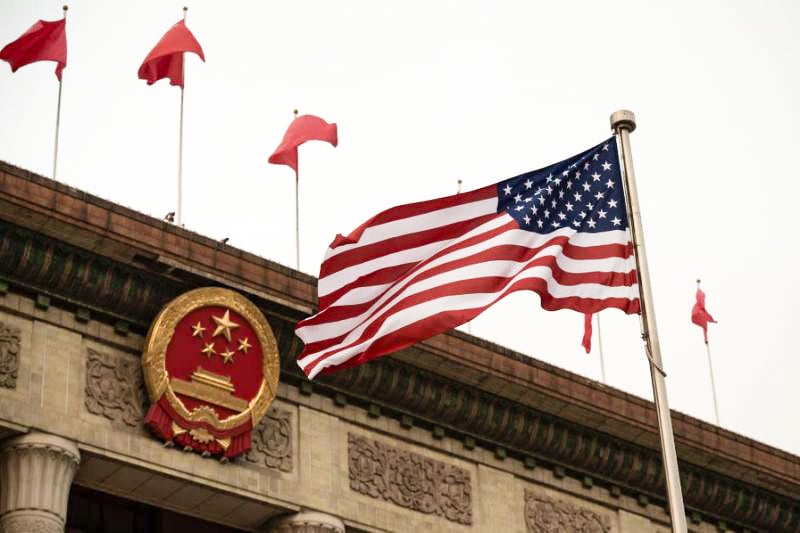
The anti-dollar awakening could be ruder and sooner than most economists predict


Thwarting the anti-dollar coalition should be Washington’s top national priority


By Gal Luft

August 30, 2018


The United States is currently waging economic warfare against one tenth of the world’s countries with cumulative population of nearly 2 billion people and combined gross domestic product (GDP) of more than $15 trillion.

These include Russia, Iran, Venezuela, Cuba, Sudan, Zimbabwe, Myanmar, the Democratic Republic of Congo, North Korea and others on which Washington has imposed sanctions over the years, but also countries like China, Pakistan and Turkey which are not under full sanctions but rather targets of other punitive economic measures.

In addition, thousands of individuals from scores of countries are included in the Treasury Department’s list of Specially Designated Nationals who are effectively blocked from the U.S.-dominated global financial system. Many of those designated are either part of or closely linked to their countries’ leadership.

Published by Yahoo Finance on August 27, 2018

From a U.S. perspective, each one of the economic entities is targeted for a good reason be it human rights violations, terrorism, crime, nuclear trade, corruption or in the case of China, unfair trade practices and intellectual property theft.

But in recent months it seems that America’s unwavering commitment to fight all of the world’s scourges has brought all those governments and the wealthy individuals who support them to a critical mass, joining forces to create a parallel financial system which would be out of reach of America’s long arm. Should they succeed, the impact on America’s global posture would be transformational.

America’s global supremacy has been made possible not only thanks to its military power and its alliance system but also due to its control over the plumbing of global finance and particularly the broad acceptance of the dollar as the world’s reserve currency. The unique status of the U.S. currency has anchored the global financial system since World War II.

Any transaction done in U.S. dollars or using a U.S. bank automatically brings the trading parties under American legal jurisdiction. When the U.S. decides to impose unilateral sanctions, as in the case of Iran, it essentially tells the world’s governments, corporations and individuals they must choose between halting business with the sanctioned country or be shut off from the world’s number one economy. This is a powerful stick.

Not many companies or banks can afford to give up on the U.S. market or be denied access to U.S. financial institutions.

Revisionist countries that wish to challenge the U.S.-led system see this as an affront to their economic sovereignty. Which is why both Russia and China have developed their own versions of the Society for Worldwide Interbank Financial Telecommunication (SWIFT), the global network that allows cross-border financial transactions among thousands of banks. Both countries are also urging their trading partners to ditch the dollar in their bilateral trade in favor of indigenous currencies.

This month Russia was quick to recruit Turkey into the anti-dollar bloc, announcing it would back non-dollar trade with it, after a financial feud between Ankara and Washington broke out. China for its part is using its trillion-dollar Belt and Road Initiative as a tool to compel countries to transact in yuan terms instead of dollars. Pakistan, the number one recipient of Belt and Road money, and Iran have already announced their intention to do just that.

Last month’s BRICS (Brazil, Russia, India, China, South Africa) summit in Johannesburg was a call to arms against the dollar hegemony with countries like Turkey, Jamaica, Indonesia, Argentina and Egypt invited to join in what is known as “BRICS plus” with the goal of creating a de-dollarized economy.

The main front where the future of the dollar will be decided is the global commodity market, especially the $1.7 trillion oil market. Ever since 1973, when President Richard Nixon unilaterally severed the U.S. dollar from the gold standard and convinced the Saudis and the rest of the OPEC countries to sell their oil only in dollars, the global oil trade has been linked to the American currency.

This paved the way for the rest of the commodities to be traded in dollars as well. The arrangement served America well. It created an ever growing demand for the greenback, which in turn enabled consecutive U.S. governments to freely run their growing deficits.

Not anymore. Because so many of the members of the anti-dollar alliance are exporters of commodities they no longer feel that their products should be either priced by a dollar-denominated benchmark like WTI and Brent or be traded in a currency they no longer crave.

For example, when China buys oil from Angola, gas from Russia, coal from Mongolia or soybeans from Brazil it prefers to do so in its own currency and thereby avoid unwanted exchange rate fees on both sides of the transaction. This is already beginning to happen.

Russia and China have agreed to transact some of their traded energy in yuan. China is pushing its main oil suppliers Saudi Arabia, Angola and Iran to receive yuans for their oil. And last year China introduced gold-backed futures contracts, dubbed “petro-yuan” in the Shanghai International Energy Exchange – the first non-dollar crude benchmark in Asia.

The gradual acceptance of digital currencies, backed by blockchain technology offers another way for the revisionists to ditch the dollar in their trading. The Russian central bank indicated that it was considering launching a national cryptocurrency called “cryptoruble” and in the interim it helped Venezuela’s launch of its own cryptocurrency, the “petro,” which is backed by the country’s vast oil reserves. Now BRICS members are discussing a BRICS-backed cryptocurrency.

All of those actions and others point to one direction: In the coming years the dollar will be facing a barrage of attacks with the goal of eroding its hegemony and the energy trading market will be one of the main battlefields where the future of America’s economic dominance will be decided. Any successful attempt to delink commodity trading from the dollar will have a cascading impact not only on the global economic system as we know it but also on America’s posture abroad.

With the overall positive state of the U.S. economy and the remarkable strength of the dollar compared to the currencies of the dollar-busters including the Russian ruble, the yuan, the Turkish lira and the Iranian rial it may be easy to sink into complacency and dismiss the actions of the revisionists as mere pinpricks.

But ignoring the growing anti-dollar coalition would be to America’s detriment. Bull markets eventually come to an end and with a national debt of $21 trillion and growing at a rate of a trillion dollars a year, the awakening could be ruder and sooner than most economists predict.

In the midst of America’s economic euphoria it is worth remembering that one of every four people on the planet lives today in a country whose government is committed to end the dollar hegemony.

Thwarting their effort should be Washington’s top national priority.


Gal Luft
– is co-director of the Institute for the Analysis of Global Security and senior advisor to the United States Energy Security Council.


Recommended reading

Cathrin Schaer
Making Europe financially independent, one transaction at a time



Related Posts

Jan Oberg, TFF director April 9, 2026 I was recently invited to have a good, long talk about the world – and, of course, about peace too – with Boris Malagurski on his Weight of Chains Channel on YouTube. It was a real joy and seems to have been greatly appreciated by the viewers too. Mr Malagurski and I shall of course be grateful if you share this conversation in your circles – of course, only if you like what you see and hear 😉☮️ And remember that this one – like hundreds of others with TFF Associates – can be enjoyed at our TFF Video Collection.
A friendly quarrel while we agree that the US sanctions are a weapon of mass destruction and kill more people than wars do. And that we must talk much more about sanctions than we have so far. Jan Oberg, TFF director March 16, 2026 John Mearsheimer recently stated that U.S. sanctions murdered around 38 million people between 1971 and 2021 – see the video below. It is a dramatic figure, and it has spread quickly because it captures, in one sentence, the enormous human cost of modern sanctions. I share his concern about the destructive effects of economic coercion. But the specific number he cites — and the way he attributes it — deserves a friendly academic clarification. The figure comes from a 2023 Lancet Global Health article estimating the mortality effects of unilateral U.S. and EU sanctions over the past half‑century. This is the first point where Mearsheimer’s shorthand diverges from the text: the study...
Jan Oberg February 19, 2026 What a thrill to be interviewed by former British diplomat Ian Proud! Don’t waste a minute: acquaint yourself with him here on his homepage, which he elegantly calls “Proud Diplomat.” Notice also his book, A Misfit In Moscow. Ian is, of course, also on Substack, where he calls himself The Peace Monger, and recently he set up his own PeaceMonger Channel on YouTube. For once, I was not interviewed as if I were a military geopolitical expert, where I normally have to twist the whole thing in the direction of peace. No, we both had a focus on peace – why it has been disappeared by research, politics and the media, but also what can be done to shape a more peaceful future for us all. One idea we came up with was that of connecting people through citizens diplomacy – in an era where...

Recent Articles

Tony Robinson October 4, 2026 Violence is easy to recognise when someone is being beaten, shot or killed. It becomes more difficult when nobody is holding a weapon. Poverty, discrimination, exploitation and repression can restrict a human life just as effectively, although they do so in very different ways and with very different consequences. Simply adding more categories to an ever-growing list of forms of violence does not really solve the problem. The more interesting question is what all these different situations have in common and why it makes sense to describe them using the same word. Human beings do not simply react to what happens around them. They remember the past, imagine things that do not yet exist, make plans and undertake projects. Workers organise because they imagine different working conditions; people migrate because they imagine another life somewhere else; social movements emerge because people refuse to accept the...
It’s a matter of principles, courage, vision and pulling together – while the militarist world is falling apart… Peter Langille October 3, 2026 “Here, then, is the problem which we present to you, stark and dreadful and inescapable: Shall we put an end to the human race; or shall mankind renounce war?”The Bertrand Russell—Albert Einstein Manifesto, July 9, 1955 ⁕ The forecast for what’s ahead is worrisome. The sharp rise in armed conflicts over the past three years is adding to what was already the highest level in over seventy years. Genocides, which should be prevented are supported. A shared climate emergency that jeopardises survival is ignored. Diverse polls now suggest that people are war-weary, worried and interested in a more effective United Nations. And, there are viable policy options for a more secure world! Yet governments are doubling-down, betting on more war and investing heavily. If current trends persist,...
Johan Galtung 1930-2024October 2015 Published here on October 3, 2026 Let us focus on Civilization for conflict analysis and remedies. Major forms of disorder use violence; war is state organized violence. The most belligerent states are the United States of America and Israel, both with civilization roots. National Evangelism, the US Protestant Christian civilization– more national than evangelical–justifies US warfare as exceptionalism of a people chosen by God, with a manifest destiny to run the world. Orthodox Judaism justifies Israeli warfare to conquer and expand from Nile to Euphrates as a religious right and duty to the Eternal One. The third most belligerent country, the UK, no longer believes it is God-chosen but chosen by the USA; not quite the same but something. But the root cause of global disorder lies in the Occident–with Islam–seeing itself as the single, universal civilization valid for all at all times, all others being...

TFF on Substack

Discover and subscribe to more peace materials on TFF Substack

Most Popular

Tony Robinson October 4, 2026 Violence is easy to recognise when someone is being beaten, shot or killed. It becomes more difficult when nobody is holding a weapon. Poverty, discrimination, exploitation and repression can restrict a human life just as effectively, although they do so in very different ways and with very different consequences. Simply adding more categories to an ever-growing list of forms of violence does not really solve the problem. The more interesting question is what all these different situations have in common and why it makes sense to describe them using the same word. Human beings do not simply react to what happens around them. They remember the past, imagine things that do not yet exist, make plans and undertake projects. Workers organise because they imagine different working conditions; people migrate because they imagine another life somewhere else; social movements emerge because people refuse to accept the...
It’s a matter of principles, courage, vision and pulling together – while the militarist world is falling apart… Peter Langille October 3, 2026 “Here, then, is the problem which we present to you, stark and dreadful and inescapable: Shall we put an end to the human race; or shall mankind renounce war?”The Bertrand Russell—Albert Einstein Manifesto, July 9, 1955 ⁕ The forecast for what’s ahead is worrisome. The sharp rise in armed conflicts over the past three years is adding to what was already the highest level in over seventy years. Genocides, which should be prevented are supported. A shared climate emergency that jeopardises survival is ignored. Diverse polls now suggest that people are war-weary, worried and interested in a more effective United Nations. And, there are viable policy options for a more secure world! Yet governments are doubling-down, betting on more war and investing heavily. If current trends persist,...
Johan Galtung 1930-2024October 2015 Published here on October 3, 2026 Let us focus on Civilization for conflict analysis and remedies. Major forms of disorder use violence; war is state organized violence. The most belligerent states are the United States of America and Israel, both with civilization roots. National Evangelism, the US Protestant Christian civilization– more national than evangelical–justifies US warfare as exceptionalism of a people chosen by God, with a manifest destiny to run the world. Orthodox Judaism justifies Israeli warfare to conquer and expand from Nile to Euphrates as a religious right and duty to the Eternal One. The third most belligerent country, the UK, no longer believes it is God-chosen but chosen by the USA; not quite the same but something. But the root cause of global disorder lies in the Occident–with Islam–seeing itself as the single, universal civilization valid for all at all times, all others being...
Read More
Living-Peace-Sign-Budapest-copy
Tony Robinson October 4, 2026 Violence is easy to recognise when someone is being beaten, shot or killed. It becomes more difficult when nobody is holding a weapon. Poverty, discrimination, exploitation and repression can restrict a human life just as effectively, although they do so in very different ways and with very different consequences. Simply adding more categories to an ever-growing list of forms of violence does not really solve the problem. The more interesting question is what all these different situations have in common and why it makes sense to describe them using the same word. Human beings do not simply react to what happens around them. They remember the past, imagine things that do not yet exist, make plans and undertake projects. Workers organise because they imagine different working conditions; people migrate because they imagine another life somewhere else; social movements emerge because people refuse to accept the...
b54a1f10-8c65-4f0b-9dd5-4abc0a7d04cc_2659x2659
It’s a matter of principles, courage, vision and pulling together – while the militarist world is falling apart… Peter Langille October 3, 2026 “Here, then, is the problem which we present to you, stark and dreadful and inescapable: Shall we put an end to the human race; or shall mankind renounce war?”The Bertrand Russell—Albert Einstein Manifesto, July 9, 1955 ⁕ The forecast for what’s ahead is worrisome. The sharp rise in armed conflicts over the past three years is adding to what was already the highest level in over seventy years. Genocides, which should be prevented are supported. A shared climate emergency that jeopardises survival is ignored. Diverse polls now suggest that people are war-weary, worried and interested in a more effective United Nations. And, there are viable policy options for a more secure world! Yet governments are doubling-down, betting on more war and investing heavily. If current trends persist,...
010
Johan Galtung 1930-2024October 2015 Published here on October 3, 2026 Let us focus on Civilization for conflict analysis and remedies. Major forms of disorder use violence; war is state organized violence. The most belligerent states are the United States of America and Israel, both with civilization roots. National Evangelism, the US Protestant Christian civilization– more national than evangelical–justifies US warfare as exceptionalism of a people chosen by God, with a manifest destiny to run the world. Orthodox Judaism justifies Israeli warfare to conquer and expand from Nile to Euphrates as a religious right and duty to the Eternal One. The third most belligerent country, the UK, no longer believes it is God-chosen but chosen by the USA; not quite the same but something. But the root cause of global disorder lies in the Occident–with Islam–seeing itself as the single, universal civilization valid for all at all times, all others being...
Screenshot 2026-10-02 011738
Jan ObergPhD, director, The Transnational Foundation for Peace and Future Research, TFFLund, Sweden October 2, 2026 This is my full original manuscript. The Chinese Academy of Social Science, CASS, makes two publications out if it. 1. China’s Five-year plan emphasized the capabilities of basic research and original innovation. It is regarded as the goal of the future social development, which, as required, should be significantly enhanced. Can you comment on the importance of original innovation in research and academic study? I believe it is easier to define “original innovation” in the natural sciences than in social sciences. The breaking points of what constitutes something new, or innovative, are not quite as sharp in the latter. But in both fields it is about opening up something that was closed, unseen, unexplored before – making manifest what was earlier latent. Innovations come in many forms and shapes – naming something that was not...
arctic-circle-map
The agreement is catastrophic both because of what it says and what it doesn’t mention. It reduces further the major asset of security policies: Freedom of action. Jan Oberg TFF director September 25, 2026 A couple of hours before the agreement was signed on September 22, 2026, I published the following 13 hypotheses about what it would most likely contain on TFF Substack (in English). I was wrong on only the first point. Contrary to what Trump had written on his Truth Social platform, it does not appear to come into force immediately. In fact, it turned out to be worse than even I had anticipated. After these hypotheses now come a number of reflections in light of what the agreement actually contains, and does not contain, as well as the way in which it has generally been presented by major media outlets and by the public-service broadcaster DR. My...
girl-5894831_1280
Below are TFF-related media mentions, comments, videos and social media posts published elsewhere but not on this homepage. We happen to catch and list only a fraction. Regarding video comments and debates, we recommend that you go to the TFF Video Channel on Substack where many of them are reproduced. Jan Oberg is a contributor to China Daily – 52 million daily clicks – and Global Times, CGTN and CCTV (the national television), China Investment, Xinhua News Agency and several others. Articles and videos on these media very often multiply into countless Chinese (and Western media) that re-post them from these main media. Thanks to The China Academy, his analyses, interviews and comments are frequently posted on YouTube channels such as Thinkers Forum and Wave Media. These videos are often re-posted on Bilibili (China’s YouTube), the China Content Center on TikTok, and on the Chinese edition of TikTok, Douyin.com. This means reaching hundreds of millions of viewers worldwide over a year. While there are too many to catch on all these...




