
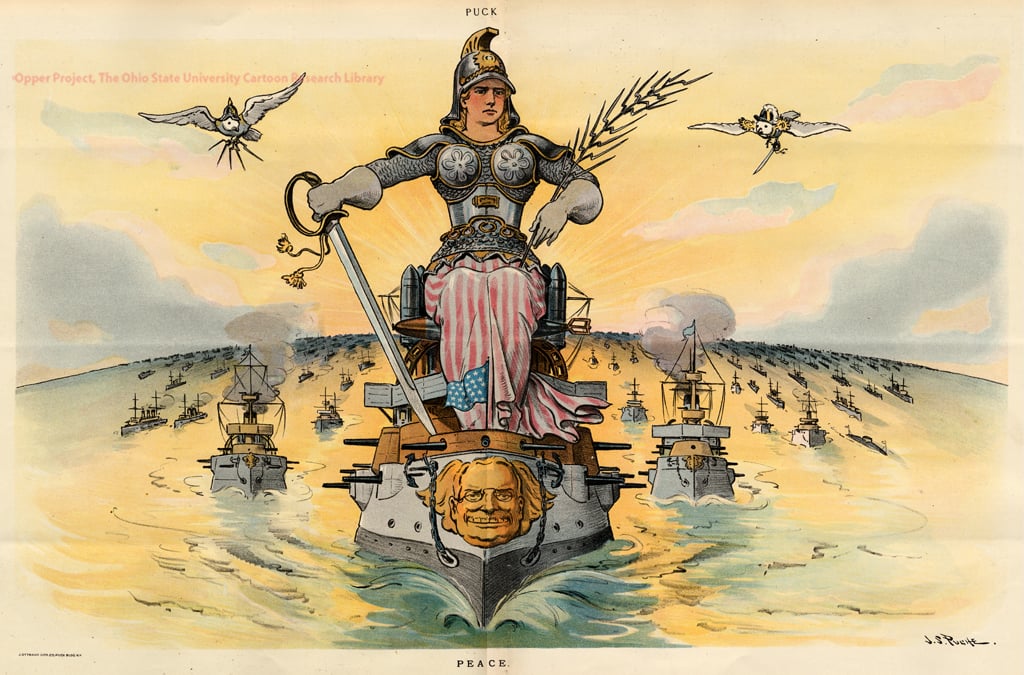
From ancient Greece onward, the West has used the Eastern other as an enemy through which to identify itself.
August 22, 2018
US President Donald Trump’s administration seems to be intent on confronting the rest of the world. With a few exceptions, such as Russia (as far as Trump himself is concerned), Israel and Saudi Arabia, almost every other nation in the world has felt the rage and contempt of the current American president.
Originally published on middleeasteye.net August 17, 2018
Bonds with traditional US allies have been questioned and the many principles, pillars, and rules of the liberal world order, itself conceived and shaped by the United States, are now disowned.
Little knowledge
These developments can’t simply be attributed to Trump and Trump alone. The president’s thinking is shared by a significant section of the American people, who have little knowledge of the world beyond their shores and who appear inclined to believe their country is forever at threat. The grievance and bitterness Trump often trades in has a real audience.
The net result is a mobilization against alleged existential threats to the American nation, and tough policies adopted to protect it from cheating, ruthless enemies and unfair trade practices by ungrateful allies.

In one slogan, Make America Great Again or, in a more brutal one, We are America Bitch!
This Manichean and polarised view of the world is not temporary. It’s unlikely it would end if Trump were impeached, or if he were defeated in the 2020 elections.
It is, in fact, an attitude rooted in American political culture, due to two core elements.
The first is American exceptionalism. The second is more generally related to wider Western culture, dating back even to ancient Greece.
American exceptionalism?
American exceptionalism is a belief that almost any American – Republican or Democrat, pro or anti-Trump – considers part of his own political genetic code.
Henry Kissinger provides a clear definition, writing that it is the belief that American principles are “universal and that the governments that do not practice them are not fully legitimized. A notion so much rooted in the American thinking… that induces to think that a part of the world lives in an unsatisfactory, provisional, situation and that one day it will be redeemed [by America.”
Kissinger concludes that American exceptionalism is a belief that causes a situation of general, latent conflict between much of the world and the world’s superpower, the United States.
This conviction has an important corollary, which is that there cannot be any difference between the interests of the United States and the interests of mankind.
American exceptionalism is a belief that almost any American – Republican or Democrat, pro or anti-Trump – considers part of his own political genetic code.
Although eminent American scholars believe it is a myth, during the 20th century, American exceptionalism could be said to have saved millions of people from a horrible destiny.
Since the end of the Cold War, its implementation was mismanaged and there is a strong feeling that, ultimately, it veered out of control.
The second core element I referred to – relating to Western culture and dating back to ancient Greece – is the West’s tendency to define itself through its own enemies, both real and imagined.
These enemies have been geographically and mentally located in the Eastern hemisphere, a place represented as the home of despotism and barbarism, in contrast to the West and its championing of freedom and democracy, science and technology.
Negative representation
In his famous book Orientalism, Edward Said maintained that primitive as well as modern societies “seem to derive a sense of their identities negatively”. In other words, they tend to define themselves more for what they are not, than for what they are.

A society’s sense of itself is thus affirmed and reinforced in comparison with societies deemed to represent its opposite. Usually, those opposing societies will be thought of as inferior and threatening.
The West seems to have looked at the East this way since Ancient times.
It is a binary distinction resulting from the dichotomous thinking inherited from Aristotelian Philosophy; this intellectual tradition has extended until today, shaping significantly not only modern Western political thought, but, most of all, how Western people think.
The negative, polarising representation of the East goes back to the fifth century BC, during the wars between Greece and the Persian Empire.
At that time, Greeks used the term “Barbarian” to refer to anyone who didn’t speak Greek.
For the most part, this meant people from eastern lands, who were considered different in terms of values and behaviors.
Eastern enemies
The Greeks were probably the first to introduce this significant distinction from their Asian neighbors on concepts concerning the self-government of their respective societies and the relationship among their inhabitants. The conflicts with Persia reinforced the Greeks’ awareness of their differences with the eastern empire.
The Greek sense of self was boosted by comparison with the Persians and the negative features of their enemies to the east were heightened and emphasized. Victories over the Persians were celebrated on the stage in tragedies by Athenian dramatists like Aescylus.
According to the tragedies, the Athenians had prevailed because they had been united, free, disciplined and effective due to their democratic values; on the contrary, their enemies had lost because they had been just the opposite, under the despotic rule of a single person.
Herodotus, with his Histories, conveyed the same view. Later on, when Alexander the Great moved to conquer Asia, he firstly stopped in Troy to make sacrifices; a symbolic act that reinterpreted the Trojan War as a clash between the Greeks and the East, with the Trojans portrayed as Barbarians, a representation that finds no evidence in Homer’s Iliad.
Across the following centuries, this mental scheme has not changed. The East came progressively to be known in the West as its great complementary and negative opposite, a view reinforced systematically by historiography and literature.
The new religion
The rise of Islam has further increased this polarisation; with the new religion soon becoming a symbol of terror and devastation. For at least four centuries, the Ottoman Empire was considered the main threat to Europe and Christianity. Paradoxically, it was through the Islamic scholars that Europe rediscovered the classic Greek works that contributed so much to the West-East polarisation.
The Battle of Salamis, which took place in 480 BC between an alliance of Greek city states and the Persian Empire, as painted by Wilhelm von Kaulbach (WikiCommons).
In the 18th and 19th centuries, European colonialism further reinforced the Western “self”, affirmed also through the famous “white man’s burden”.
The end of the 20th century saw a revival of the Eastern threat through radical Islam. Today, Eastern enemies seem to abound: Russia, China and Muslim nations, to a different degree, are all perceived as threats.
It was through the Islamic scholars that Europe rediscovered the classic Greeks works that contributed so much to the West-East polarisation.
Western attitudes toward Eastern cultures and civilizations have not been characterized only by a sense of superiority but also by a tendency to portray the relationship in Manichean terms.
It is really surprising to see how little Western language and (mis)characterization have changed over the centuries.
The phrase “Axis of Evil” is considered a modest political heritage left by former American president George W. Bush. Actually, it was probably used for the first time on 17 September 1656 by Oliver Cromwell in the English parliament, when he referred to an “axis of evil” abroad, a strange and illiberal other that was out to threaten the English way of life.
Less than twenty years before Bush used the term, Ronald Reagan was calling the Soviet Union the “Evil Empire”.
Democracy and freedom
Democracy and freedom are therefore the two fundamental principles the West is making use of in justifying its distinction from the “others”.
One of the main problems we are facing today is that the West has applied these principles with double standards, à la carte, thus weakening the credibility of the liberal order.
There have, for Western nations, been good dictators and bad dictators. Human rights violations have been viewed in different lights, depending on the perpetrator. Electoral processes have been fair and legitimate only if the winners were friends of the West.
Anyone attempting to interpret or frame freedom and democracy in a way that diverted even slightly from the Western handbook has been equated to an evil enemy with whom compromise, or coexistence, is impossible.
Former US President Bush and US mainstream media explained September 11 as driven by the hatred toward Western societies for what they were.
One of main problems we are facing today is that the West has applied the principles of freedom and democracy with double standards, à la carte, thus weakening the credibility of the liberal order.
There is some truth in this assertion, but the same Western societies have not been touched by any doubt about the possibility that, sometimes, the West could be hated for what it did, and not for what it was. These policies were enacted long before Donald Trump’s arrival in the White House.
The Western trend to portray or frame the “other” not as the simple bearer of different interests or values, but also as the incarnation of evil,

is now deeply rooted in mainstream political thinking and language.
The matrix now prevailing, according to the exceptionalist handbook, is regime change.
Following the end of the Cold War, new enemies have been sought to replace old ones.
New enemies
At times, the easiness and haste with which Washington identifies new threats appear ridiculous. In the last quarter of a century, the most powerful nation in the world has framed Panama, the Serbian Republic, the tiny island of Grenada, a bunch of fanatics in an Afghan cave and a series of embattered Muslim nations as clear and present dangers to its own national security.
After the collapse of the Soviet Union, the United States, through “smart” NATO’s eastward expansion, achieved the masterpiece of recreating a broken nation like the Russian Federation as its main enemy.
Furthermore, with the recent trade offensive against China and the financial bullying through the dollar, the old alignment between the two Eurasian giants has been revived.
Binary thinking
The current international situation has become so phobic that any sober discussion on Russia, China, Israel-Palestine or Iran, to quote the most compelling cases, has become almost impossible.
Expressing doubts about the mainstream narrative on Russia’s activities leads to being labeled a stooge of Putin. Pointing out that China’s trade surpluses are in good part the result of massive industrial de-localisations carried out by top Western companies (one example for all: Apple) means to be considered a fool.
Criticizing certain questionable acts of the Israeli government exposes you to the accusation of anti-Semitism.
Remembering that Iran has signed and so far respected the JCPOA, or claiming the respect of Palestinian rights supported by International Law, is collusion with terrorism.
This binary thinking – either you are with us or against us – comes from American exceptionalism and from the Western quest to identify itself through its Eastern enemies, a quest that, as I have written, goes back to ancient Greece.
Read also ► Forty years of Orientalism, an eternity to go
When political establishments start to believe in their own propaganda, and they drive their own people to do the same – as the US did with the Iraqi’s “weapons of mass destruction” – the chances of miscalculation and, consequently, of conflict, increase.
Originally published on middleeasteye.net August 17, 2018
Fundamental questions
Some fundamental questions need an answer:
Why do Western nations feel so frequently the need to believe in so many unsubstantiated stories and to envisage so many threats to their national security?
Why this constant hunt for enemies to display, prove and safeguard Western liberal values when the latter are so intrinsically strong and valid on their own?
A school of thought usually answers pointing to the US Military-Industrial Complex (MIC). It is an answer but not the answer.
We are afraid that there could be a more worrisome one: The suspicion that the real threat to the West and its values is inside the same Western societies; and that it would be reductive, to say the least, to blame everything on the last arrived, Donald Trump.
If the enemy is within us, buried in the depth in our own consciences, it could be something so difficult to accept that, in the end, we are compelled to look for it outside.
Marco Carnelos
– is a former Italian diplomat. He has been assigned to Somalia, Australia and the United Nations. He has served in the foreign policy staff of three Italian prime ministers between 1995 and 2011. More recently he has been Middle East Peace Process Coordinator Special Envoy for Syria for the Italian government and, until November 2017, ambassador of Italy to Iraq.






4 Responses
the general picture may be right but it is not true that greek philosophy has been transferred to the west by muslim scolars. It was translated by byzantine and Toledo christian translators. The constant self bashing of western civilisation and its wars against mohammedan invasions up to this very day and the refusal of Oberg’s think tank to denounce the political correct Swedish government’s reaction to bewildering criminal acts by mohammedan and african invaders today are not at all conducive to peace making but an expression of class discrimination against the lower autochronic europeans being the most suffering victims of the ruling elite’s open door policies.Vi
I know this is your view, you’ve written mails to me several times, last yesterday. Let me just say: TFF works with what our Board finds important and a tiny shoestring operation like ours cannot spread thin. There are lots of important themes, problems and issues that we cannot also work with. Please respect that. Secondly, you hangup – if I may call it so, that is at least how it appears to me – is not borne out by facts, at least not in Sweden. Just today in the large liberal Dagens Nyheter daily (DN) you’ll find an analysis. https://www.dn.se/nyheter/sverige/fakta-i-fragan-ar-utrikesfodda-overrepresenterade-i-brottsstatistiken/ You probably do not read Swedish but the main fact is this: Among all convicted for criminality, the share of non-Sweden born is 1,6% and for Swedish born 0,9. A difference, yes, but really out of proportion to the Islamophonic sentiments at present in Sweden. You should, if I may, take a good look too at Islamophobic sentiments, policies and new laws in a series of European countries. Such attitudes wouild be impossible if directed against Christians or Jews. Secondly, try a bit of empathy and ask yourself how you would feel if you lived in countries like Afghanistan, Iraq, Iran, Libya and Syria and had been the object of Western policies the last good 100 years. Having now – again – responded to you, I am afraid I have not wish to continue since all I get is basically repetitions of what you’ve said before. If you bring something new and well-documented, I shall certainly take a look. – Best – Jan
First british Imperialism and then US imperialism have dominated and conquered in the East. Secular oriented governments and movements have been crushed by the west. So there are many good reasons why the west is hated
1. I appreciate fully your fight against NATO wars in the Dar-el-Islam. We have been in te andem fighting NATO bombardments on Yougoslavia. And I repsect that your think tank does do so with limited means and cannot pay attention to all important issues in this chaotic world. 2. The (neo-)colonial wars against the Dar-el-Islam do have their antagonistic countertpart in the past centuries: The islamic conquest as far as Vienna and El Andalus. Your contributions so far tend to consider islamic dhihad as a third world emancipatory revulutionasry force agianst western imperialism without recognizing its intrinsic imperialist strategy as coded for in the Koran. 3. You have obviously had no time to study the coranic tactics of invasion and therefor, like many Europeran enforcement institutions like the juridical and police instituions rather fail to understand many behavioral phenomena inhaerent of mohammedan invasion which they classify as ‘criminal’ instead of recognizing their military significance in the ever lasting either reddendistic or expansive fight for world dominance. 4. I am convinced by 17 years of living among mohammedan people in Amsterdam, Teh Hague, Antwerp, Brussels and Cebu (Philippines) that peaceful cohabitation with a majority of mohammedan people is not possible. I have been studying the state systems and cultures and have succesfully withstand islamic dhimmi status and none of these are liberal democracies. 5. All left-wing (communist) alliances with islamic dhihad against brutal dictatorships have ended by the progressive forces being slaughtered by the islamic regimes which these alliances helped to establish (Iran, Indonesia). So, progrtessiver left wing scolars should learn from that and preclude further facilitation if islamization. 6. The European autochtonic peoples who are nowadays exposed to islamic aggressiveness have not the slightest influence on the NATO decisions where to bomb and cannot be held responsible for the nasty chaos which NATO forces have purposely caused in the Dar-el-Islam. 7. Most refugees or rahter illegal immigrants dont come from war zônes but from Marokko, Turkey and the Subsahara, all of these countries with exploding fertility rates causing exodus. Let wing progressive scolars should protect the very peoples and civilisation by whom they have been educated and financed instead of vilifying them as racists if, like today in Chemnitz, they only protest against the brerakingh of their cultural values and safety by unchained young brutal youngsters either african or mohammedan, the combination being the worst of terrifying outcome. To deny this European batlefield by referring to biased official statistics equals the confession that you, are, because of time and ressources limitations, merely focussing on international geopolitical antagonisms, and so were totally blinded and failing to recognize the very nature of the civilisational (civil ) war in your own country and continent. I dearly hope to be wrong and expect that the very swift deteriorating civil security situations in Europe will help refocussing you and your institute on this problématique and its relation to geopolitical antagonisms (islamic Turkey and mass turkish immigration into Germany; Arab Spring and mass islamic immigration to Europe; Desintegration of EU because of islamic invasion (BREXIT, Visegrad countriesÁustria against EUCie). Many thanks, in advance, for my outcry. I shall not take more of your time and still, I express my admiration for your fight against nuclear power politics and the atlantic deep state. salutations, alfred vierling