Introduction
An interview with Daniel Falcone on the future of NATO that considers Trump’s brazen challenges and the tepid responses of European political leaders, and what this interplay signifies for the future of world order.
At least, Trump’s approach has so far avoided the drift toward Cold War 2 that might have happened had Hillary Clinton become president, but Trump’s trade war mentality may hasten the advent of a different kind of second Cold War, with China and Europe at its epicenter, that is, if the Trump presidency is not undermined in the November elections or otherwise. We should be puzzled by the seeming passivity of the deep state in the U.S. Does it not exist after all?
Q1: What are the reasons for Trump’s insistence that NATO is just another extension of corruption and an institutional burden for the United States?
RF: It is difficult to evaluate Trump’s particular moves from coherent rational perspectives. He seems driven by narcissistic motivations of various sorts that have little to do with any overall grand strategy, and a diplomatic style that he has managed to impose on the conduct of American foreign policy that consists of provocative bluster and insults of respected foreign leaders, a continuation of the sort of vulgar irreverence that brought him unexpected success on the presidential campaign trail in 2016 and earlier celebrity in the deal-making world of real estate, gambling casinos, beauty pageants, professional boxing, and reality TV (“The Apprentice”).
Explaining Trump’s recent confrontational focus on financial contributions by NATO members seems as simple as this at first glance, but of course, such assessments based on personality never tell the whole story in the complex unfolding political narrative. Undoubtedly, another part of the story can be associated with the insistence during a Trump’s interview that Europe is a trade rival of the United States.
A further conjecture may be a geopolitical ‘peace’ framework based on Russia, China, and the U.S..
With regard to NATO, Trump has a clear target related to two things he seems to love, and admittedly such affections were not alien to the foreign policy he inherited from his predecessors: money and weapons.
By showing that he can gain what Obama failed to achieve with respect to meeting the agreed 2% of GDP goal set for NATO members, he can, and certainly will, boast of his greater effectiveness in protecting America’s material interests than prior presidents. As suggested he measures foreign policy success by reference to monetary returns and America, First (and Me, First) criteria, and tends to put to one side the solidarities of friendship among countries sharing a common cultural identity and mutual respect that have been at the core of the alliance ethos over the decades, especially in relations with Western Europe since World War II.

For Trump it appears that alliances, including even NATO, are to be treated as nothing more than business arrangements that are only worthwhile so long as their profit margins hold up. This means that financial contributions become the clearest test of whether cooperative frameworks makes sense in present settings.
Interests and values are put to one side while the bundles of cash are counted. In such a process, the circumstances that brought the alliance into being, or justify its continuation, are ignored. Actually, Trump could make a credible case for withdrawing from or greatly downsizing the alliance, given present world conditions, which would help reduce the U.S. fiscal deficit, as well as easing the burdens of security that fall to Washington.
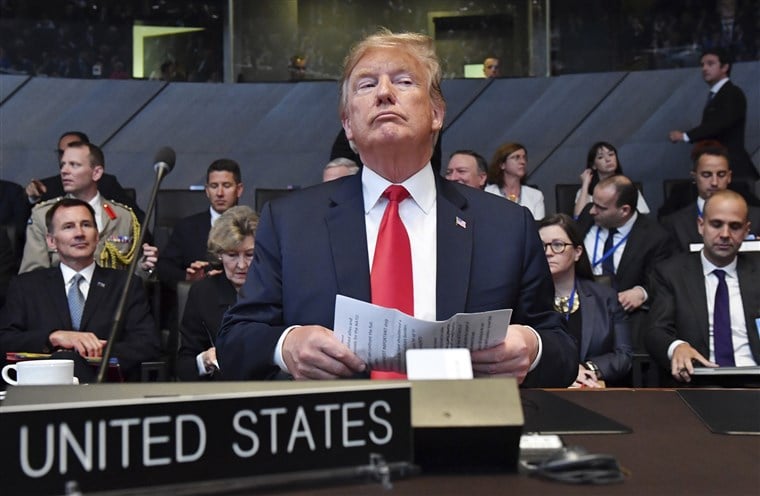
In the end, Trump could credibly claim a narrow victory for himself at this recent NATO summit in the transactional sense of gaining assurances from the European governments that they will be increasing their defense budgets.
In return Trump reaffirmed continuing U.S. support for the NATO alliance. Like a Mafioso family gathering when the cash flow is restored, friendship between European governments and Trump’s America becomes again possible, providing foreign leaders are prepared to continue absorbing the insults Trump delivers along the way, and then when they create awkward moments, as with Teresa May in Helsinki, are curtly dismissed as his own ‘fake news.’
When ‘fake’ is used to discredit the truth, trust vanishes, and one of the pillars of a healthy democracy is destroyed.
We gradually lose our understanding of what is truth, and worse, no longer care or hold leaders accountable by reference to reality.
There is no indication of any attention given by Trump to the crucial question: whether NATO serves sufficient useful purposes in the post-Cold War world to be worth the economic costs, let alone the political costs associated with spending on weapons rather than the well-being of people and their natural surroundings.
Would not the long overdue transition to a real peacetime security posture have many positive advantages for the U.S. and Europe, including exploring prospects for a mutually beneficial cooperative relationships with Russia and China?
We have reached a stage in world history where we should be asking whether NATO might be abandoned altogether or drastically redesigned in light of the current agenda of actual global policy challenges. If NATO were converted into a vehicle for the realization of human security, setting its new agenda by reference to the well-being of people, it would be a genuine triumph for Trump and the global public interest, but such an orientations seems well outside the boundaries of his political imagination.
In fairness, no American leader has dared to adopt the discourse of human security, or questioned the continued viability of Cold War alliances and accompanying strategic doctrine, and it would be pure wishful thinking to expect such demilitarizing words to issue from the lips or mind of Donald Trump.
At least those of us who watch the Trump spectacle in bemused fear should more than ever put forward our own hopes and beliefs in broad gauged cooperation between North America and Europe based on a commitment to peace, justice, and security, and demand that discussion of the future of the relationship between Europe and North America not be reduced to a demeaning debate about how to raise the level of military spending or keep obsolete alliances in being by the artifice of worrying only about whether particular governments are meeting the 2% goal, which seems like an arbitrary number that is unrelated to the actuality of security challenges.
Q2: How do you forecast the European reaction to the Trump commentary on NATO and could you explain how this might impact key portions of US foreign affairs?
RF: Europe’s governmental response to the Trump onslaught so far has been very disappointing, while recent civil society responses in Europe has been generally encouraging.
On the one side, NATO leaders seem to pout like aggrieved children, angered and humiliated, but too frightened of the uncertainties associated with confronting Trump to raise their objections above the level of a whisper.
On the other side, their acquiescence to the Trump insistence that NATO viability is to be measured in dollars or maybe Euros, unaccompanied by even a pretense of putting forward a relevant substantive rationale for Cold War levels of spending. Such passive aggressive behavior by European leaders is likely best understood as a sullen endorsement of Trumpism.
In effect, the Europeans are muttering “yes, we in Europe should be allocating more of our resources to the defense budget and begin to live up to our 2% commitment” so as to keep a renewed watchful eye on Russia and go along with the slouch toward a Second Cold War.
There is no justification given for supposing that Europe will be safer if more heavily invested in military equipment, and my view is that Europe would be far safer, more secure, and more serene if it instead invested these additional funds in helping alleviate the refugee challenge at both the asylum end and at its various sources where combat and climate change have made some national habitats virtually unlivable.
It might be emphasized that these habitants from which people are escaping to Europe most commonly at great risk to themselves, have been rendered uninhabitable partly by industrialization in the West and by the bloody aftermath of European colonialism that left behind arbitrary borders that did not correspond to natural communities.
Responding to the root causes of refugee and migration pressures should be seen as a matter of long deferred collective responsibility, and not as charity or as exercises of discretion.

Furthermore, if NATO were responsive to real threats to the security of Europe, including to its democratic way of life, it would focus its attention with a sense of urgency on these issues instead of implicitly preparing the continent for a new Cold War that an anti-Russian weaponized foreign policy will, ironically, help bring about, initially no doubt in the form of a destablizing arms race, and calls for raising defense spending to even higher levels.
Here Trump seems to have his priorities confused.
At times, for instance in supporting Brexit, and now endorsing a hard Brexit and the Boris Johnson approach, Trump seems to be furthering Moscow’s prime aim of weakening the unity of Europe, while at the same time by rallying NATO members to increase military spending Trump seems to be lending credibility to Russian worries of a new Cold War.
Whether for personal reasons associated with his shady financial dealings and his vulnerability to blackmail or a sense that the way to bring stability to the world is to have strong leaders work together, and establish a grand alliance of autocrats, Trump’s soft spot for Putin may be preferable to what a hard-edged, NATO enthusiast like Hilary Clinton would have brought to the White House had she won the election.
A Clinton presidency would almost certainly have gone easy on NATO when it comes to the economics and politics of burden-sharing while insisting on the adoption of a hardline on such geopolitical issues as Crimea and eastern Ukraine. Given the recent show of timidity by NATO leaders scared to cut the umbilical cord that has tied their security policies to the diktats of Washington ever since 1945 (with the notable exception of DeGaulle’s ‘France, First’ leadership).
We sometimes forget that aspiring to the role of global leader has always come with a high price tag, but the expense involved is more than offset by the benefits of status, heightened influence in global arenas, and a favorable positioning in the world economy, or so it seemed to the political elites of both parties until Trump through handfuls of sand into the intricate machinery of the national security state.
Q3: In the past US led and authorized NATO bombings are criticized rather easily and justifiably from the left, but what is the danger of the Trump mentality to foster a disregard for global order from the reactionary right wing? And does resistance to Trump cynicism put NATO skeptics on the left in a difficult position in your view?
RF: I think that the ideological discourse has definitely been altered by Trump’s alt-right approach to NATO. The left, such as it is, has refocused its energies on resisting what it believes to be a slide toward fascism at home arising from its correct perceptions of the Trump presidency as racist, ultra-nationalist, chauvinist, Islamophobic, subverting constitutionalism, and haunted by demagogic leadership.
Those most upset with the attacks on the alliance underpinnings of NATO are not the left, but rather the more centrist liberal constituencies encompassing moderate Republicans as well as mainstream Democrats. These are persons likely as upset by the challenge mounted by the mildly insurgent left-leaning politics of Bernie Sanders as by Trump, perhaps more so.
Trump is ardently pro-business, pushed through Congress tax reform that mainly benefits those, like himself, who are part of a tiny billionaire class. What remains of the liberal establishment, whether on Wall Street or situated in the dark inner and hidden recesses of the deep state, is on the verge of tears in the aftermath of Trump’s assault on the NATO anchoring of the Atlanticist approach to American foreign policy that became so iconic for the political classes comprising the bipartisan American establishment ever since 1945.

Q4: Trump was elected partly because of what amounts to his “Me First” Doctrine as well as his “Make America Great Again” slogan. Does he in your estimation fully intend to utilize NATO in the background while appeasing his rabid anti institution base?
Trump and his fanatical base in the U.S. never seem far apart. Even in pursuing trade wars around the world, especially with China, that harm many of those who voted for him, his rationalizations, invoking the ‘America, First’ language and jobs rhetoric whether or not the evidence supports such claims.
Apparently, so far, a relentless demagogue can fool many of the people all the time, especially by the rants of a populist politic that takes delight in scapegoating outsiders and arousing rage against the insiders who are portrayed as reaping the benefits of the international liberalism that gave us both the Cold War world economy and produced a neo-liberal predatory aftermath identified in the 1990s as ‘globalization’, a view of political legitimacy that combines a private sector economy with some minimal form of democracy.
How NATO will eventually fit within this Trump scheme is not yet clear, and may never be so. It seems a blustery sideshow at this point as NATO does not seem to have clear missions in post-Cold War Europe except to be a rallying center for counter-terrorist tactics, which operationally depend on national policing and paramilitary capabilities.
It seems that Europe is willing to pay up to sustain the NATO status quo, allowing Trump to laugh his way to the bank.
NATO’s leading members are most worried these days about keeping the EU together in the face of various stresses associated with Brexit, refugees, a far right anti-immigration resurgence, and some loss of confidence in the Euro and austerity fiscal discipline. Handling Trump is an unpleasant additional chore for European leaders, but it is so far treated more in the spirit of the London protesters’ giant baby balloon, a matter of parenting, lacking real substantive weight, or so it seems.
Aside from Turkey no European government seems to be considering alternative alignments now.
On the broader posture of anti-institutionalism and anti-multilateralism, Trump has kept faith with his pre-Fascist base by bullying tactics at the UN, repudiating the Nuclear Agreement with Iran, and withdrawing from the Paris Climate Change Agreement. These are big ticket items that represent extremely serious setbacks for responsible efforts to address challenges of regional and global scale that pose severe threats to peace and ecological stability.
Q5: Trump likes to portray himself as a populist alternative to the Bushes and Clintons and their reckless foreign policy while questioning our “exceptionalism.” In reality however we have broadened and expanded our presence around the world under Trump. Can you talk about the Trump foreign policy and how’d you categorize it?
Trump foreign policy, such as it is, seeks to diminish engagement with international institutions, including treaty regimes, and retain greater freedom of maneuver for the U.S. Government in international relations.
It seems also to deny the reality of such global challenges as climate change, global migrations, genocidal behavior, and extreme poverty. It is definitely statist in outlook, both because of a belief in nationalism as the best guide to policy-making and problem solving, and because the United States as the richest and most powerful of states can supposedly gain greater advantages for itself by reliance on its superior bargaining leverage in any bilateral bargaining process.
Borrowing from his deal-making past, Trump seems convinced that the U.S. will get more of what it wants when it deals bilaterally than in hemmed in my multilateral frameworks as in trade relations or environmental protection.
Beyond this kind of transactional search for material advantages, oblivious to substantive realities that make cooperative approaches more likely to achieve beneficial results, Trump has been consistent in promoting reactionary issues at home and abroad whenever given the chance, whether by tweeting or issuing executive orders. While in Europe he gave public voice via TV to an anti-immigration screed, telling Europeans that immigrants were ruining Europe, bringing to the continent crime and terrorism, a malicious argument similar to the slander of undocumented Hispanic immigrants present in the United States, some long in the country, and making laudable contributions.
Trump’s silences are also important. He seems determined to ignore crimes against humanity if committed by states against people subject to its authority, whether the Rohingya in Myanmar or Palestinians in Gaza. American support for human rights, always subject to geopolitical manipulation, is now a thing of the past so long as Trump hangs around, although such considerations may be cynically invoked when helpful to strengthen arguments for sanctions and uses of force against adversery states.
Whether wittingly or not, Trump seems determined to shatter the legacy of the Bushes and Clinton built around an American led liberal international order, but without any real alternative conception of global governance to put in its place. So far this has produced an ad hoc approach, beset by contradictions, which one day can veer in the direction of confrontation as with Iran or North Korea, or on another day seem to seek some sort of long-term accommodation with Russia and North Korea, and sometimes even China.
Also evident is the extent to which Trump’s foreign policy initiatives are designed to please Israel, as with the move of the American Embassy to Jerusalem announced last December, or the heightened tensions with Iran, or have no justification other than to uphold the expectations of billionaire domestic donors of his presidential campaign.
And finally, there is the search for the grandiose, ‘the deal of the century,’ a breakthrough that will make Trump great for once and for many, but when more closely considered the deal, as the one in the offing to end the Israel/Palestine struggle turns out to be a house of cards, so one-sided that it effectively collapses before its absurdly pro-Israeli contents have been officially disclosed.
Whether by his blunt actions sowing discord or his silent acquiescence in the face of atrocities, we have reason to fear the trajectory of the Trump presidency.
In this sense, the NATO performance was just a tip of a dangerous iceberg imperiling world order, but also the future of responsible and responsive governance in a period of grave danger and intense turmoil. As with the weak response of European governments to Trumpism, there is reason for disappointment about the resilience of republican institutions within the United States, including such stalwarts as separation of powers and the constitutional integrity of political parties.
Alarm bells should be ringing through the night at maximum volume, but so far the silences outweigh the noise as the world slouches toward catastrophe, chaos, and cruelty.
Recommeded reading and viewing
Jan Oberg
NATO’s crisis and the Transatlantic conflict
Jan Oberg
Make NATO civilian and civilised
TFF Live
NATO is Outdated/Obsolete – 8 Arguments
TFF Associates
Ten articles on the New Cold War and a reflection