
Denmark prepares for even more interventions and wars instead of civil conflict handling


Danish media have just informed the gaping Danes that their country is entering no less than “two military alliances” this week. That’s how the Ritzau News Bureau describes it and since a decent basic journalist capacity to problematize security and defence issue – as well as the peace discourse – has vanished, or been abolished, years ago, this is how both the leading conservative daily Berlingske Tidende and the Danish Broadcasting Corporation, Danmarks Radio, describe it too.

Such headlines should raise a few eyebrows. They don’t.

The Danes have – also long ago – willingly accepted that their country is among the most interventionist and war-fighting in Europe. One reason is that the media have virtually no people left who could perform deeper research or ask critical questions, especially about US/NATO affairs, let alone provide a diversity of perspectives.

Abroad few bother to know about H.C. Andersen’s idyllic little country, still sold on being a very happy country, on producing good beer and having the Little Mermaid sitting bored on her stone forever.


Denmark as a ‘rogue bomber state’

Denmark used to be anti-interventionist, anti-war country and a “footnote” member of NATO. It was considered incompatible with Danish mentality to participate in global military missions.

The author served as an expert member of the Danish government’s Disarmament and Security Political Committee (SNU in Danish) during the 1980s. Not one MP, expert, military, journalist or minister for that matter would, back then, have even thought of suggesting that Denmark ought to use its defence forces for anything but under two kinds of circumstances: if another NATO member was attacked and Article 5 would apply and, secondly, in the – unlikely – case of an isolated attack on Denmark.

But 1999 represented a – tragic – turning point.

Under the Social Democratic PM Poul Nyrup Rasmussen and liberal foreign minister Niels Helveg Petersen, Denmark became a bomber nation engaged, virtually ever since, in military missions mostly without a UN Security Council mandate. Denmark’s debut as ‘rogue state’ in this sense was Yugoslavia, two days of bombings with NATO in Kosovo and Serbia.

Then followed a multi-year presence in Afghanistan, participation in the occupation and administration of the predictable fiasco called Iraq 2003-2007, then Libya 2011 where Denmark was particularly active in the criminal enterprise in which a UN mandate about a No-Fly Zone was misused to virtually destroy the country. Denmark bombed a palace and killed a grandchild of Moammar Khadafi. Then followed a second bombing task in Iraq and deployment of troops on the Syrian side of the border. So five ‘missions’ all in all and all at the command of Washington of course.

The argument most often brought forward by Danish ministers, MPs, spokespersons and researchers/experts (the latter mostly with some kind of military background) to the effect that these missions were conducted to yield a positive influence upon the world or on the security of the Danish people can be relegated to history’s heaps of pretexts, human folly, blind loyalty with Washington, propaganda – or worse.

All these wars have been fiascos on their own terms and made the countries, the region and the world, including Denmark, much less secure – not to say the unmentionable word, peaceful.


The two new military initiatives Denmark “proudly” joins

One is the Macron-initiated European Intervention Initiative (E2I) that was invented as part of the French President’s 2017 Strategic Review of Defence and National Security.

In his speech, held at Sorbonne University, he said that “At the beginning of the next decade, Europe needs to establish a common intervention force, a common defence budget and a common doctrine for action.” It’s far from a new idea but it was stated in a new framework – as meaning outside the EU and outside NATO, a kind of coalition of the willing and a way to maintain cooperation with the UK after Brexit.

As usual in these circles, the essential concepts are deliberately either non-defined or defined in ways that they can be transformed into any kind of action later. Intervention can be for peace and in some kind of cooperation with the UN – but then why a European decision-making a not a word about the UN?

Intervention is more likely to imply – whenever the situation should materialize – something like the interventions in Iraq, Libya, or Syria.

One must assume that Macron puts forward such a proposal both to:

a) manifest French leadership of Europe (while Germany is grappling, to a large extent, with its own domestic issues);

b) to revitalize, and also challenge, the EU by also setting up non-EU decision-making mechanisms for rapid intervention – i.e. increase the capacity and not having to wait for an all-EU consensus (which hardly ever take place in spite of the Lisbon Treaty’s provisions about speaking with one voice); and

c) prepare Europe/EU for a time when relations with the US have turned really sour and the very survival of NATO may be at stake.

Below, please find a few good (within the traditional security policy discourse) articles about the many possible interpretations of this initiative.

• •

The Danish defence minister, Claus Hjort Frederiksen states that “We in Europe shall take upon us even more of the responsibility for our own security. The world looks less stable than it has for a long time, both in the Middle East and thanks to a steadily more self-asserting Russian behaviour.”

And he adds, “That (the situation) requires that there are countries that have both the will and the capability if it becomes necessary. We have that (i.e. in Denmark) and that’s why we join.”

None of this has any relevance to the two initiatives; they are standard phrases employed to work miracles at every decision having to do with the Danish military and defence – not the least the “threat” that is called Russia.

France has repeatedly intervened in the Middle East and Africa for about a century, it’s pretty much in her genes. Why on earth should Denmark place itself at the disposal for anything that does not explicitly state that that is not what’s intended in the E2I – if it isn’t?

Secondly, it would be reasonable to ask the minister – but no journalist is able or willing to: With all the earlier defence initiatives and increased budgets over the years, how come we have less peace, according to you, than we ought to have? Could there be some kind of end to repeated investments in military projects and interventions (such as in the Middle East) when, contrary to what you and NATO hoped and stated, the wars we have fought there have yielded only less, and not more, security for the region, for the world and for Denmark itself? What makes you think that this E2I shall become a success when other similar military-enhancing initiatives and policies have not?

Defence minister Frederiksen is a former minister of finance with no competence in military or foreign affairs. One would like to believe that the media abstain from asking him such questions to avoid creating an intellectually embarrassing situation for the minister. However, that is hardly the reason the media are merely and repeatedly conveying official information and press releases and then interview only carefully selected experts known to at the very least never challenge the official policies.

The other initiative Denmark proudly joins is Joint Expeditionary Forces (JEF) for which a letter of intent was signed in 2014. The British government defines is here:

“The letter of intent, signed with partners from Denmark, Estonia, Latvia, Lithuania, the Netherlands and Norway, aims to develop the Joint Expeditionary Force (JEF) so that it is fully operational before 2018. The JEF is a pool of high readiness, adaptable forces that is designed to enhance the UK’s ability to respond rapidly, anywhere in the world, with like-minded allies, or on behalf of international organisations such as the UN or NATO.”

One notices, again, that the geographical framework is “anywhere in the world” – neither defensively the NATO nor the EU member areas. Britain too has a century-long tradition of intervening early and late here or there when it sees fit.

Denmark membership in such frameworks is virtually problem-free. It should be highly controversial, in the perspective of both Danish and international law, to commit Denmark to military missions “anywhere in the world” and in particularistic networks of countries, neither in the framework of the UN, EU or NATO as such.

The answer to such concerns would, of course, be that “Denmark decides on a case-by-case basis” if and when the situation occurs; Denmark has the freedom to make its own decisions.” That is true. In theory.

However, such independent decisions require an independent thinking and research, intellectual capacity, a diverse expertise and a solid leadership of the country’s foreign, security and defence policy. The only problems are that all these are things of the past and that there is no longer the slightest discussion about non-military initiatives, mediation, peacekeeping, conflict-resolution, etc.

Denmark’s so-called security rests to the extent of 80 per cent on military thinking and policies. Twenty years of war-fighting adventures have had no intellectual impact on the ongoing militarism and on seeing the world’s problems mainly through military lenses. Like in the U.S.,

The media, left and right and with a few individual exceptions, as well as the research world have adapted to this orientation long ago.

At some point, this is bound to go wrong. Very wrong. Joining these two ill-defined interventionist “alliances” is only one more confirmation of the politics of confusion that has long ago replaced an intellectually defensible and sustainable concept and vision of security politics as such.

A rogue state needs neither.


Recommended literature

President Macron’s Initiative for Europe

Alice Panier
Macron’s “European Intervention Initiative”: more questions than answers

Nick Witney
Macron and the European Intervention Initiative: Erasmus for soldiers?

The British Government
International partners sign joint Expeditionary Forces Agreement

Fabrice Pothier
Macron’s European vision

Daniel Buffey
Nine EU states sign off on joint military intervention force

German Foreign Policy


Photo credit
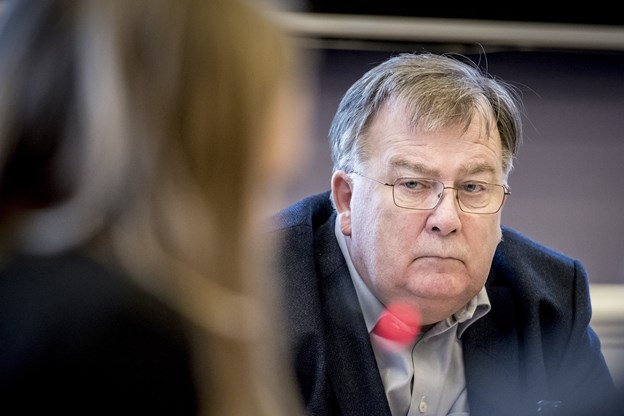
Defence minister Claus Hjort Frederiksen
Photographer Mads Claus Rasmussen © Ritzau Scanpix

 

Peace & future researcher + ‌Art Photographer

3 Responses

  1. To be more responsible would be to drag out of all military and war engagements

  2. But we are like trapped. Cause noone in government listen. Only keep on putting Lies creating false enemies in the name of terror

Related Posts

Johan Galtung 1930-2024October 2015 Published here on October 3, 2026 Let us focus on Civilization for conflict analysis and remedies. Major forms of disorder use violence; war is state organized violence. The most belligerent states are the United States of America and Israel, both with civilization roots. National Evangelism, the US Protestant Christian civilization– more national than evangelical–justifies US warfare as exceptionalism of a people chosen by God, with a manifest destiny to run the world. Orthodox Judaism justifies Israeli warfare to conquer and expand from Nile to Euphrates as a religious right and duty to the Eternal One. The third most belligerent country, the UK, no longer believes it is God-chosen but chosen by the USA; not quite the same but something. But the root cause of global disorder lies in the Occident–with Islam–seeing itself as the single, universal civilization valid for all at all times, all others being...
Jan ObergPhD, director, The Transnational Foundation for Peace and Future Research, TFFLund, Sweden October 2, 2026 This is my full original manuscript. The Chinese Academy of Social Science, CASS, makes two publications out if it. 1. China’s Five-year plan emphasized the capabilities of basic research and original innovation. It is regarded as the goal of the future social development, which, as required, should be significantly enhanced. Can you comment on the importance of original innovation in research and academic study? I believe it is easier to define “original innovation” in the natural sciences than in social sciences. The breaking points of what constitutes something new, or innovative, are not quite as sharp in the latter. But in both fields it is about opening up something that was closed, unseen, unexplored before – making manifest what was earlier latent. Innovations come in many forms and shapes – naming something that was not...
The agreement is catastrophic both because of what it says and what it doesn’t mention. It reduces further the major asset of security policies: Freedom of action. Jan Oberg TFF director September 25, 2026 A couple of hours before the agreement was signed on September 22, 2026, I published the following 13 hypotheses about what it would most likely contain on TFF Substack (in English). I was wrong on only the first point. Contrary to what Trump had written on his Truth Social platform, it does not appear to come into force immediately. In fact, it turned out to be worse than even I had anticipated. After these hypotheses now come a number of reflections in light of what the agreement actually contains, and does not contain, as well as the way in which it has generally been presented by major media outlets and by the public-service broadcaster DR. My...

Recent Articles

Tony Robinson October 4, 2026 Violence is easy to recognise when someone is being beaten, shot or killed. It becomes more difficult when nobody is holding a weapon. Poverty, discrimination, exploitation and repression can restrict a human life just as effectively, although they do so in very different ways and with very different consequences. Simply adding more categories to an ever-growing list of forms of violence does not really solve the problem. The more interesting question is what all these different situations have in common and why it makes sense to describe them using the same word. Human beings do not simply react to what happens around them. They remember the past, imagine things that do not yet exist, make plans and undertake projects. Workers organise because they imagine different working conditions; people migrate because they imagine another life somewhere else; social movements emerge because people refuse to accept the...
It’s a matter of principles, courage, vision and pulling together – while the militarist world is falling apart… Peter Langille October 3, 2026 “Here, then, is the problem which we present to you, stark and dreadful and inescapable: Shall we put an end to the human race; or shall mankind renounce war?”The Bertrand Russell—Albert Einstein Manifesto, July 9, 1955 ⁕ The forecast for what’s ahead is worrisome. The sharp rise in armed conflicts over the past three years is adding to what was already the highest level in over seventy years. Genocides, which should be prevented are supported. A shared climate emergency that jeopardises survival is ignored. Diverse polls now suggest that people are war-weary, worried and interested in a more effective United Nations. And, there are viable policy options for a more secure world! Yet governments are doubling-down, betting on more war and investing heavily. If current trends persist,...
Johan Galtung 1930-2024October 2015 Published here on October 3, 2026 Let us focus on Civilization for conflict analysis and remedies. Major forms of disorder use violence; war is state organized violence. The most belligerent states are the United States of America and Israel, both with civilization roots. National Evangelism, the US Protestant Christian civilization– more national than evangelical–justifies US warfare as exceptionalism of a people chosen by God, with a manifest destiny to run the world. Orthodox Judaism justifies Israeli warfare to conquer and expand from Nile to Euphrates as a religious right and duty to the Eternal One. The third most belligerent country, the UK, no longer believes it is God-chosen but chosen by the USA; not quite the same but something. But the root cause of global disorder lies in the Occident–with Islam–seeing itself as the single, universal civilization valid for all at all times, all others being...

TFF on Substack

Discover and subscribe to more peace materials on TFF Substack

Most Popular

Tony Robinson October 4, 2026 Violence is easy to recognise when someone is being beaten, shot or killed. It becomes more difficult when nobody is holding a weapon. Poverty, discrimination, exploitation and repression can restrict a human life just as effectively, although they do so in very different ways and with very different consequences. Simply adding more categories to an ever-growing list of forms of violence does not really solve the problem. The more interesting question is what all these different situations have in common and why it makes sense to describe them using the same word. Human beings do not simply react to what happens around them. They remember the past, imagine things that do not yet exist, make plans and undertake projects. Workers organise because they imagine different working conditions; people migrate because they imagine another life somewhere else; social movements emerge because people refuse to accept the...
It’s a matter of principles, courage, vision and pulling together – while the militarist world is falling apart… Peter Langille October 3, 2026 “Here, then, is the problem which we present to you, stark and dreadful and inescapable: Shall we put an end to the human race; or shall mankind renounce war?”The Bertrand Russell—Albert Einstein Manifesto, July 9, 1955 ⁕ The forecast for what’s ahead is worrisome. The sharp rise in armed conflicts over the past three years is adding to what was already the highest level in over seventy years. Genocides, which should be prevented are supported. A shared climate emergency that jeopardises survival is ignored. Diverse polls now suggest that people are war-weary, worried and interested in a more effective United Nations. And, there are viable policy options for a more secure world! Yet governments are doubling-down, betting on more war and investing heavily. If current trends persist,...
Johan Galtung 1930-2024October 2015 Published here on October 3, 2026 Let us focus on Civilization for conflict analysis and remedies. Major forms of disorder use violence; war is state organized violence. The most belligerent states are the United States of America and Israel, both with civilization roots. National Evangelism, the US Protestant Christian civilization– more national than evangelical–justifies US warfare as exceptionalism of a people chosen by God, with a manifest destiny to run the world. Orthodox Judaism justifies Israeli warfare to conquer and expand from Nile to Euphrates as a religious right and duty to the Eternal One. The third most belligerent country, the UK, no longer believes it is God-chosen but chosen by the USA; not quite the same but something. But the root cause of global disorder lies in the Occident–with Islam–seeing itself as the single, universal civilization valid for all at all times, all others being...
Read More
Living-Peace-Sign-Budapest-copy
Tony Robinson October 4, 2026 Violence is easy to recognise when someone is being beaten, shot or killed. It becomes more difficult when nobody is holding a weapon. Poverty, discrimination, exploitation and repression can restrict a human life just as effectively, although they do so in very different ways and with very different consequences. Simply adding more categories to an ever-growing list of forms of violence does not really solve the problem. The more interesting question is what all these different situations have in common and why it makes sense to describe them using the same word. Human beings do not simply react to what happens around them. They remember the past, imagine things that do not yet exist, make plans and undertake projects. Workers organise because they imagine different working conditions; people migrate because they imagine another life somewhere else; social movements emerge because people refuse to accept the...
b54a1f10-8c65-4f0b-9dd5-4abc0a7d04cc_2659x2659
It’s a matter of principles, courage, vision and pulling together – while the militarist world is falling apart… Peter Langille October 3, 2026 “Here, then, is the problem which we present to you, stark and dreadful and inescapable: Shall we put an end to the human race; or shall mankind renounce war?”The Bertrand Russell—Albert Einstein Manifesto, July 9, 1955 ⁕ The forecast for what’s ahead is worrisome. The sharp rise in armed conflicts over the past three years is adding to what was already the highest level in over seventy years. Genocides, which should be prevented are supported. A shared climate emergency that jeopardises survival is ignored. Diverse polls now suggest that people are war-weary, worried and interested in a more effective United Nations. And, there are viable policy options for a more secure world! Yet governments are doubling-down, betting on more war and investing heavily. If current trends persist,...
010
Johan Galtung 1930-2024October 2015 Published here on October 3, 2026 Let us focus on Civilization for conflict analysis and remedies. Major forms of disorder use violence; war is state organized violence. The most belligerent states are the United States of America and Israel, both with civilization roots. National Evangelism, the US Protestant Christian civilization– more national than evangelical–justifies US warfare as exceptionalism of a people chosen by God, with a manifest destiny to run the world. Orthodox Judaism justifies Israeli warfare to conquer and expand from Nile to Euphrates as a religious right and duty to the Eternal One. The third most belligerent country, the UK, no longer believes it is God-chosen but chosen by the USA; not quite the same but something. But the root cause of global disorder lies in the Occident–with Islam–seeing itself as the single, universal civilization valid for all at all times, all others being...
Screenshot 2026-10-02 011738
Jan ObergPhD, director, The Transnational Foundation for Peace and Future Research, TFFLund, Sweden October 2, 2026 This is my full original manuscript. The Chinese Academy of Social Science, CASS, makes two publications out if it. 1. China’s Five-year plan emphasized the capabilities of basic research and original innovation. It is regarded as the goal of the future social development, which, as required, should be significantly enhanced. Can you comment on the importance of original innovation in research and academic study? I believe it is easier to define “original innovation” in the natural sciences than in social sciences. The breaking points of what constitutes something new, or innovative, are not quite as sharp in the latter. But in both fields it is about opening up something that was closed, unseen, unexplored before – making manifest what was earlier latent. Innovations come in many forms and shapes – naming something that was not...
arctic-circle-map
The agreement is catastrophic both because of what it says and what it doesn’t mention. It reduces further the major asset of security policies: Freedom of action. Jan Oberg TFF director September 25, 2026 A couple of hours before the agreement was signed on September 22, 2026, I published the following 13 hypotheses about what it would most likely contain on TFF Substack (in English). I was wrong on only the first point. Contrary to what Trump had written on his Truth Social platform, it does not appear to come into force immediately. In fact, it turned out to be worse than even I had anticipated. After these hypotheses now come a number of reflections in light of what the agreement actually contains, and does not contain, as well as the way in which it has generally been presented by major media outlets and by the public-service broadcaster DR. My...
girl-5894831_1280
Below are TFF-related media mentions, comments, videos and social media posts published elsewhere but not on this homepage. We happen to catch and list only a fraction. Regarding video comments and debates, we recommend that you go to the TFF Video Channel on Substack where many of them are reproduced. Jan Oberg is a contributor to China Daily – 52 million daily clicks – and Global Times, CGTN and CCTV (the national television), China Investment, Xinhua News Agency and several others. Articles and videos on these media very often multiply into countless Chinese (and Western media) that re-post them from these main media. Thanks to The China Academy, his analyses, interviews and comments are frequently posted on YouTube channels such as Thinkers Forum and Wave Media. These videos are often re-posted on Bilibili (China’s YouTube), the China Content Center on TikTok, and on the Chinese edition of TikTok, Douyin.com. This means reaching hundreds of millions of viewers worldwide over a year. While there are too many to catch on all these...




