
In Pursuit of Peace and Justice: 100 Peace & Justice Leaders and Models

29 Jan 2018

By Anthony J. Marsella and Kathleen Malley-Morrison

Introduction

26 Jan 2018 – The annual memorial holiday on January 15, 2018, celebrating Reverend Martin Luther King, Jr.’s enduring contributions to peace and justice, has passed.

The events of the day linger in our minds, eternally grateful for Reverend King’s efforts to free people and nations from the brutal oppressions imposed by governments, nations, societies, organizations, and individuals, who willfully continue to support and sustain the evils of racism, prejudice, violence, and war.

Reverend King’s commitment to freedom from oppression and abuse compel us to continue his efforts far beyond the words, songs, and promises of his day.

To this end, we, (i.e., Kathy Malley-Morrison & Anthony J. Marsella), the authors of this article, have chosen to demonstrate our responsibilities to continuing the work of Reverend King, by identifying 100 living peace and social justice leaders and models.

The number is arbitrary for there are tens of thousands more who deserve citation. Many are not listed, but will be listed in future efforts. Do not be dismayed! Patience! We believed it essential to create a dynamic list of living peace and justice activists and advocates to encourage peace and justice work.

The individuals included on our list are from all genders, ages, roles.  They are from many nations, ethnocultural groups, and “races.”  We sense a rising tide of commitment to peace and justice, and an intolerance of the corruption, cronyism, and asymmetric power sustaining current abuses.

We consider our efforts a beginning, and we will continue to publish new lists. This is because the struggle for peace and justice is endless, and each day new people are rising to the call.

This is as it should be, and must be, until such time the forces of oppression yield to the forces of good; evil will continue, but human virtue, endowed in conscience will triumph! While the work of many included will be recognized, some of those listed may not be apparent. We have attached website information after each name to offer insight into their efforts.

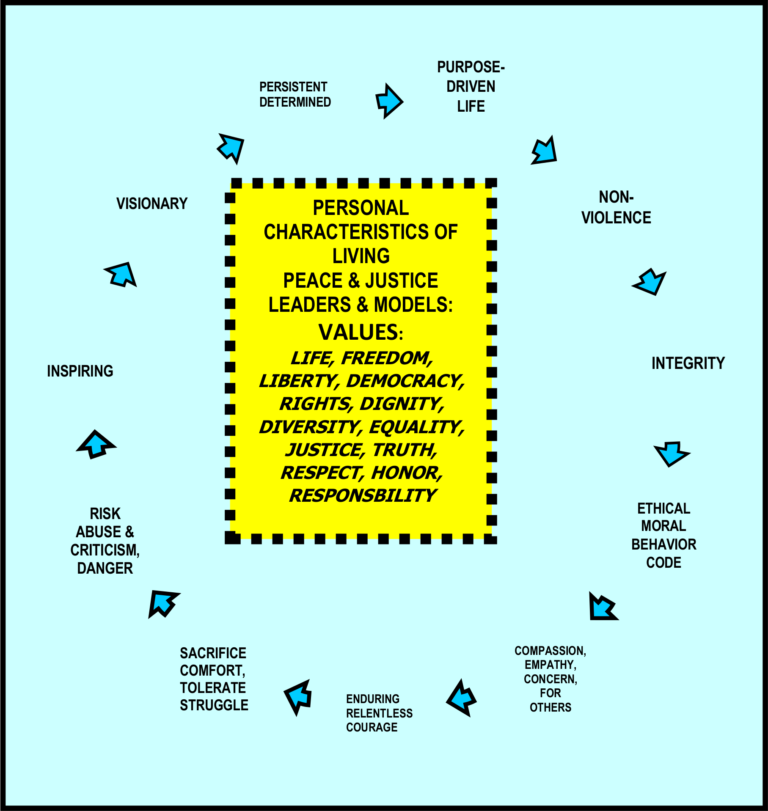
Before sharing our list, however, we wish to include two charts offering graphic displays of essential material for understanding and appreciating living leaders.


CHART 1: PERSONAL CHARACTERISTICS OF PEACE AND JUSTICE LEADERS AND MODELS
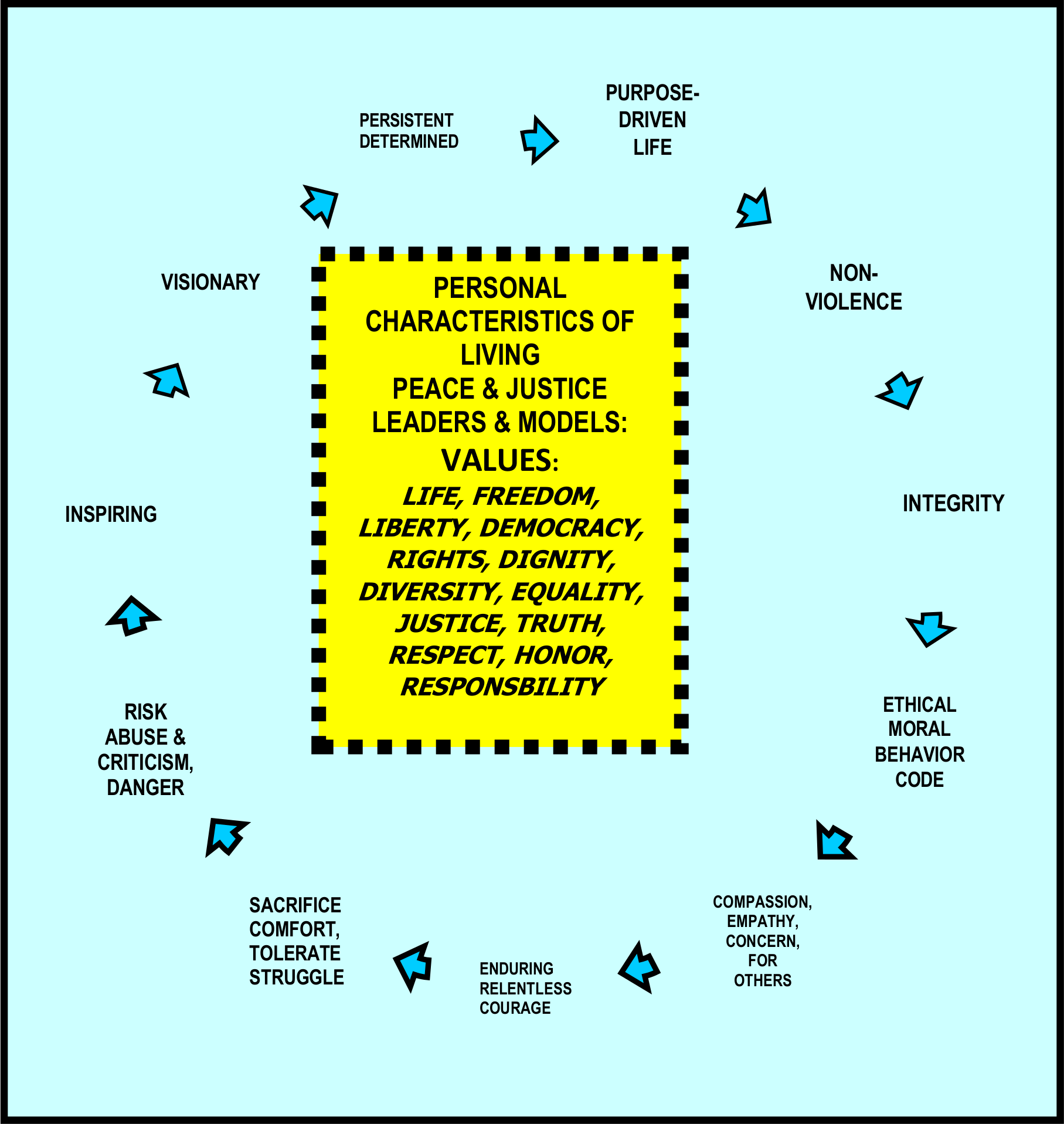


CHART 2: ROLES AND STATUSES OF LIVING PEACE & JUSTICE LEADERS AND MODELS
 

TABLE 1:

One Hundred Living Peace and Justice Activists, Advocates, Models

  1. Abdul-Jabbar: Kareem Abdul-Jabbar
  2. Adams: David Adams
  3. Albertini: James Albertini
  4. Assange: Julian Assange
  5. Atzmon: Gilad Atzmon
  6. Avnery: Uri Avnery
  7. Bacevich: Andrew Bacevich
  8. Baroud: Ramzy Baroud
  9. Benjamin: Medea Benjamin
  10. Berrigan: Frida Berrigan
  11. Binney: William Binney
  12. Blum: Willam Blum
  13. Burrowes: Robert J. Burrowes
  14. Caldicott: Helen Caldicott
  15. Castro: Gustavo Castro
  16. Chiponda: Melania Chiponda
  17. Chomsky: Noam Chomsky
  18. Coates: Ta-Nehisi Coates
  19. Cole: Juan Cole
  20. Cook: Michelle Cook
  21. Dalai: Dalai Lama (Tenzin Gyatso)
  22. Davis: Angela Davis
  23. Ebadi: Shrin Ebadi
  24. Eidelson: Roy Eidelson
  25. Ellsberg: Daniel Ellsberg
  26. Engelhardt: Tom Engelhardt
  27. Falk: Richard Falk
  28. Feeley: Tom Feeley
  29. Fonda: Jane Fonda
  30. Galtung: Johan Galtung
  31. Garza: Alicia Garza
  32. Giroux: Henry A. Giroux
  33. Goodman: Amy Goodman
  34. Gorbachev: Mikhail Gorbachev
  35. Greenwald: Glen Greenwald
  36. Guevara-Rosas: Erika Guevara-Rosas
  37. Haugen: Gary Haugen
  38. Hedges: Chris Hedges
  39. Hersh: Seymour Hersh
  40. Hightower: Jim Hightower
  41. Ikeda: Daisaku Ikeda
  42. Jamail: Dahr Jamail
  43. Jones: Van Jones
  44. Kalaygian: Ani Kalayjian
  45. Karman: Tawakkol Abdel-Salam Karman
  46. Kelly: Kathy Kelly
  47. Killelea: Steve Killelea
  48. Kiriakou: John Kiriakou   
  49. Klein: Naomi Klein
  50. Knox: Michael Knox 
  51. Koehler: Robert Koehler  
  52. Kohls: Gary G. Kohls 
  53. Lakey: George Lakey
  54. Leonard: Annie Leonard 
  55. Lerner: Rabbi Michael Lerner
  56. Lifton:   Robert Lifton
  57. Lindorff: David Lindorff
  58. Manning: Chelsea Manning
  59. McCoy: Alfred McCoy
  60. McGovern: Ray McGovern 
  61. Maguire: Mairead McGuire  
  62. Menchu: Rigoberto Menchu 
  63. Miles: Stephen Miles
  64. Monbiot: George Monbiot 
  65. Nader: Ralph Nader
  66. Oberg: Jan Oberg 
  67. Okon: Emen Okon  
  68. Ono: Yoko Ono
  69. Peled: Miko Peled
  70. Petras: James Petras
  71. Pilger: John Pilger
  72. Pilisuk: Marc Pilisuk  
  73. Qumsiyeh: Mazin Qumsiyeh
  74. Ragbir: Ravi Ragbir 
  75. Reich: Robert Reich
  76. Risen: James Risen 
  77. Roberts: Paul Craig Roberts 
  78. Rosa: Antonio C. S. Rosa
  79. Roy: Arundhati Roy 
  80. Satyarthri: Kailash Satyarthi 
  81. Sharpton: Al Sharpton 
  82. Sheehan: Cindy Sheehan
  83. Shoman: Samia Shoman 
  84. Soetoro-Ng: Maya Soetoro-Ng 
  85. Staub: Ervin Staub  
  86. Swanson: David Swanson
  87. Taibibi: Matt Taibibi 
  88. Tamimi: Ahed Tamimi 
  89. Thich: Thích Nhất Hạnh 
  90. Trask: Haunani-Kay Trask 
  91. Turse: Nick Turse  
  92. Tutu: Desmond Tutu 
  93. Vandeman: Mike Vandeman 
  94. Walsh: Dot Walsh
  95. Weir: Alice Weir 
  96. Whitehead: John W. Whitehead
  97. West: Cornel West 
  98. Wilkerson: Colonel Larry Wilkerson
  99. Williams: Jody Williams 
  100. Yousafzai: Malala Yousafzai

This is our continuing contribution to the legacy of Reverend Martin Luther King, Jr.

His work continues in the lives of those who share his commitments.

______________________________________________
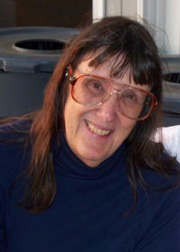
Kathleen Malley-Morrison, Ed.D., Director of the Group on International Perspectives on Governmental Aggression and Peace (GIPGAP), is Professor Emerita of Psychological and Brain Sciences at Boston University. She is the author or coauthor of several books, including Family Violence in a Cultural Perspective, and Family Violence in the United States, as well as editor of the four volume series: State violence and the right to peace: An international survey of the views of ordinary people. She has authored numerous articles and book chapters on violence within relationships and nations. Her current efforts to advance peace and social justice are centered primarily in her blog, Engaging Peace. http://engagingpeace.com. She can be reached at: kathiemm@engagingpeace.com
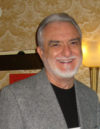
Anthony J. Marsella, Ph.D., a member of the TRANSCEND Network for Peace Development Environment, is a past president of Psychologists for Social Responsibility, Emeritus Professor of psychology at the University of Hawaii’s Manoa Campus in Honolulu, Hawaii, and past director of the World Health Organization Psychiatric Research Center in Honolulu.  He is known internationally as a pioneer figure in the study of culture and psychopathology who challenged the ethnocentrism and racial biases of many assumptions, theories, and practices in psychology and psychiatry. In more recent years, he has been writing and lecturing on peace and social justice. He has published 21 books and more than 300 articles, tech reports, and popular commentaries. His TMS articles may be accessed HERE and he can be reached at marsella@hawaii.edu.


Originally published at the Transcend Media Service, TMS, here
One Response

  1. Uhm… so this is supposed to be non-violent? “I’m not going to say whether it is right or not to burn down a synagogue, I can see that it is a rational act.” Hahaha you compare this guy to Martin Luther King. He believes that the narrative of the holocaust is misleading and should be revised. “At a talk by Richard Falk at LSE in March 2017, Atzmon shouted “rauss”, the German word for “out”, at a group of students in the audience, telling them that Jews had been “expelled from Germany for misbehaving” and recommending that they read Holocaust Denier David Irving” (Irving believes Hitler knew nothing about the extermination of Jews) Kahn-Harris describes Atzmon as “deliberately apathetic about the Holocaust and other atrocities against Jews, nodding towards without completely embracing both justification and denial” Liberation is about compassion for ALL people. I think this is some privileged, whitey academic biases perhaps? Like I get it your anti-zionist, that doesn’t mean you have to idolize holocaust deniers and place them on the same status as MLK.

Related Posts

Tony Robinson October 4, 2026 Violence is easy to recognise when someone is being beaten, shot or killed. It becomes more difficult when nobody is holding a weapon. Poverty, discrimination, exploitation and repression can restrict a human life just as effectively, although they do so in very different ways and with very different consequences. Simply adding more categories to an ever-growing list of forms of violence does not really solve the problem. The more interesting question is what all these different situations have in common and why it makes sense to describe them using the same word. Human beings do not simply react to what happens around them. They remember the past, imagine things that do not yet exist, make plans and undertake projects. Workers organise because they imagine different working conditions; people migrate because they imagine another life somewhere else; social movements emerge because people refuse to accept the...
It’s a matter of principles, courage, vision and pulling together – while the militarist world is falling apart… Peter Langille October 3, 2026 “Here, then, is the problem which we present to you, stark and dreadful and inescapable: Shall we put an end to the human race; or shall mankind renounce war?”The Bertrand Russell—Albert Einstein Manifesto, July 9, 1955 ⁕ The forecast for what’s ahead is worrisome. The sharp rise in armed conflicts over the past three years is adding to what was already the highest level in over seventy years. Genocides, which should be prevented are supported. A shared climate emergency that jeopardises survival is ignored. Diverse polls now suggest that people are war-weary, worried and interested in a more effective United Nations. And, there are viable policy options for a more secure world! Yet governments are doubling-down, betting on more war and investing heavily. If current trends persist,...
Johan Galtung 1930-2024October 2015 Published here on October 3, 2026 Let us focus on Civilization for conflict analysis and remedies. Major forms of disorder use violence; war is state organized violence. The most belligerent states are the United States of America and Israel, both with civilization roots. National Evangelism, the US Protestant Christian civilization– more national than evangelical–justifies US warfare as exceptionalism of a people chosen by God, with a manifest destiny to run the world. Orthodox Judaism justifies Israeli warfare to conquer and expand from Nile to Euphrates as a religious right and duty to the Eternal One. The third most belligerent country, the UK, no longer believes it is God-chosen but chosen by the USA; not quite the same but something. But the root cause of global disorder lies in the Occident–with Islam–seeing itself as the single, universal civilization valid for all at all times, all others being...

Recent Articles

Tony Robinson October 4, 2026 Violence is easy to recognise when someone is being beaten, shot or killed. It becomes more difficult when nobody is holding a weapon. Poverty, discrimination, exploitation and repression can restrict a human life just as effectively, although they do so in very different ways and with very different consequences. Simply adding more categories to an ever-growing list of forms of violence does not really solve the problem. The more interesting question is what all these different situations have in common and why it makes sense to describe them using the same word. Human beings do not simply react to what happens around them. They remember the past, imagine things that do not yet exist, make plans and undertake projects. Workers organise because they imagine different working conditions; people migrate because they imagine another life somewhere else; social movements emerge because people refuse to accept the...
It’s a matter of principles, courage, vision and pulling together – while the militarist world is falling apart… Peter Langille October 3, 2026 “Here, then, is the problem which we present to you, stark and dreadful and inescapable: Shall we put an end to the human race; or shall mankind renounce war?”The Bertrand Russell—Albert Einstein Manifesto, July 9, 1955 ⁕ The forecast for what’s ahead is worrisome. The sharp rise in armed conflicts over the past three years is adding to what was already the highest level in over seventy years. Genocides, which should be prevented are supported. A shared climate emergency that jeopardises survival is ignored. Diverse polls now suggest that people are war-weary, worried and interested in a more effective United Nations. And, there are viable policy options for a more secure world! Yet governments are doubling-down, betting on more war and investing heavily. If current trends persist,...
Johan Galtung 1930-2024October 2015 Published here on October 3, 2026 Let us focus on Civilization for conflict analysis and remedies. Major forms of disorder use violence; war is state organized violence. The most belligerent states are the United States of America and Israel, both with civilization roots. National Evangelism, the US Protestant Christian civilization– more national than evangelical–justifies US warfare as exceptionalism of a people chosen by God, with a manifest destiny to run the world. Orthodox Judaism justifies Israeli warfare to conquer and expand from Nile to Euphrates as a religious right and duty to the Eternal One. The third most belligerent country, the UK, no longer believes it is God-chosen but chosen by the USA; not quite the same but something. But the root cause of global disorder lies in the Occident–with Islam–seeing itself as the single, universal civilization valid for all at all times, all others being...

TFF on Substack

Discover and subscribe to more peace materials on TFF Substack

Most Popular

Tony Robinson October 4, 2026 Violence is easy to recognise when someone is being beaten, shot or killed. It becomes more difficult when nobody is holding a weapon. Poverty, discrimination, exploitation and repression can restrict a human life just as effectively, although they do so in very different ways and with very different consequences. Simply adding more categories to an ever-growing list of forms of violence does not really solve the problem. The more interesting question is what all these different situations have in common and why it makes sense to describe them using the same word. Human beings do not simply react to what happens around them. They remember the past, imagine things that do not yet exist, make plans and undertake projects. Workers organise because they imagine different working conditions; people migrate because they imagine another life somewhere else; social movements emerge because people refuse to accept the...
It’s a matter of principles, courage, vision and pulling together – while the militarist world is falling apart… Peter Langille October 3, 2026 “Here, then, is the problem which we present to you, stark and dreadful and inescapable: Shall we put an end to the human race; or shall mankind renounce war?”The Bertrand Russell—Albert Einstein Manifesto, July 9, 1955 ⁕ The forecast for what’s ahead is worrisome. The sharp rise in armed conflicts over the past three years is adding to what was already the highest level in over seventy years. Genocides, which should be prevented are supported. A shared climate emergency that jeopardises survival is ignored. Diverse polls now suggest that people are war-weary, worried and interested in a more effective United Nations. And, there are viable policy options for a more secure world! Yet governments are doubling-down, betting on more war and investing heavily. If current trends persist,...
Johan Galtung 1930-2024October 2015 Published here on October 3, 2026 Let us focus on Civilization for conflict analysis and remedies. Major forms of disorder use violence; war is state organized violence. The most belligerent states are the United States of America and Israel, both with civilization roots. National Evangelism, the US Protestant Christian civilization– more national than evangelical–justifies US warfare as exceptionalism of a people chosen by God, with a manifest destiny to run the world. Orthodox Judaism justifies Israeli warfare to conquer and expand from Nile to Euphrates as a religious right and duty to the Eternal One. The third most belligerent country, the UK, no longer believes it is God-chosen but chosen by the USA; not quite the same but something. But the root cause of global disorder lies in the Occident–with Islam–seeing itself as the single, universal civilization valid for all at all times, all others being...
Read More
Living-Peace-Sign-Budapest-copy
Tony Robinson October 4, 2026 Violence is easy to recognise when someone is being beaten, shot or killed. It becomes more difficult when nobody is holding a weapon. Poverty, discrimination, exploitation and repression can restrict a human life just as effectively, although they do so in very different ways and with very different consequences. Simply adding more categories to an ever-growing list of forms of violence does not really solve the problem. The more interesting question is what all these different situations have in common and why it makes sense to describe them using the same word. Human beings do not simply react to what happens around them. They remember the past, imagine things that do not yet exist, make plans and undertake projects. Workers organise because they imagine different working conditions; people migrate because they imagine another life somewhere else; social movements emerge because people refuse to accept the...
b54a1f10-8c65-4f0b-9dd5-4abc0a7d04cc_2659x2659
It’s a matter of principles, courage, vision and pulling together – while the militarist world is falling apart… Peter Langille October 3, 2026 “Here, then, is the problem which we present to you, stark and dreadful and inescapable: Shall we put an end to the human race; or shall mankind renounce war?”The Bertrand Russell—Albert Einstein Manifesto, July 9, 1955 ⁕ The forecast for what’s ahead is worrisome. The sharp rise in armed conflicts over the past three years is adding to what was already the highest level in over seventy years. Genocides, which should be prevented are supported. A shared climate emergency that jeopardises survival is ignored. Diverse polls now suggest that people are war-weary, worried and interested in a more effective United Nations. And, there are viable policy options for a more secure world! Yet governments are doubling-down, betting on more war and investing heavily. If current trends persist,...
010
Johan Galtung 1930-2024October 2015 Published here on October 3, 2026 Let us focus on Civilization for conflict analysis and remedies. Major forms of disorder use violence; war is state organized violence. The most belligerent states are the United States of America and Israel, both with civilization roots. National Evangelism, the US Protestant Christian civilization– more national than evangelical–justifies US warfare as exceptionalism of a people chosen by God, with a manifest destiny to run the world. Orthodox Judaism justifies Israeli warfare to conquer and expand from Nile to Euphrates as a religious right and duty to the Eternal One. The third most belligerent country, the UK, no longer believes it is God-chosen but chosen by the USA; not quite the same but something. But the root cause of global disorder lies in the Occident–with Islam–seeing itself as the single, universal civilization valid for all at all times, all others being...
Screenshot 2026-10-02 011738
Jan ObergPhD, director, The Transnational Foundation for Peace and Future Research, TFFLund, Sweden October 2, 2026 This is my full original manuscript. The Chinese Academy of Social Science, CASS, makes two publications out if it. 1. China’s Five-year plan emphasized the capabilities of basic research and original innovation. It is regarded as the goal of the future social development, which, as required, should be significantly enhanced. Can you comment on the importance of original innovation in research and academic study? I believe it is easier to define “original innovation” in the natural sciences than in social sciences. The breaking points of what constitutes something new, or innovative, are not quite as sharp in the latter. But in both fields it is about opening up something that was closed, unseen, unexplored before – making manifest what was earlier latent. Innovations come in many forms and shapes – naming something that was not...
arctic-circle-map
The agreement is catastrophic both because of what it says and what it doesn’t mention. It reduces further the major asset of security policies: Freedom of action. Jan Oberg TFF director September 25, 2026 A couple of hours before the agreement was signed on September 22, 2026, I published the following 13 hypotheses about what it would most likely contain on TFF Substack (in English). I was wrong on only the first point. Contrary to what Trump had written on his Truth Social platform, it does not appear to come into force immediately. In fact, it turned out to be worse than even I had anticipated. After these hypotheses now come a number of reflections in light of what the agreement actually contains, and does not contain, as well as the way in which it has generally been presented by major media outlets and by the public-service broadcaster DR. My...
girl-5894831_1280
Below are TFF-related media mentions, comments, videos and social media posts published elsewhere but not on this homepage. We happen to catch and list only a fraction. Regarding video comments and debates, we recommend that you go to the TFF Video Channel on Substack where many of them are reproduced. Jan Oberg is a contributor to China Daily – 52 million daily clicks – and Global Times, CGTN and CCTV (the national television), China Investment, Xinhua News Agency and several others. Articles and videos on these media very often multiply into countless Chinese (and Western media) that re-post them from these main media. Thanks to The China Academy, his analyses, interviews and comments are frequently posted on YouTube channels such as Thinkers Forum and Wave Media. These videos are often re-posted on Bilibili (China’s YouTube), the China Content Center on TikTok, and on the Chinese edition of TikTok, Douyin.com. This means reaching hundreds of millions of viewers worldwide over a year. While there are too many to catch on all these...





