
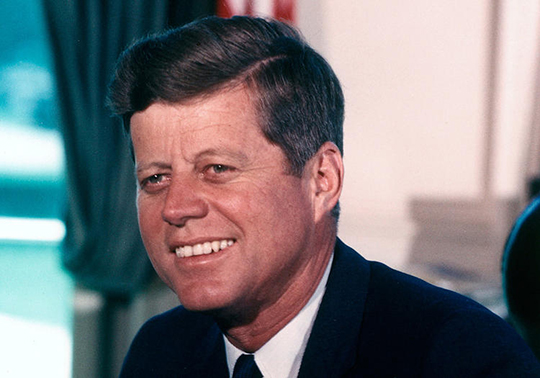
JFK Made a Forgotten Turn Toward Peace Before He Was Killed: We’ve Abandoned it Entirely


By Patricia Hynes

Co-author: Frances Crowe

June 4, 2018

Greenfield, MA (Informed Comment) – Fifty-five years ago on June 10, 1963, President John F. Kennedy delivered a commencement address at American University that, in fewer than 30 minutes, turned traditional national security policy on its head. Kennedy proclaimed that world peace is “the most important topic on earth….not merely peace for Americans but peace for all men and women – not merely peace in our time but peace for all time.”

His speech was hailed by then Soviet Union premier Nikita Khrushchev as “the greatest speech by any American President since Roosevelt.”

Originally published at Informed Comment by Juan Cole here


Eight months earlier, both men had faced the terrifying possibility of nuclear holocaust in a showdown between the United States and the Soviet Union, remembered to history as the Cuban Missile Crisis. Shaken but emboldened by it, Kennedy laid out a principled, strategic and humanistic vision for ending the arms race and dissipating the hostile Cold War rhetoric and culture. He led by example in honoring the Russian people “for their many achievements –in science and space, in economic and industrial growth, in culture and in acts of courage” (alluding to 20 million Russians killed in World War II). And he announced a proposed direct line of communication between Moscow and Washington.

Within two months of his commencement address, both former Cold War antagonists and Britain signed the Partial Nuclear Test Ban Treaty, prohibiting nuclear testing in the atmosphere, outer space and under water, resulting in substantial reduction of radioactive contamination. President Kennedy was assassinated before being able to construct a path toward complete and permanent disarmament.

Let us contrast Kennedy’s words and convictions expressed on June 10, 1963 with our government’s present-day national defense posture. These two diverging roads – Kennedy’s, the one less traveled by – lay before us.

JFK
“What kind of peace do we seek…?” Not one “enforced on the world by American weapons of war…I am talking about…the kind of peace…that enables people…to hope and to build a better life for their children – not merely peace for Americans but peace for all men and women.”

Stockpiling weapons – nuclear and non-nuclear – “is not the only” nor the most efficient means of achieving peace, he continues. Both the United States and the Soviet Union “are devoting massive sums of money that could be better devoted to combatting ignorance, poverty, and disease…New weapons beget new counterweapons.”

The Pentagon
2018 opened with a new National Defense Posture: The greatest threat to U.S national security and prosperity is now Russia and China, with terrorism relegated to a second tier. Elsewhere the Pentagon speaks of 4+1 threats: Russia, China, North Korea, Iran and terrorism. Their chief concern is that the 2018-19 defense budget –morbidly obese by comparison with the funds dedicated to diplomacy – is not large enough for conducting war on all these fronts.

President Trump’s proposed national defense budget for next fiscal year, recently passed overwhelmingly by Republicans and Democrats in the House of Representatives, allocates 18 times more funding ($717 billion) to military defense than to his proposed budget for diplomacy ($39 billion).

China’s response to U.S. war talk? The United States has unparalleled military might, spending three times more on military than China, remarks Chinese foreign ministry spokesman Geng Shuang. Yet its sense of insecurity is “beyond comprehension.” He urged the United States to abandon its confrontation mindset and move with the trend of the times – multipolarity, that is, numerous power centers in the world. Bluntly put: get used to sharing power with other regions, alliances and countries.


JFK
“The pursuit of peace is not as dramatic as the pursuit of war…but we have no more urgent task…Too many of us think it is impossible…But that is a dangerous, defeatist belief…Our problems are man-made – therefore, they can be solved by [us].”

Resolving to end war for good is not a perfect guarantee, he continues, but it does offer “far more security and far fewer risks than an unabated, uncontrolled, unpredictable arms race.”

“… We can seek a relaxation of tensions without relaxing our guard…we are willing and able to engage in peaceful competition with any people on earth.” What will this require, he asks. “Increased understanding” with our enemies, which requires “increased contact and communication.” The goal is complete disarmament achieved in stages while building “new institutions of peace which would take the place of arms.”

The Pentagon
Since 9/11 we have expended more than $250 billion dollars on training soldiers and security officers from at least 150 countries in the name of combatting terrorism and promoting democracy, international peace and security. The results: no tangible national security benefit in Middle East and African countries; and no evidence of an increase in democratic values and civilian control of armed forces. If anything, the opposite: a doubling of military-backed coups in the home countries of militaries we have trained. The program, according to a former U.S. commanding officer for Africa, Carter Ham, succeeded in transmission of military skills, but failed to spend enough time on promoting good governance and democratic values.

Vietnam veteran and foreign policy historian Andrew Bacevich asserts that the goal of the United States since the fall of the Soviet Union and end of the Cold War has been to remake the world in its own image: to “align everybody from A to Z – Afghanistan to Zimbabwe with American values and the American way of life.” With this goal, the U.S. embroiled itself for decades now in “a series of costly, senseless, unsuccessful and ultimately counterproductive wars.” Millions have been killed; countries, broken; trillions in U.S. war debt, accumulated; and terrorism abroad and at home, fueled.


JFK
If we cannot end now our differences, at least we can focus on our “common interests” and work to “make the world safe for diversity” of ideas, beliefs, forms of economy and government. “For in the final analysis, we all inhabit this small planet. We all breathe the same air. We all cherish our children’s future. And we are all mortal.”

How far we have diverged as a country from this principled, strategic and humanistic vision for our national security toward one of moral collapse. The road taken by Trump and his administration – clutching to military superpower status, abandoning the multiparty nuclear agreement with Iran and the Paris climate agreement, threatening to use nuclear weapons, and eroding decades of environmental protection – leads only to hate, hostility and extreme peril.


H. Patricia Hynes is a retired professor of environmental health, directs the Traprock Center for Peace and Justice in western Massachusetts. She has written and edited 7 books, among them The Recurring Silent Spring. She writes and speaks on issues of war and militarism with an emphasis on women, environment, and public health.

Co-author Frances Crowe is a much-honored lifelong activist for peace and justice who lives in western Massachusetts.


Recommended reading

About the background of the speech and who contributed to it – Wikipedia

Full transcript of the speech

The American University’s video with students who were present and various experts

 

Related Posts

Advocates of nuclear disarmament are regularly dismissed by the champions of nuclear deterrence as naïve and unrealistic, utopian or even irresponsible. Yet this ‘doctrine’ of deterrence, regarded by France as the ‘cornerstone’ of its national security, is based on quasi-religious beliefs, a theory that cannot be proven, risky gambles and fragile assumptions. So much so that one might legitimately ask which side the ‘Care Bears’ are on. Marc FinaudVice-President of Initiatives for Nuclear Disarmament (IDN) October 9, 2026 This article was originally published on Pressenza When it comes to these things being treated as religious concepts, look here. Idealists and realists It was Hubert Védrine, François Mitterrand’s former Foreign Minister, who repeatedly coined the phrase: ‘Europeans are a sort of Care Bears who don’t realise they’re living in Jurassic Park’. He applies this reference to the cartoon for well-behaved children not only to what he regards as weakness or idealism...
What the West Borrowed from Asia and What It Left Behind Jan Krikke October 8, 2026 The article was originally published here In the late 1960s, the musical Hair announced that the Age of Aquarius was dawning. Its opening anthem promised a transformation of human consciousness: an era of peace, harmony and understanding. Half a century later, a familiar echo of that promise is a meditation app offered by your employer. You can find it in the same list of benefits as the pension plan and the gym discount. How did a spiritual revolution become an employee benefit? The answer lies in the history of the movement known as New Age: where it came from, what it borrowed from Asia, and why the meaning of what it borrowed changed in the process. Two definitions will help. New Age is a loose label for a wide range of spiritual practices and...
Small and different + among the 10% most active + 9,000 texts + 150 Associates + 60 000 a day — and a stubborn belief that peace is smarter and must be secured by peaceful means. In 2026, the Transnational Foundation for Peace and Future Research (TFF) turns 40. On Monday, October 5, 2026, a new TFF homepage will go live — a new gateway to more than 9,000 articles, analyses, research papers and other contributions produced over four decades of independent peace research. But this is not simply a new website. For four decades, TFF has worked from a simple conviction: peace is smarter than militarism and can be brought about by peaceful means. This is not merely an aspiration. It is the principle expressed in the UN Charter and the Gandhian tradition that has guided our work from the beginning. TFF is a research-based, independent and people-financed foundation....

Recent Articles

The Quest for Humane Survival Richard Falk Professor emeritus, Princeton UniversityTFF Associate since 1986October 12, 2026 After decades of teaching and writing about international law in academic frameworks that were not institutionally situated within law school environments—at Princeton and the University of California, Santa Barbara—I found myself most receptive to the TWAIL outlook. It has been especially illuminating in clarifying the extent to which international law evolved as a dialogical critique of Europe’s efforts to legitimize its colonial undertakings. In particular, TWAIL has exposed how international law has functioned to legalize the subjugation of Third World peoples, securing conditions for exploitative investment and trade relations, the coercive enforcement of public debts, and an ideology of cultural superiority. TWAIL’s exposure of these economic legacies of colonialism has influenced my understanding of the history and development of international law, broadly conceived, as an ideological project of the Western sub-system of the world...
Advocates of nuclear disarmament are regularly dismissed by the champions of nuclear deterrence as naïve and unrealistic, utopian or even irresponsible. Yet this ‘doctrine’ of deterrence, regarded by France as the ‘cornerstone’ of its national security, is based on quasi-religious beliefs, a theory that cannot be proven, risky gambles and fragile assumptions. So much so that one might legitimately ask which side the ‘Care Bears’ are on. Marc FinaudVice-President of Initiatives for Nuclear Disarmament (IDN) October 9, 2026 This article was originally published on Pressenza When it comes to these things being treated as religious concepts, look here. Idealists and realists It was Hubert Védrine, François Mitterrand’s former Foreign Minister, who repeatedly coined the phrase: ‘Europeans are a sort of Care Bears who don’t realise they’re living in Jurassic Park’. He applies this reference to the cartoon for well-behaved children not only to what he regards as weakness or idealism...
What the West Borrowed from Asia and What It Left Behind Jan Krikke October 8, 2026 The article was originally published here In the late 1960s, the musical Hair announced that the Age of Aquarius was dawning. Its opening anthem promised a transformation of human consciousness: an era of peace, harmony and understanding. Half a century later, a familiar echo of that promise is a meditation app offered by your employer. You can find it in the same list of benefits as the pension plan and the gym discount. How did a spiritual revolution become an employee benefit? The answer lies in the history of the movement known as New Age: where it came from, what it borrowed from Asia, and why the meaning of what it borrowed changed in the process. Two definitions will help. New Age is a loose label for a wide range of spiritual practices and...

TFF on Substack

Discover and subscribe to more peace materials on TFF Substack

Most Popular

The Quest for Humane Survival Richard Falk Professor emeritus, Princeton UniversityTFF Associate since 1986October 12, 2026 After decades of teaching and writing about international law in academic frameworks that were not institutionally situated within law school environments—at Princeton and the University of California, Santa Barbara—I found myself most receptive to the TWAIL outlook. It has been especially illuminating in clarifying the extent to which international law evolved as a dialogical critique of Europe’s efforts to legitimize its colonial undertakings. In particular, TWAIL has exposed how international law has functioned to legalize the subjugation of Third World peoples, securing conditions for exploitative investment and trade relations, the coercive enforcement of public debts, and an ideology of cultural superiority. TWAIL’s exposure of these economic legacies of colonialism has influenced my understanding of the history and development of international law, broadly conceived, as an ideological project of the Western sub-system of the world...
Advocates of nuclear disarmament are regularly dismissed by the champions of nuclear deterrence as naïve and unrealistic, utopian or even irresponsible. Yet this ‘doctrine’ of deterrence, regarded by France as the ‘cornerstone’ of its national security, is based on quasi-religious beliefs, a theory that cannot be proven, risky gambles and fragile assumptions. So much so that one might legitimately ask which side the ‘Care Bears’ are on. Marc FinaudVice-President of Initiatives for Nuclear Disarmament (IDN) October 9, 2026 This article was originally published on Pressenza When it comes to these things being treated as religious concepts, look here. Idealists and realists It was Hubert Védrine, François Mitterrand’s former Foreign Minister, who repeatedly coined the phrase: ‘Europeans are a sort of Care Bears who don’t realise they’re living in Jurassic Park’. He applies this reference to the cartoon for well-behaved children not only to what he regards as weakness or idealism...
What the West Borrowed from Asia and What It Left Behind Jan Krikke October 8, 2026 The article was originally published here In the late 1960s, the musical Hair announced that the Age of Aquarius was dawning. Its opening anthem promised a transformation of human consciousness: an era of peace, harmony and understanding. Half a century later, a familiar echo of that promise is a meditation app offered by your employer. You can find it in the same list of benefits as the pension plan and the gym discount. How did a spiritual revolution become an employee benefit? The answer lies in the history of the movement known as New Age: where it came from, what it borrowed from Asia, and why the meaning of what it borrowed changed in the process. Two definitions will help. New Age is a loose label for a wide range of spiritual practices and...
Read More
law-419057_1280
The Quest for Humane Survival Richard Falk Professor emeritus, Princeton UniversityTFF Associate since 1986October 12, 2026 After decades of teaching and writing about international law in academic frameworks that were not institutionally situated within law school environments—at Princeton and the University of California, Santa Barbara—I found myself most receptive to the TWAIL outlook. It has been especially illuminating in clarifying the extent to which international law evolved as a dialogical critique of Europe’s efforts to legitimize its colonial undertakings. In particular, TWAIL has exposed how international law has functioned to legalize the subjugation of Third World peoples, securing conditions for exploitative investment and trade relations, the coercive enforcement of public debts, and an ideology of cultural superiority. TWAIL’s exposure of these economic legacies of colonialism has influenced my understanding of the history and development of international law, broadly conceived, as an ideological project of the Western sub-system of the world...
images-2
Advocates of nuclear disarmament are regularly dismissed by the champions of nuclear deterrence as naïve and unrealistic, utopian or even irresponsible. Yet this ‘doctrine’ of deterrence, regarded by France as the ‘cornerstone’ of its national security, is based on quasi-religious beliefs, a theory that cannot be proven, risky gambles and fragile assumptions. So much so that one might legitimately ask which side the ‘Care Bears’ are on. Marc FinaudVice-President of Initiatives for Nuclear Disarmament (IDN) October 9, 2026 This article was originally published on Pressenza When it comes to these things being treated as religious concepts, look here. Idealists and realists It was Hubert Védrine, François Mitterrand’s former Foreign Minister, who repeatedly coined the phrase: ‘Europeans are a sort of Care Bears who don’t realise they’re living in Jurassic Park’. He applies this reference to the cartoon for well-behaved children not only to what he regards as weakness or idealism...
8824b09f-33a5-43f9-9fd0-550f28cda24d_1536x1024
What the West Borrowed from Asia and What It Left Behind Jan Krikke October 8, 2026 The article was originally published here In the late 1960s, the musical Hair announced that the Age of Aquarius was dawning. Its opening anthem promised a transformation of human consciousness: an era of peace, harmony and understanding. Half a century later, a familiar echo of that promise is a meditation app offered by your employer. You can find it in the same list of benefits as the pension plan and the gym discount. How did a spiritual revolution become an employee benefit? The answer lies in the history of the movement known as New Age: where it came from, what it borrowed from Asia, and why the meaning of what it borrowed changed in the process. Two definitions will help. New Age is a loose label for a wide range of spiritual practices and...
Screenshot 2026-10-04 210142
Small and different + among the 10% most active + 9,000 texts + 150 Associates + 60 000 a day — and a stubborn belief that peace is smarter and must be secured by peaceful means. In 2026, the Transnational Foundation for Peace and Future Research (TFF) turns 40. On Monday, October 5, 2026, a new TFF homepage will go live — a new gateway to more than 9,000 articles, analyses, research papers and other contributions produced over four decades of independent peace research. But this is not simply a new website. For four decades, TFF has worked from a simple conviction: peace is smarter than militarism and can be brought about by peaceful means. This is not merely an aspiration. It is the principle expressed in the UN Charter and the Gandhian tradition that has guided our work from the beginning. TFF is a research-based, independent and people-financed foundation....
Living-Peace-Sign-Budapest-copy
Tony Robinson October 4, 2026 Violence is easy to recognise when someone is being beaten, shot or killed. It becomes more difficult when nobody is holding a weapon. Poverty, discrimination, exploitation and repression can restrict a human life just as effectively, although they do so in very different ways and with very different consequences. Simply adding more categories to an ever-growing list of forms of violence does not really solve the problem. The more interesting question is what all these different situations have in common and why it makes sense to describe them using the same word. Human beings do not simply react to what happens around them. They remember the past, imagine things that do not yet exist, make plans and undertake projects. Workers organise because they imagine different working conditions; people migrate because they imagine another life somewhere else; social movements emerge because people refuse to accept the...
b54a1f10-8c65-4f0b-9dd5-4abc0a7d04cc_2659x2659
It’s a matter of principles, courage, vision and pulling together – while the militarist world is falling apart… Peter Langille October 3, 2026 “Here, then, is the problem which we present to you, stark and dreadful and inescapable: Shall we put an end to the human race; or shall mankind renounce war?”The Bertrand Russell—Albert Einstein Manifesto, July 9, 1955 ⁕ The forecast for what’s ahead is worrisome. The sharp rise in armed conflicts over the past three years is adding to what was already the highest level in over seventy years. Genocides, which should be prevented are supported. A shared climate emergency that jeopardises survival is ignored. Diverse polls now suggest that people are war-weary, worried and interested in a more effective United Nations. And, there are viable policy options for a more secure world! Yet governments are doubling-down, betting on more war and investing heavily. If current trends persist,...




