
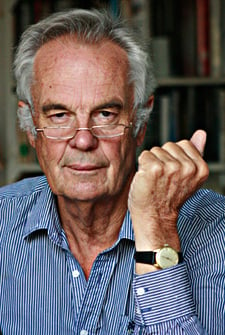
TFF PressInfo # 298: Solve the Ukraine crisis now

The vote last week in the Ukrainian parliament was a seriously disturbing move- it has made reconciliation with Russia near impossible. The parliament voted to work for Ukraine’s membership of Nato, a red rag to a bear.

The truth is this whole Russian-Ukrainian-Western confrontation could be largely solved if the Ukrainian and Western sides wrote on paper that they don’t want to see Ukraine in Nato. This is the key issue for Russia. But it must be written down.

Moscow no longer trusts verbal understandings that can be broken, as when the Reagan Administration gave President Mikhail Gorbachev the distinct impression that the US would not take advantage of the Soviet Union now that the Cold War was over. But it did. President Bill Clinton provocatively began the expansion of Nato which has now reached right up to Russia’s borders. Gorbachev too innocently believed the Cold War was totally over and the US would never contemplate such a move.

Of course there are other issues- the trade relationship with the EU, Crimea, the Donbas enclave and the price of gas for Ukraine. The EU issue is effectively on hold and could be easily solved if the EU said that it had no objection to Ukraine facing both ways and thus not penalised if it wants to join the Russian-sponsored Eurasian Economic Union. (After all the EU itself is negotiating a North Atlantic Trade Agreement with the US, Canada and Mexico.)

The gas payments issue is no longer, now that oil and gas prices have fallen dramatically.

On Crimea, ideally Russia should agree to a new UN-supervised referendum. But as far as I can tell unity with Russia is widely welcomed among Crimeans, so a bit of real politik by the West- shelving the issue- wouldn’t go amiss.

As for the dissident Donbas enclave, it has been anti-reform, anti-Western, pro-Russian since Ukraine’s independence. Allow it to secede and then watch. Donbas is paying a steep price for its effort to wrench itself away from Ukraine- 80% of its industrial production has fallen and coal mines, factories, the airport and other infrastructure have been badly damaged. Let economically-pressed Russia bear the burden of this, plus paying the pensions, social provisions and the water and electricity that needs to be imported from Ukraine.

Important strategic political thinkers in the US have made it clear that present Western policy towards Russia is flawed. The late George Kennan, architect of Cold War containment, said that to expand Nato would result in “a new Cold War, probably ending in a hot one”. As I found in Moscow, during my visits in October and November, nuclear war doctrines are being dusted off by a regime which has no experience of how to deal with the art of nuclear brinkmanship.

Zbigniew Brzezinski, a former presidential national security advisor, said earlier this month that Ukraine should have a policy of “non-involvement with Nato”- as Finland practices and did during all the years of the Cold War. Finland kept its geopolitical distance from the West while, at the same time, forging a strong democracy and close Western economic links.

Whilst critical of what Russia has done, Brzezinski understands that Russia is in the process of trying to regain its own national pride after the shattering of the USSR. He is optimistic for the future. He believes that Putin now does realise that the Ukraine imbroglio should be solved without the use of force, although if it becomes apparent that he doesn’t Ukraine should be provided with offensive weaponry.

Henry Kissinger wrote earlier in the year that “the West must understand that, to Russia, Ukraine can never be just a foreign country. Russian history began with Kievan-Rus. The Russian religion spread from there. Ukraine has been part of Russia for centuries. The Russian Black Sea Fleet- Russia’s means of projecting power in the Mediterranean- is based in Sevastopol, Crimea (with Ukraine’s longtime agreement). Even such famed dissidents as Aleksandr Sozhenitsyn and Joseph Brodsky insisted that Ukraine was an integral part of Russia”. He adds, “Ukraine should not join Nato”.

What good does it do for the US Congress to take the opposite tack? The Ukraine Freedom Support Act, as Jeffrey Tayler wrote last week in Foreign Policy, “is short on common sense and long on belligerent ultimatums and misstatements of recent history.”

How can the US dare to preach lawful international practice when it itself made an unprovoked invasion and occupation of Iraq, makes hundreds of lethal drone strikes across the Islamic world, made an illegal bombing campaign in Serbia, has a history that ended not long ago of supporting Third World dictators and withdraws from the jurisdiction of the World Court when it loses a case brought by Nicaragua over the mining of its harbour?

Let’s be straight about Ukraine and then the pieces could well fall into place.

© Jonathan Power 2014
Related Posts

A friendly quarrel while we agree that the US sanctions are a weapon of mass destruction and kill more people than wars do. And that we must talk much more about sanctions than we have so far. Jan Oberg, TFF director March 16, 2026 John Mearsheimer recently stated that U.S. sanctions murdered around 38 million people between 1971 and 2021 – see the video below. It is a dramatic figure, and it has spread quickly because it captures, in one sentence, the enormous human cost of modern sanctions. I share his concern about the destructive effects of economic coercion. But the specific number he cites — and the way he attributes it — deserves a friendly academic clarification. The figure comes from a 2023 Lancet Global Health article estimating the mortality effects of unilateral U.S. and EU sanctions over the past half‑century. This is the first point where Mearsheimer’s shorthand diverges from the text: the study...
Photos © TFF 2000 Read PressInfo 90 “Lift the Sanctions and Bring More Aid to Yugoslavia” See Pictures from Belgrade © TFF 2000 Please reprint, copy, archive, quote or re-post this item, but please retain the source.
Farhang Jahanpour TFF Associate and former Board member September 8, 2025 On 28 August 2025, France, Germany, and the United Kingdom (the EU Troika) decided to trigger the so-called “snapback mechanism” and reimpose stringent sanctions on Iran after 30 days for its alleged violation of the terms of the Iran nuclear deal, known as the Joint Comprehensive Plan of Action (JCPOA), if Iran did not give in to their demands within 30 days. In the lawless world in which we are living at the moment, discussing the principles of international law is futile and irrelevant. We have reverted to the age of imperial dictatorship and big power dominance. This state of affairs is dangerous for the whole world, especially the Global South, which is at the mercy of the dictates of the superpowers. However, a return to the rivalry between powerful empires outside the scope of international law, which led...

Recent Articles

Below are TFF-related media mentions, comments, videos and social media posts published elsewhere but not on this homepage. We happen to catch and list only a fraction. Regarding video comments and debates, we recommend that you go to the TFF Video Channel on Substack where many of them are reproduced. Jan Oberg is a contributor to China Daily – 52 million daily clicks – and Global Times, CGTN and CCTV (the national television), China Investment, Xinhua News Agency and several others. Articles and videos on these media very often multiply into countless Chinese (and Western media) that re-post them from these main media. Thanks to The China Academy, his analyses, interviews and comments are frequently posted on YouTube channels such as Thinkers Forum and Wave Media. These videos are often re-posted on Bilibili (China’s YouTube), the China Content Center on TikTok, and on the Chinese edition of TikTok, Douyin.com. This means reaching hundreds of millions of viewers worldwide over a year. While there are too many to catch on all these...
Jan Oberg TFF director October 13, 2026 According to Alfred Nobel’s will, the Nobel Peace Prize shall be awarded: ”to the person who has done the most or best to advance fellowship among nations, the abolition or reduction of standing armies, and the establishment and promotion of peace congresses.” Further down, he also expresses how the prize for the “champions of peace” shall be decided: “that for champions of peace by a committee of five persons to be selected by the Norwegian Storting. Alfred Nobel’s will is remarkably short and clear. But few seem to have read it. Nobel did not say that the committee itself should consist of members of parliament. He entrusted the Storting with appointing five persons. In principle, it could have selected diplomats, mediators, peace researchers, conflict-resolution specialists, or other individuals with recognised expertise in matters of peace from around the world. Instead, the Storting gradually...
The Quest for Humane Survival Richard Falk Professor emeritus, Princeton UniversityTFF Associate since 1986October 12, 2026 After decades of teaching and writing about international law in academic frameworks that were not institutionally situated within law school environments—at Princeton and the University of California, Santa Barbara—I found myself most receptive to the TWAIL outlook. It has been especially illuminating in clarifying the extent to which international law evolved as a dialogical critique of Europe’s efforts to legitimize its colonial undertakings. In particular, TWAIL has exposed how international law has functioned to legalize the subjugation of Third World peoples, securing conditions for exploitative investment and trade relations, the coercive enforcement of public debts, and an ideology of cultural superiority. TWAIL’s exposure of these economic legacies of colonialism has influenced my understanding of the history and development of international law, broadly conceived, as an ideological project of the Western sub-system of the world...

TFF on Substack

Discover and subscribe to more peace materials on TFF Substack

Most Popular

Below are TFF-related media mentions, comments, videos and social media posts published elsewhere but not on this homepage. We happen to catch and list only a fraction. Regarding video comments and debates, we recommend that you go to the TFF Video Channel on Substack where many of them are reproduced. Jan Oberg is a contributor to China Daily – 52 million daily clicks – and Global Times, CGTN and CCTV (the national television), China Investment, Xinhua News Agency and several others. Articles and videos on these media very often multiply into countless Chinese (and Western media) that re-post them from these main media. Thanks to The China Academy, his analyses, interviews and comments are frequently posted on YouTube channels such as Thinkers Forum and Wave Media. These videos are often re-posted on Bilibili (China’s YouTube), the China Content Center on TikTok, and on the Chinese edition of TikTok, Douyin.com. This means reaching hundreds of millions of viewers worldwide over a year. While there are too many to catch on all these...
Jan Oberg TFF director October 13, 2026 According to Alfred Nobel’s will, the Nobel Peace Prize shall be awarded: ”to the person who has done the most or best to advance fellowship among nations, the abolition or reduction of standing armies, and the establishment and promotion of peace congresses.” Further down, he also expresses how the prize for the “champions of peace” shall be decided: “that for champions of peace by a committee of five persons to be selected by the Norwegian Storting. Alfred Nobel’s will is remarkably short and clear. But few seem to have read it. Nobel did not say that the committee itself should consist of members of parliament. He entrusted the Storting with appointing five persons. In principle, it could have selected diplomats, mediators, peace researchers, conflict-resolution specialists, or other individuals with recognised expertise in matters of peace from around the world. Instead, the Storting gradually...
The Quest for Humane Survival Richard Falk Professor emeritus, Princeton UniversityTFF Associate since 1986October 12, 2026 After decades of teaching and writing about international law in academic frameworks that were not institutionally situated within law school environments—at Princeton and the University of California, Santa Barbara—I found myself most receptive to the TWAIL outlook. It has been especially illuminating in clarifying the extent to which international law evolved as a dialogical critique of Europe’s efforts to legitimize its colonial undertakings. In particular, TWAIL has exposed how international law has functioned to legalize the subjugation of Third World peoples, securing conditions for exploitative investment and trade relations, the coercive enforcement of public debts, and an ideology of cultural superiority. TWAIL’s exposure of these economic legacies of colonialism has influenced my understanding of the history and development of international law, broadly conceived, as an ideological project of the Western sub-system of the world...
Read More
girl-5894831_1280
Below are TFF-related media mentions, comments, videos and social media posts published elsewhere but not on this homepage. We happen to catch and list only a fraction. Regarding video comments and debates, we recommend that you go to the TFF Video Channel on Substack where many of them are reproduced. Jan Oberg is a contributor to China Daily – 52 million daily clicks – and Global Times, CGTN and CCTV (the national television), China Investment, Xinhua News Agency and several others. Articles and videos on these media very often multiply into countless Chinese (and Western media) that re-post them from these main media. Thanks to The China Academy, his analyses, interviews and comments are frequently posted on YouTube channels such as Thinkers Forum and Wave Media. These videos are often re-posted on Bilibili (China’s YouTube), the China Content Center on TikTok, and on the Chinese edition of TikTok, Douyin.com. This means reaching hundreds of millions of viewers worldwide over a year. While there are too many to catch on all these...
Nobel-Prize-Plaque
Jan Oberg TFF director October 13, 2026 According to Alfred Nobel’s will, the Nobel Peace Prize shall be awarded: ”to the person who has done the most or best to advance fellowship among nations, the abolition or reduction of standing armies, and the establishment and promotion of peace congresses.” Further down, he also expresses how the prize for the “champions of peace” shall be decided: “that for champions of peace by a committee of five persons to be selected by the Norwegian Storting. Alfred Nobel’s will is remarkably short and clear. But few seem to have read it. Nobel did not say that the committee itself should consist of members of parliament. He entrusted the Storting with appointing five persons. In principle, it could have selected diplomats, mediators, peace researchers, conflict-resolution specialists, or other individuals with recognised expertise in matters of peace from around the world. Instead, the Storting gradually...
law-419057_1280
The Quest for Humane Survival Richard Falk Professor emeritus, Princeton UniversityTFF Associate since 1986October 12, 2026 After decades of teaching and writing about international law in academic frameworks that were not institutionally situated within law school environments—at Princeton and the University of California, Santa Barbara—I found myself most receptive to the TWAIL outlook. It has been especially illuminating in clarifying the extent to which international law evolved as a dialogical critique of Europe’s efforts to legitimize its colonial undertakings. In particular, TWAIL has exposed how international law has functioned to legalize the subjugation of Third World peoples, securing conditions for exploitative investment and trade relations, the coercive enforcement of public debts, and an ideology of cultural superiority. TWAIL’s exposure of these economic legacies of colonialism has influenced my understanding of the history and development of international law, broadly conceived, as an ideological project of the Western sub-system of the world...
images-2
Advocates of nuclear disarmament are regularly dismissed by the champions of nuclear deterrence as naïve and unrealistic, utopian or even irresponsible. Yet this ‘doctrine’ of deterrence, regarded by France as the ‘cornerstone’ of its national security, is based on quasi-religious beliefs, a theory that cannot be proven, risky gambles and fragile assumptions. So much so that one might legitimately ask which side the ‘Care Bears’ are on. Marc FinaudVice-President of Initiatives for Nuclear Disarmament (IDN) October 9, 2026 This article was originally published on Pressenza When it comes to these things being treated as religious concepts, look here. Idealists and realists It was Hubert Védrine, François Mitterrand’s former Foreign Minister, who repeatedly coined the phrase: ‘Europeans are a sort of Care Bears who don’t realise they’re living in Jurassic Park’. He applies this reference to the cartoon for well-behaved children not only to what he regards as weakness or idealism...
8824b09f-33a5-43f9-9fd0-550f28cda24d_1536x1024
What the West Borrowed from Asia and What It Left Behind Jan Krikke October 8, 2026 The article was originally published here In the late 1960s, the musical Hair announced that the Age of Aquarius was dawning. Its opening anthem promised a transformation of human consciousness: an era of peace, harmony and understanding. Half a century later, a familiar echo of that promise is a meditation app offered by your employer. You can find it in the same list of benefits as the pension plan and the gym discount. How did a spiritual revolution become an employee benefit? The answer lies in the history of the movement known as New Age: where it came from, what it borrowed from Asia, and why the meaning of what it borrowed changed in the process. Two definitions will help. New Age is a loose label for a wide range of spiritual practices and...
Screenshot 2026-10-04 210142
Small and different + among the 10% most active + 9,000 texts + 150 Associates + 60 000 a day — and a stubborn belief that peace is smarter and must be secured by peaceful means. In 2026, the Transnational Foundation for Peace and Future Research (TFF) turns 40. On Monday, October 5, 2026, a new TFF homepage will go live — a new gateway to more than 9,000 articles, analyses, research papers and other contributions produced over four decades of independent peace research. But this is not simply a new website. For four decades, TFF has worked from a simple conviction: peace is smarter than militarism and can be brought about by peaceful means. This is not merely an aspiration. It is the principle expressed in the UN Charter and the Gandhian tradition that has guided our work from the beginning. TFF is a research-based, independent and people-financed foundation....





